
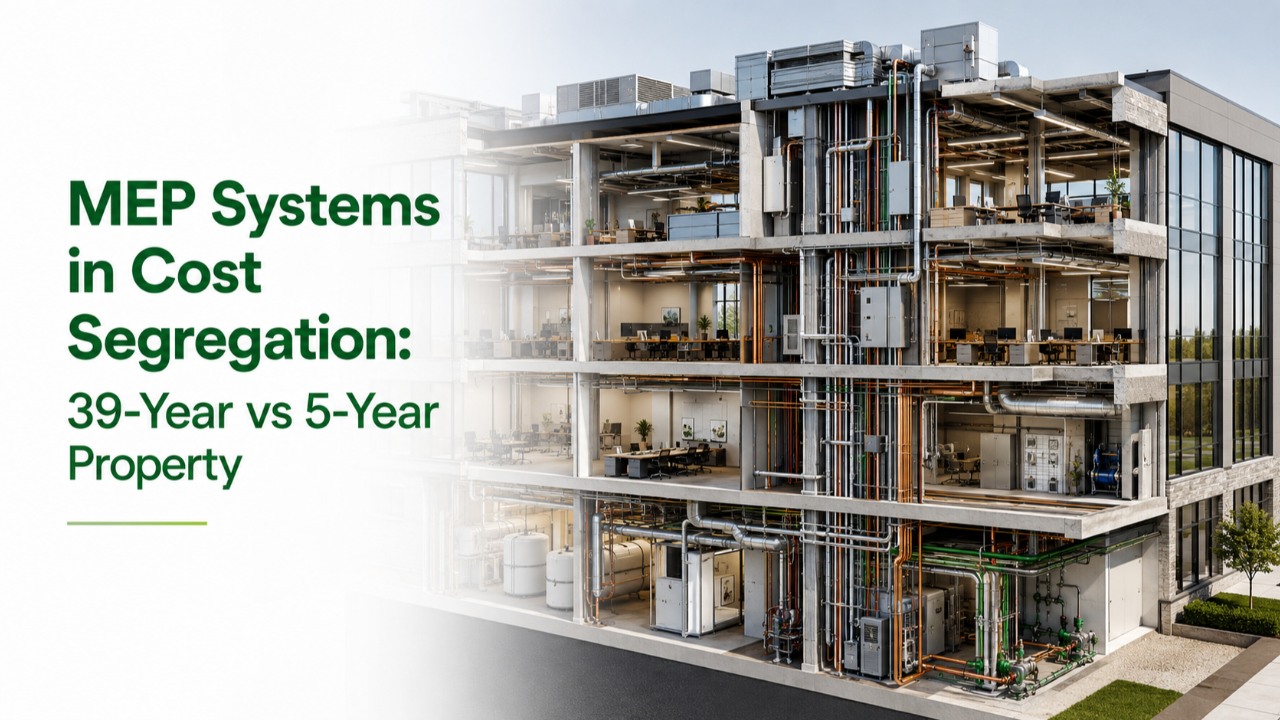
MEP Systems in Cost Segregation: 39-Year vs 5-Year Property
Jul 16, 2026Mechanical, electrical, and plumbing systems are some of the most misunderstood areas of cost segregation. Many investors assume the trade category determines the tax treatment, but that is not how engineering-based classification works. One electrical system may remain part of 39-year nonresidential real property, while another portion may support 5-year property. The same logic can apply to plumbing and mechanical systems.
Wondering how much tax you could save with cost segregation? Let’s find out. Schedule a Cost Segregation Strategy call today.
Key Takeaways
- Understand why MEP systems require functional analysis
- See how engineers separate building and equipment support
- Learn why MEP classification affects investor cash flow
- Apply MEP analysis across commercial property types
- Plan documentation before systems are hidden inside walls
- Compare general MEP costs to supported asset classifications
- Use function, documentation, and engineering support together
What MEP Classification Means in Cost Segregation
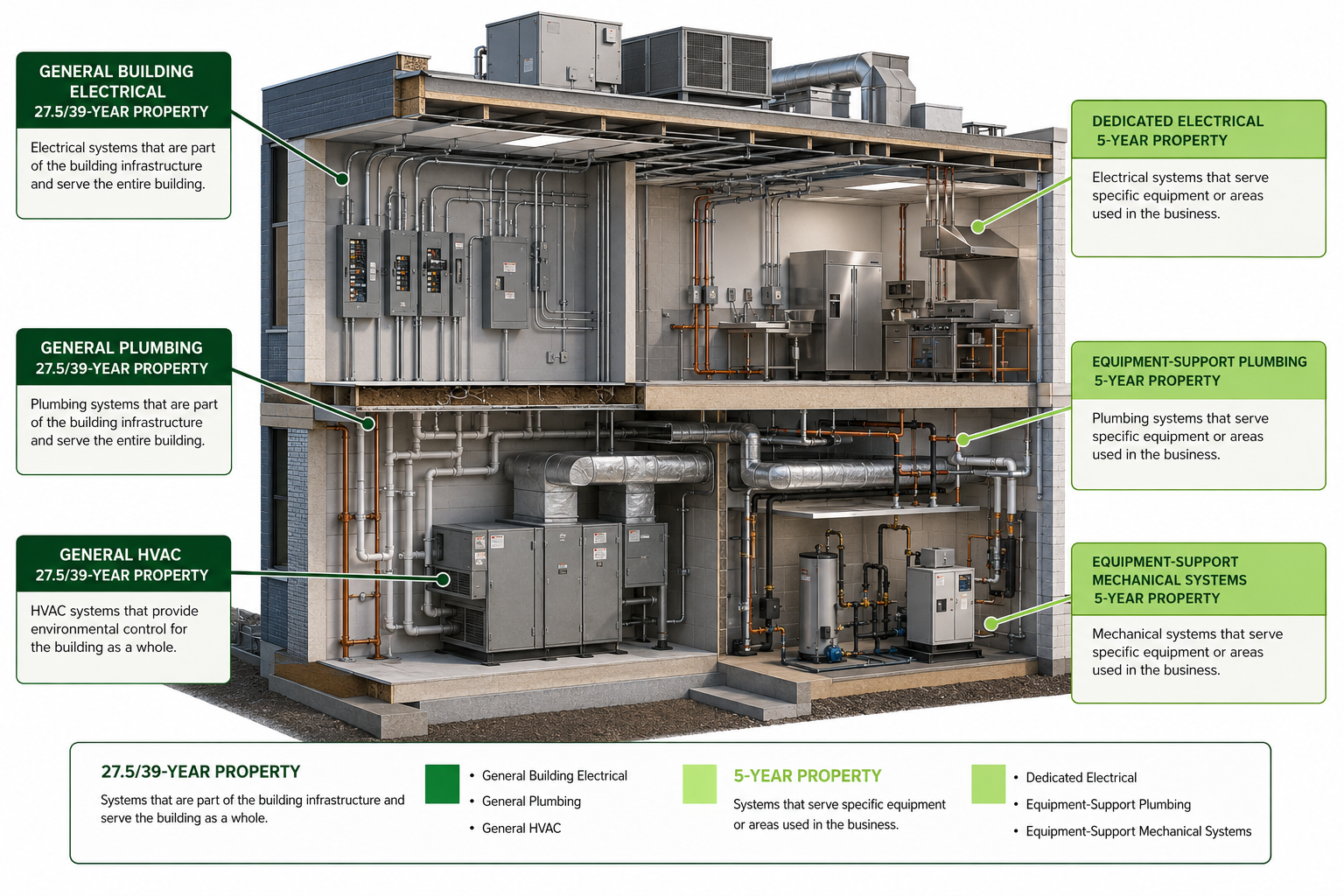
MEP stands for mechanical, electrical, and plumbing. In cost segregation, these systems are reviewed to determine whether they serve the general operation of the building or directly support qualifying assets.
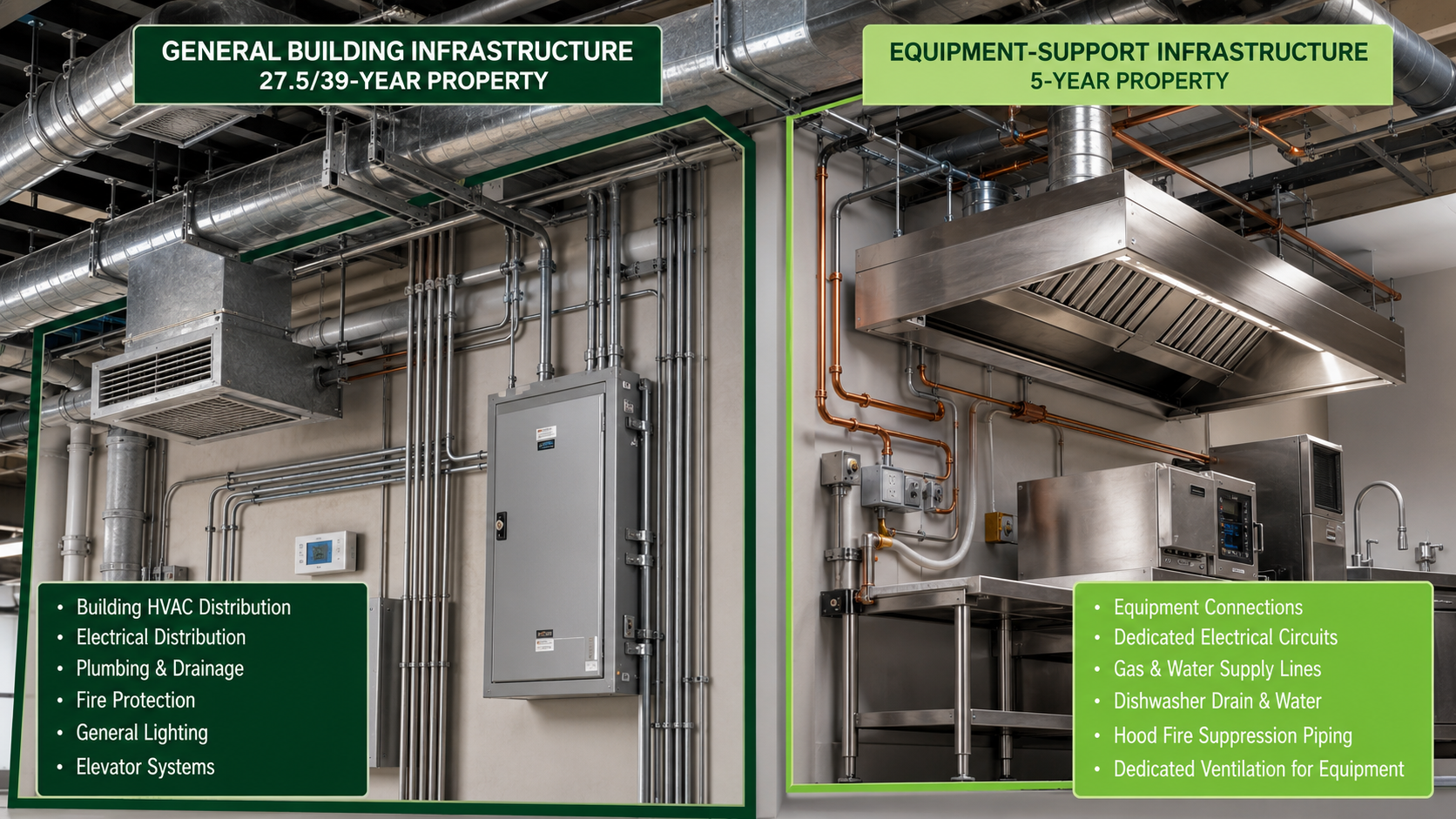
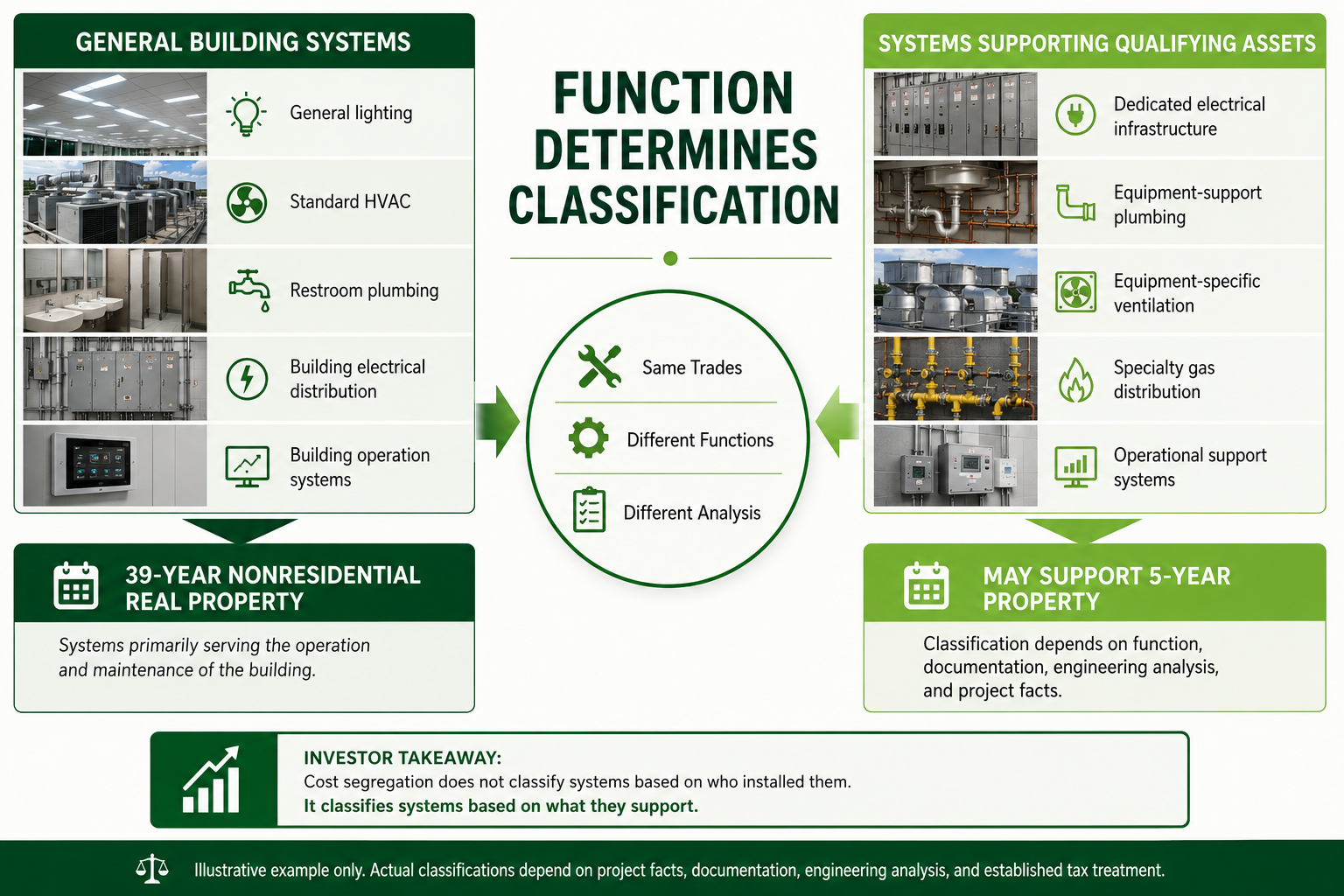
General building systems usually remain part of 39-year nonresidential real property. Examples may include standard building electrical distribution, general restroom plumbing, standard building HVAC, ordinary lighting, and systems that support the operation or maintenance of the building.
Other systems may require deeper review. Dedicated electrical serving qualifying equipment, process-related plumbing, equipment-specific gas lines, and certain specialty mechanical systems may support 5-year property when the facts and documentation support that treatment.
This is why electrical distribution systems in cost segregation often require engineering review instead of a simple contractor invoice review.
How Engineers Separate Building Systems From 5-Year Property Support
The key question is function.
A system is not classified as 5-year property just because an electrician, plumber, or mechanical contractor installed it. The classification depends on what the system supports and whether that support is tied to qualifying property.
For electrical systems, engineers may evaluate whether circuits, panels, feeders, or dedicated connections serve general building use or specific equipment. A general lighting panel is very different from dedicated power serving qualifying production equipment, kitchen equipment, medical equipment, or other specialty assets.
For plumbing systems, engineers may distinguish between general building plumbing and process or equipment-support piping. Restrooms, domestic water, and general sewer service usually remain building property. Dedicated systems serving qualifying equipment may require separate analysis.
For mechanical systems, general comfort HVAC typically remains part of the building. Equipment-specific ventilation, specialty environmental systems, or mechanical support tied to qualifying operations may require a different review depending on the property type and facts.
For a closer example of this distinction, CostSegRx also covers dedicated vs general purpose electrical outlets in cost segregation.
Why MEP Classification Matters for Investor Returns
MEP systems can represent a meaningful portion of a commercial property’s construction or acquisition cost. If all MEP costs are grouped into 39-year nonresidential real property without analysis, qualifying portions may be missed.
That can affect early-year depreciation, taxable income, and investor cash flow. It can also affect the accuracy of the fixed asset schedule and the quality of support available during a future review.
The goal is not to force MEP costs into 5-year property. The goal is to classify each system based on facts, function, documentation, and established tax treatment. That is also why a quality cost segregation study should explain methodology, cost support, and asset classifications clearly.

Where MEP Classification Shows Up Most Often
MEP classification issues can appear in many commercial property types.
Restaurants may have dedicated kitchen electrical, gas, plumbing, floor drains, exhaust systems, and refrigeration support. Medical and dental offices may include equipment support infrastructure, dedicated circuits, specialty plumbing, and imaging support. Industrial properties may include process piping, equipment power, compressed air, ventilation, and machinery support systems.
Retail, self-storage, labs, veterinary clinics, manufacturing facilities, and tenant build-outs can also raise MEP classification questions. In each case, the analysis depends on what the system does, not just what trade installed it.
This is why MEP review often connects closely with 5-year property audit defense. Strong classifications need stronger support.

How to Document MEP Systems Properly
The best time to document MEP systems is before the details disappear into walls, ceilings, slabs, and closed construction records. Once a project is complete, engineers can still perform a study, but the available documentation may limit how much can be supported.
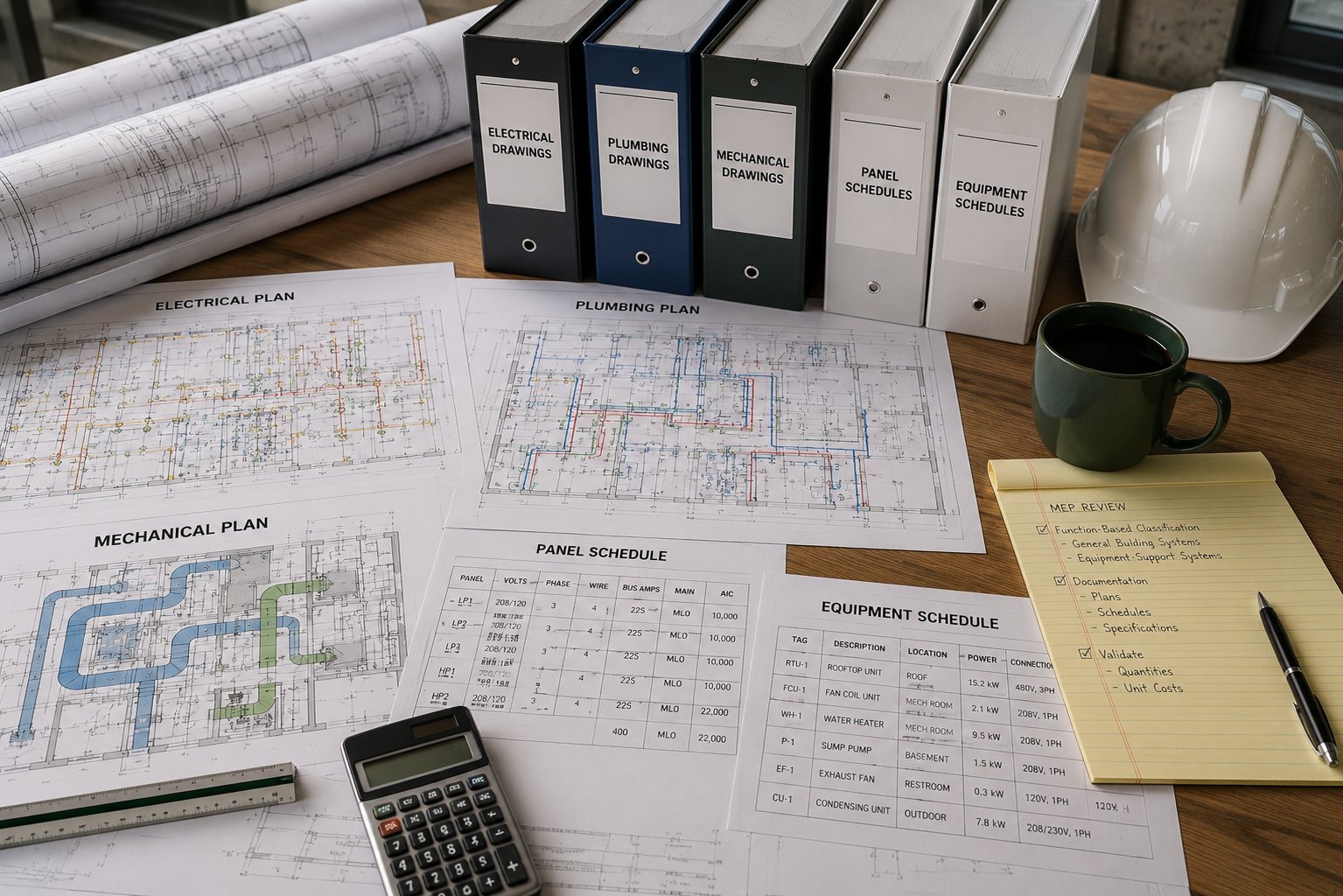
Helpful records may include electrical plans, panel schedules, plumbing drawings, mechanical drawings, equipment schedules, construction specifications, subcontractor cost details, photos, and site observations.
For new construction or major renovations, it can be especially valuable to identify dedicated systems before closeout. This does not mean tracking every wire, pipe, or fitting. It means preserving the records that explain which systems support general building use and which systems support qualifying assets.
Financial Example: General MEP Costs vs Supported Classifications
Assume an investor acquires a commercial property for $5,000,000. Land is allocated at an estimated 20%, or $1,000,000. That leaves a depreciable basis of $4,000,000.
A broad contractor summary shows $700,000 of combined electrical, plumbing, and mechanical costs. Without deeper review, those costs may appear to belong mostly in 39-year nonresidential real property.
An engineering-based review looks deeper. The study identifies which portions serve the general building and which portions directly support qualifying assets. The result may look like this:
- General building electrical, plumbing, and HVAC remain 39-year nonresidential real property.
- Dedicated electrical serving qualifying equipment may support 5-year property.
- Process or equipment-support plumbing may support 5-year property.
- General restroom plumbing, standard HVAC, roof drainage, and ordinary building lighting remain building property.
- Exterior site systems may be reviewed separately as possible 15-year land improvements when supported.
For many commercial properties, supported reclassification often falls within a 17% to 28% range of depreciable basis, depending on property type, documentation, and engineering findings. Some properties may support higher results, but stronger outcomes require stronger facts.
The important lesson is that the $700,000 MEP number is not the answer. It is only the starting point. The real classification depends on how each system functions.
The Real Lesson Behind MEP Cost Segregation
MEP classification is not about trade labels. It is about function.
Electrical does not automatically mean 5-year property. Plumbing does not automatically mean 5-year property. Mechanical does not automatically mean 5-year property. Each system must be evaluated based on what it serves, how it is documented, and whether the facts support classification outside 39-year nonresidential real property.
The strongest studies combine engineering analysis, construction knowledge, cost reconciliation, and established tax treatment. That is how investors avoid oversimplified classifications and build a clearer, more defensible depreciation strategy.
Do you have a question about Cost Segregation?
Let us know how we can help
Your information is secure. We only use your details to answer your direct inquiry.