

Engineering-Driven Cost Segregation: Why Asset Function Matters
Aug 10, 2026Commercial real estate investors often think about buildings through construction categories: electrical, plumbing, mechanical, concrete, flooring, and site work. Those categories are useful during construction, but they do not determine depreciation treatment. In an engineering-based cost segregation study, the more important question is what each asset supports. A system installed by the same contractor may include assets that support the building, assets that support business operations, and assets that require separate engineering analysis. That is why function matters more than construction trade.
Wondering how much tax you could save with cost segregation? Let’s find out. Schedule a Cost Segregation Strategy Call today.
- Understand what engineering-driven cost segregation means
- See how engineers evaluate asset function
- Learn why contractor trade categories can mislead investors
- Apply functional analysis across commercial property types
- Use documentation to support stronger classifications
- Review a practical investor example
- Remember why engineering comes before tax treatment
What Is Engineering-Driven Cost Segregation?
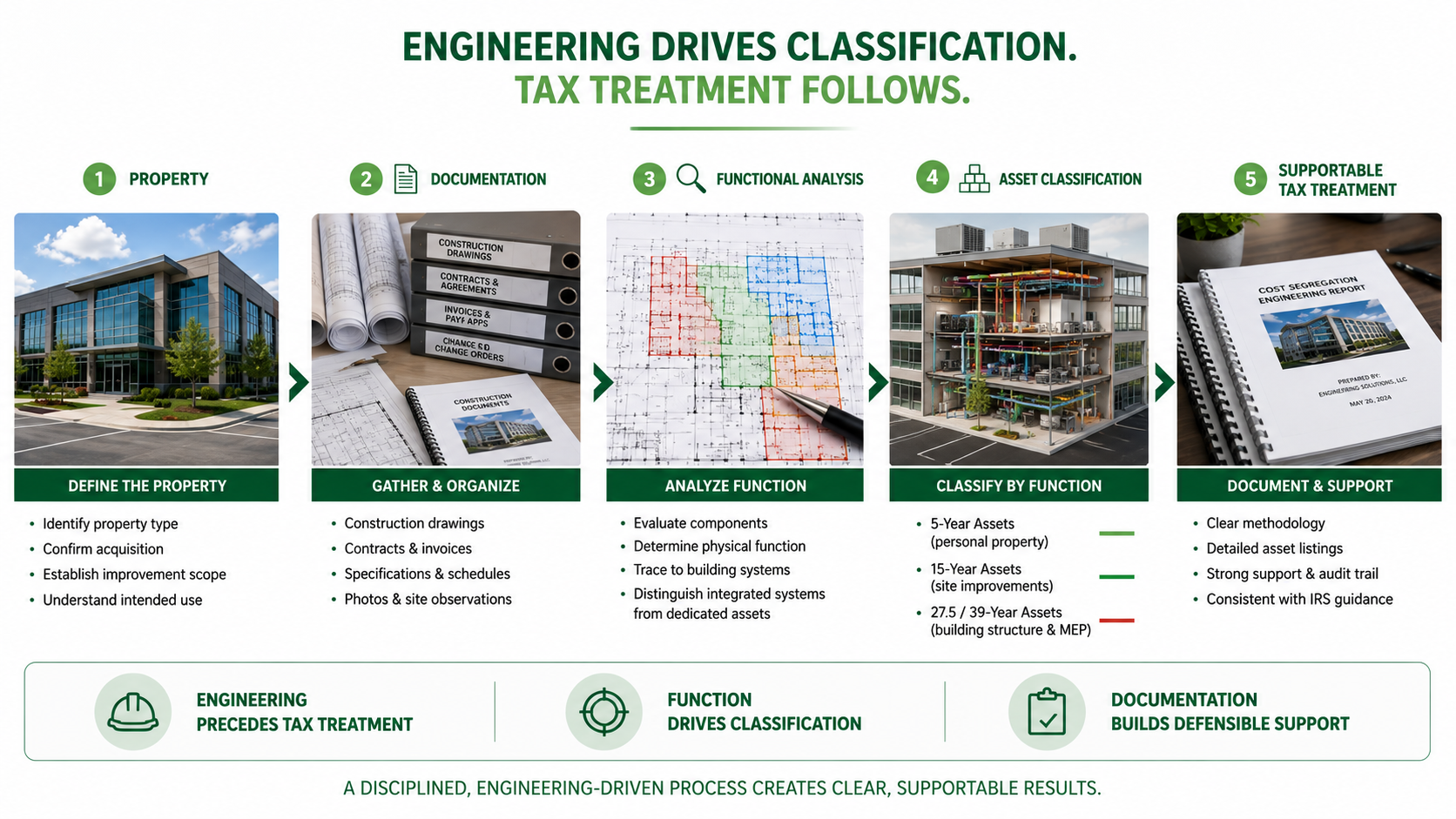
Engineering-driven cost segregation is the process of identifying, documenting, and classifying the assets inside and around a commercial property based on how they function. The goal is not to assign one depreciation class to an entire building. The goal is to evaluate individual assets and determine whether they belong in 5-year property, 15-year land improvements, QIP 15-year property, 27.5-year residential rental property, or 39-year nonresidential real property.
This is why how engineers perform cost segregation matters. Engineers do not stop at construction divisions or contractor invoices. They review the property as an operating business inside real estate.
A restaurant, medical office, warehouse, or retail center may all contain electrical, plumbing, and mechanical work. But those systems do not automatically receive the same depreciation treatment. The classification depends on what the asset supports, how it is installed, and whether the documentation supports the conclusion.

How Engineers Evaluate Asset Function
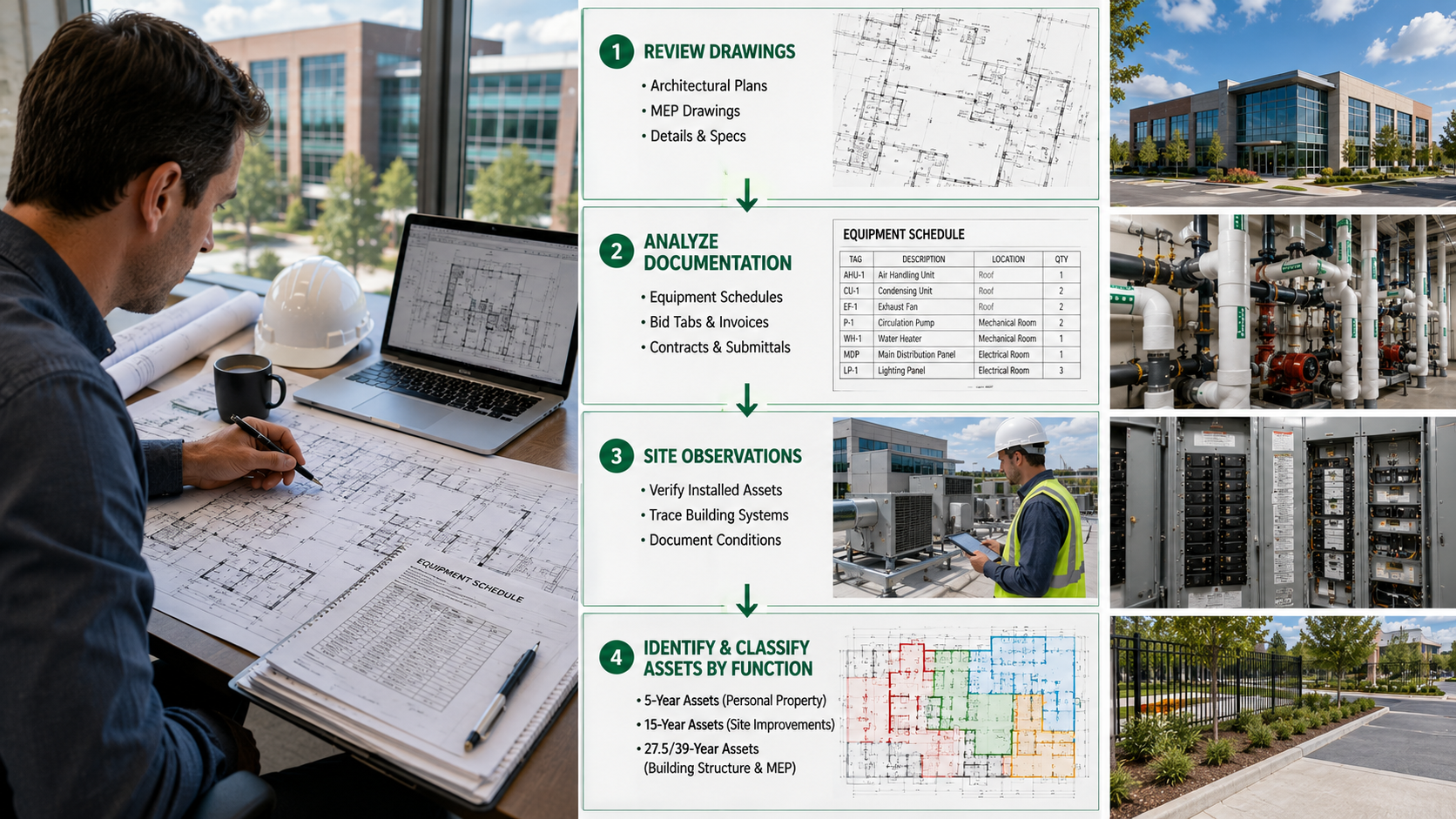
Engineers begin with the property facts. They review drawings, invoices, cost records, site observations, equipment schedules, photographs, and owner input. Then they ask what each asset does.
An electrical panel may serve general building lighting, which commonly remains part of 39-year nonresidential real property. A separate electrical circuit may directly support specialized equipment, which may require a different analysis. A plumbing line may serve ordinary restrooms, while another line may support business equipment or specialized operations. The trade is the same. The function is different.
This is especially important with MEP systems. A useful investor starting point is understanding MEP systems cost segregation, because electrical, plumbing, and mechanical assets often require careful functional review rather than broad assumptions.
Engineering analysis also separates construction information from depreciation classification. A contractor builds the system. An engineer studies the system. The tax treatment follows the engineering conclusion.
Why Contractor Trade Categories Can Mislead Investors
Contractor categories are designed for building a property, not classifying assets for depreciation. A construction budget may group many different assets under electrical, plumbing, HVAC, site work, or interior finishes. Those labels help manage a project, but they do not explain the function of each asset.
This creates risk when investors assume that a trade category equals a depreciation class. Not all electrical work is 5-year property. Not all plumbing is 5-year property. Not all site work is 15-year land improvements. General building components commonly remain part of 39-year nonresidential real property unless the facts support a different classification.
The same principle applies to §1245 property. Investors who want to understand the reasoning behind asset classification should understand what is §1245 property and why function, permanence, use, and documentation matter.
Engineering-driven analysis helps investors avoid unsupported classifications. It also creates a clearer record if the study is reviewed later.

Applications Across Commercial Properties
Functional analysis appears in almost every commercial property type. In a restaurant, engineers may evaluate dedicated kitchen infrastructure, walk-in cooler support, floor drains, grease systems, and specialized electrical loads. In a warehouse, they may evaluate equipment support, dock infrastructure, racking-related systems, and exterior site improvements. In a medical office, they may evaluate specialized treatment infrastructure, dedicated electrical service, and tenant improvements.
The building type provides context, but it does not replace asset-level review. A retail center, for example, may include standard building systems, tenant-specific improvements, parking areas, signage, specialty lighting, and exterior improvements. Each asset needs its own classification.
This is why cost segregation audit readiness depends on the quality of the study. A strong report should explain the methodology, identify the assets, support the classifications, and reconcile costs in a way that can be understood by investors, CPAs, and reviewers.

Strategy for Better Documentation
Investors can improve cost segregation outcomes by thinking like owners, not just buyers. The best time to preserve useful documentation is before it is needed. Purchase records, settlement statements, construction drawings, cost schedules, invoices, site plans, photographs, tenant improvement records, and CapEx history can all help engineers understand the property.
This matters during acquisition, renovation, refinancing, and long-term ownership. When an investor treats the property as a business, records become part of the asset management system. That approach is consistent with a stronger investment property management strategy.
Good documentation does not guarantee a specific result. It does help engineers make more supportable conclusions. It also helps investors understand what they own, what was improved, and how the property’s engineering history affects depreciation.

Financial Example
Illustrative example only. Figures shown are estimated for demonstrative purposes only. Actual land allocations, asset classifications, depreciation, and tax results depend on the specific property, supporting documentation, engineering analysis, and taxpayer circumstances.
Consider an investor who acquires a small commercial property for $2,000,000. For demonstrative purposes, assume $400,000 is allocated to land, leaving $1,600,000 of depreciable basis.
Investor A records the building as one asset and depreciates the full $1,600,000 as 39-year nonresidential real property. Investor B obtains an engineering-based cost segregation study. The study identifies certain assets as 5-year property, certain exterior improvements as 15-year land improvements, and the remaining building components as 39-year nonresidential real property.
The difference is not that Investor B used a shortcut. The difference is that Investor B obtained an engineering inventory of the property. The study reviewed the assets, evaluated their function, documented the reasoning, and assigned costs based on supportable methodology.
That documentation may improve first-year depreciation, but the larger lesson is ownership clarity. Investor B has a better understanding of what the property contains, what supports business operations, and how future improvements should be documented.
Closing
Engineering-driven cost segregation starts with the property, not the tax result. Contractor trades explain who installed the work, but engineering explains what the assets do. That distinction matters because asset function, installation, documentation, and property facts drive classification.
For commercial real estate investors, the lesson is simple: do not classify a building by trade category alone. Understand how the property operates. Document the assets that support that operation. Let engineering lead, and let tax treatment follow.
Do you have a question about Cost Segregation?
Let us know how we can help
Your information is secure. We only use your details to answer your direct inquiry.