
Signage: Identity vs. Function
Sep 15, 2026A sign may identify a tenant, direct a customer, mark a restroom, display a trade name, or sit on a monument at the entrance to a property. To an investor, all of those assets may simply appear under one construction category: signage. For cost segregation, that label does not necessarily tell the whole story. ATG 2025 contains commercial examples where signs fall into 5-year property, 15-year land improvements, or 39-year nonresidential real property depending on what the asset is and what function it performs. CostSegRx engineers therefore look beyond the word "sign" to understand what it communicates, what it serves, how it is installed, and what physically supports it.
Wondering how much tax you could save with cost segregation? Let’s find out. Schedule a Cost Segregation Strategy Call today.
Key Takeaways
- Signage is not automatically one depreciation classification.
- Engineers evaluate what a sign communicates, serves, and physically includes.
- Identity signs and building-operation signs can receive different treatment.
- Wayfinding, tenant identity, room signs, and site signage create different questions.
- Owners should document sign purpose, construction, electrical support, and site components.
- One monument sign can contain assets with different recovery periods.
- The word signage is only the beginning of the engineering analysis.
What Signage Means in Cost Segregation
Commercial signage covers more than the sign above a storefront.
A property can contain tenant identification, trade names, trade symbols, directories, directional signs, address identification, room numbers, restroom identifiers, exit signs, monument signs, pylon signs, sign faces, message screens, poles, foundations, and related electrical components.
The important distinction is that these assets do not all perform the same function.
ATG 2025's retail matrix provides a clear example. Exit signs, restroom identifiers, room numbers, and other signs relating to the operation or maintenance of the building are identified as 39-year nonresidential real property. The same matrix separately identifies interior and exterior signs used for display or theme identity, including department identification, trade names, and trade symbols, as 5-year property under Asset Class 57.0.
That is a strong example of the broader principle discussed in what makes an asset §1245 property. Classification starts with the actual asset, its function, and the applicable facts, not merely the construction label.
The title of this article, "Identity vs. Function," is a teaching framework rather than a tax test. Identity signage is one useful category to examine, but the actual classification must follow applicable authority and property-specific facts.
How Engineers Break a Sign Into Its Components
A sign that looks like one asset from the parking lot may contain several physical components.
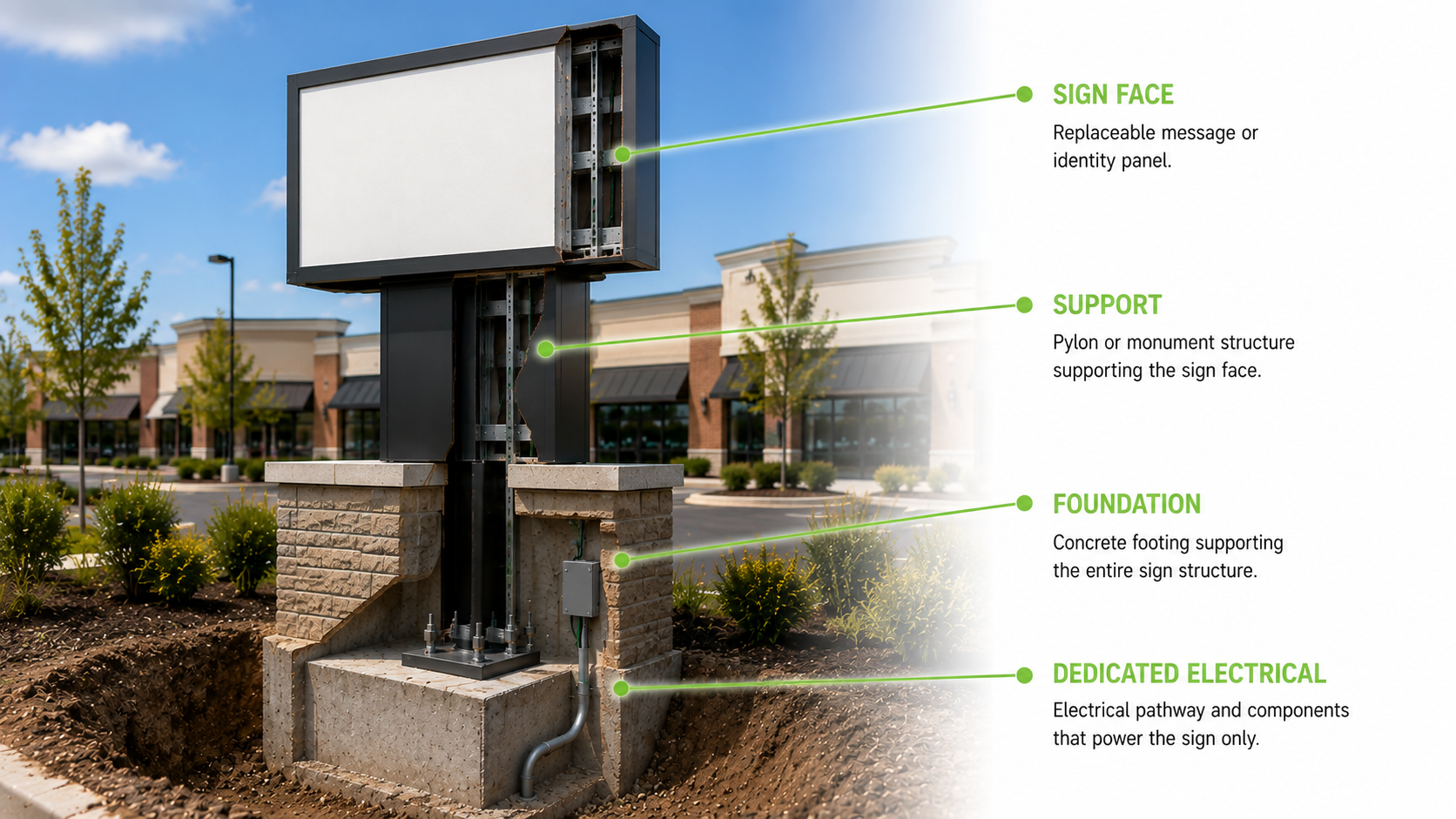
Consider a freestanding monument or pylon sign. An engineer may need to distinguish among the sign face, message screen, supporting pylon or pole, foundation, dedicated electrical components, and other supporting construction.
ATG 2025 demonstrates why that matters. In applicable guidance, pylons made from materials such as concrete, brick, wood frame, or stucco and set in the ground or on a concrete foundation are treated as 15-year land improvements under Asset Class 00.3. The sign face or message screen is separately identified as 5-year property under Asset Class 57.0.
Other ATG guidance also specifically identifies concrete foundations and footings for signs and other land improvements with the associated 15-year land improvement treatment.
That means CostSegRx engineers do not necessarily stop at:
Monument Sign: $XX,XXX
Instead, the engineering questions include:
- What is physically installed?
- What is the sign communicating?
- Is it serving building operation or business identity?
- Is there a separate sign face or message component?
- What physically supports the sign?
- Is there a pole, pylon, monument structure, or foundation?
- Are electrical components dedicated to the signage?
- What construction documents, invoices, site plans, electrical drawings, photographs, and field observations support those conclusions?
This is the same engineering mindset discussed in Every Building Tells a Story. Engineers Just Read It Differently. A visible asset can represent only part of the property's engineering story.
Why Identity and Function Matter
Imagine walking through a shopping center.
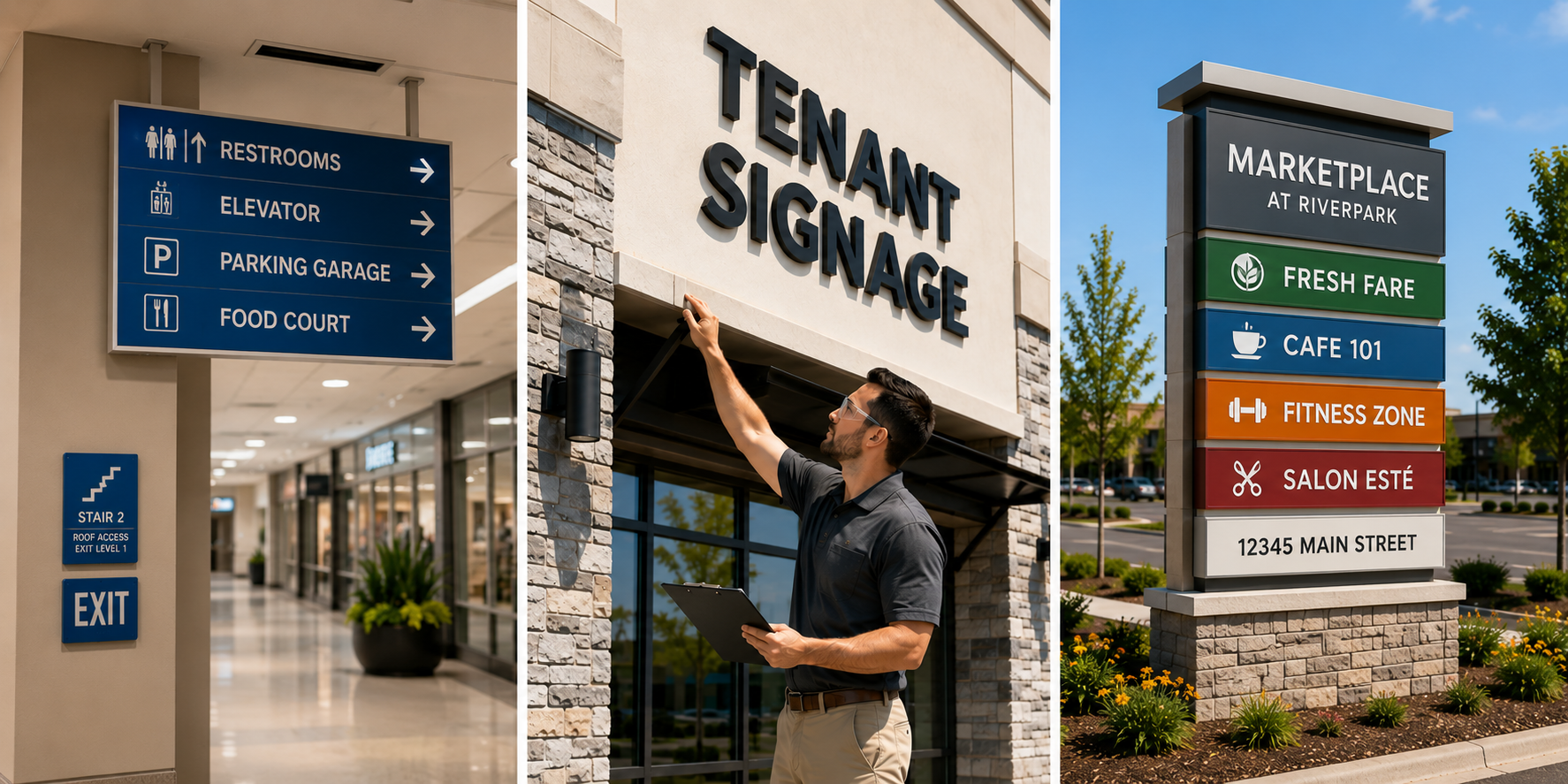
At the entrance is a monument sign displaying the property name and tenant identities. On the building are individual tenant trade names. Along the drive aisles are directional signs. Inside a tenant space are restroom identifiers, room numbers, and exit signs.
They are all signs.
But they are not all doing the same job.
ATG 2025's retail guidance distinguishes signs used for display or theme identity from signs relating to operation or maintenance of the building. Exterior trade names and trade symbols are specifically included in the 5-year property category under the applicable retail matrix, while exit signs, restroom identifiers, room numbers, and other building-operation signs are identified with 39-year nonresidential real property.
The casino and gaming matrix provides another useful illustration of functional analysis. It distinguishes building-operation signs from directories and signs indicating locations of business functions and departments, and it separately addresses signs associated with gaming or entertainment activities under the applicable activity class.
That reinforces an important point for investors.
There is no useful rule that says:
Sign = 5 years.
There is also no useful rule that says:
Sign attached to building = 39 years.
The engineering analysis needs the actual facts.

Where Different Sign Types Create Different Questions
Tenant and Trade-Name Signage
Retail properties often contain signs displaying tenant names, trade names, or trade symbols.
ATG 2025's retail matrix specifically identifies interior and exterior signs used for display or theme identity, including exterior trade names and trade symbols, as 5-year property under Asset Class 57.0.
This can include signage mounted on a building, which is another reason attachment alone should not be treated as the classification test. The underlying question is what the asset is and what function it performs.
Wayfinding and Directional Signs
Wayfinding requires more care because "directional sign" can describe different functions.
ATG 2025's casino and gaming matrix identifies certain interior directories and signs indicating the location of business functions and departments as 5-year property under Asset Class 57.0 when they are not related to operation or maintenance of the building. It also includes exterior signs displaying names, symbols, and directions in that category.
That does not establish a universal rule that every wayfinding sign at every property is 5-year property. CostSegRx engineers need to determine what the particular sign communicates and which industry guidance and authority apply.
Address Letters and Building Identification
Address letters are a good example of why we should avoid material-based shortcuts.
The ATG material reviewed for this article does not provide a blanket rule stating that every set of address letters receives one recovery period. Their actual function and property context therefore need to be established rather than inferred from appearance.
An address element may be part of a broader identity-sign system, or it may serve another building-related identification function. CostSegRx engineers document what exists and why it exists before applying the relevant authority.
Exit Signs, Restroom Identifiers, and Room Numbers
Here the retail guidance is much more explicit.
Exit signs, restroom identifiers, room numbers, and other signs relating to operation or maintenance of the building are identified as 39-year nonresidential real property.
These signs may be physically smaller and less expensive than a tenant identity sign, but size does not determine recovery period.
Function matters.
Monument and Pylon Signs
Site signage introduces another layer because what an owner casually calls "the sign" may actually contain multiple assets.
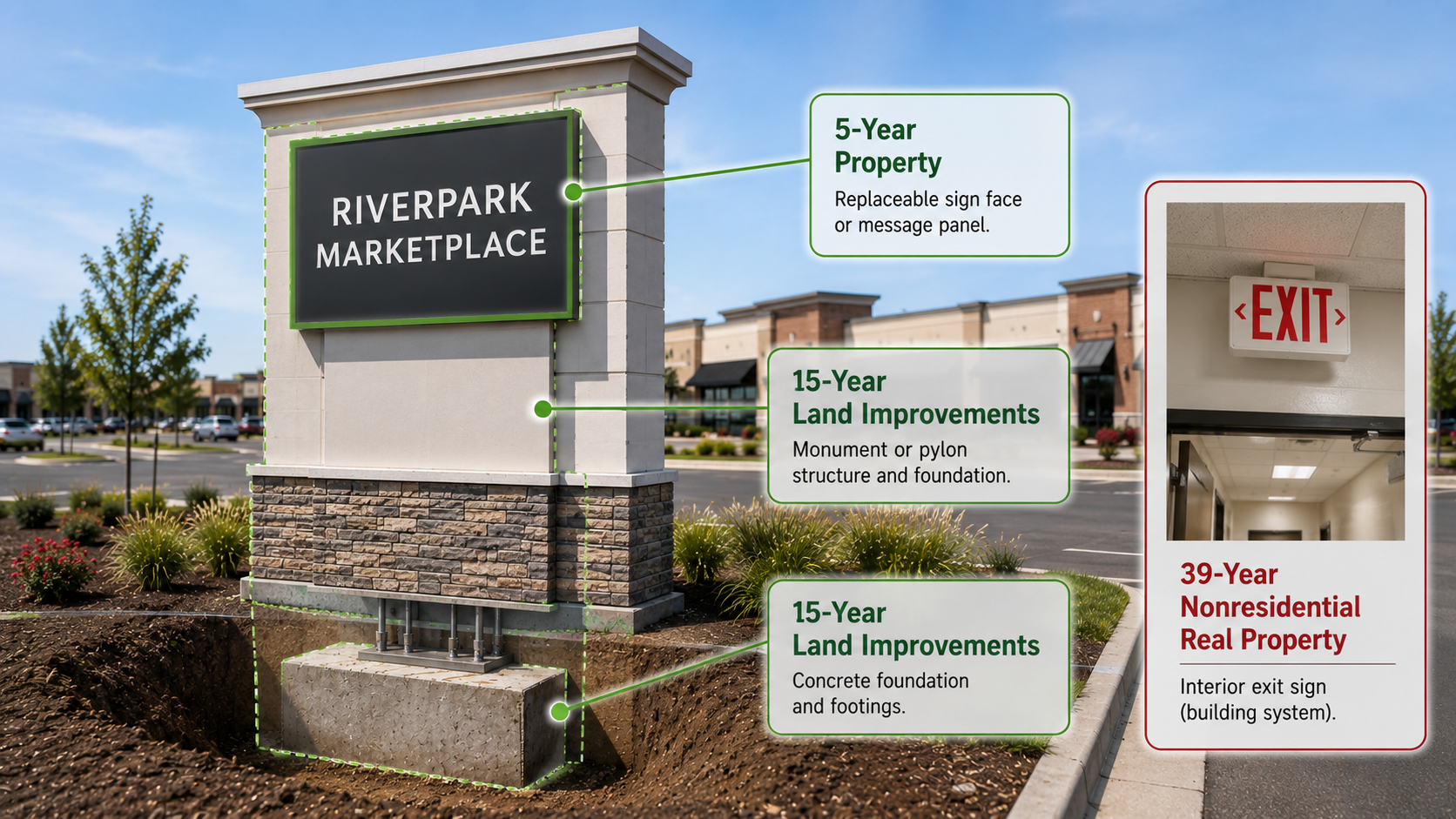
ATG 2025 distinguishes the pylon structure from the sign face. A pylon constructed from concrete, brick, wood frame, stucco, or similar materials and set in the ground or on a foundation is identified with 15-year land improvements, while the sign face or message screen and related components can be 5-year property under applicable guidance.
Poles poured into concrete footings or bolt-mounted for signage are likewise identified as 15-year land improvements in the retail matrix.
For investors, this connects signage to the broader opportunity to understand 15-year land improvements throughout a commercial site.

Document Signage as a System, Not Just an Invoice
Signage often changes during ownership.
Tenants move. Brands change. Shopping centers are rebranded. Monument faces are replaced. Digital message components are upgraded. Directional systems are updated. Exterior signs are added during renovations.
Owners can make future engineering analysis easier by preserving the history of those changes.
Keep available sign drawings, site plans, architectural elevations, electrical drawings, vendor proposals, invoices, photographs, specifications, and records showing what was replaced or added.
For a monument sign, documentation should ideally make it possible to understand the physical pieces of the project. Was the existing structure retained while only the sign face changed? Was a new pylon installed? Was a foundation constructed? Was dedicated electrical work added? Was only a tenant panel replaced?
Those distinctions can matter because ATG 2025 itself separates the sign face from the supporting site structure in applicable fact patterns.
This is also why good cost segregation audit readiness depends on more than assigning a recovery period. The supporting facts, engineering reasoning, documentation, and cost allocation should explain how the conclusion was reached.

Example: One Monument Sign, More Than One Asset
Consider a hypothetical shopping center installing a new freestanding monument sign.
From an ownership or construction perspective, the project might appear on an invoice simply as:
Shopping Center Monument Sign
That description is useful, but it does not necessarily describe the depreciable assets with enough detail for engineering classification.
Suppose the installed system contains a permanent monument or pylon structure set on a concrete foundation, plus replaceable sign faces displaying the shopping center and tenant identities.
Under the applicable ATG examples, the pylon or monument-type supporting structure can fall within 15-year land improvements under Asset Class 00.3. The sign face or message screen can be separately identified as 5-year property under Asset Class 57.0.
If the project also includes dedicated electrical components, the engineer should identify and evaluate those components under the applicable facts rather than assuming their treatment from the word "sign."
Now compare that site sign with an exit sign inside the shopping center.
The retail matrix identifies the exit sign, as a sign relating to building operation or maintenance, with 39-year nonresidential real property.
The investor sees signs.
The engineer sees function, physical construction, supporting infrastructure, and potentially different asset classifications.
That is the lesson.
A Sign Is More Than Its Message
Signage is a useful example of why cost segregation starts with engineering.
A tenant trade-name sign, an exit sign, and a freestanding monument sign may all communicate information, but they do not necessarily perform the same function or represent the same physical asset.
ATG 2025 provides support for meaningful distinctions among 5-year property, 15-year land improvements, and 39-year nonresidential real property in applicable signage fact patterns. It even demonstrates how one freestanding sign installation can contain a 15-year supporting structure and a separately analyzed 5-year sign face.
CostSegRx engineers look at what exists, why it exists, what it serves, how it is installed, and what documentation supports the conclusion.
The word "signage" identifies the category.
Identity and function help reveal the engineering story.
Do you have a question about Cost Segregation?
Let us know how we can help
Your information is secure. We only use your details to answer your direct inquiry.