

What Makes an Asset §1245 Property? The Four Questions Engineers Ask
Jul 23, 2026Many investors think §1245 property is simply a list of assets. They picture electrical systems, plumbing, specialty equipment, or removable improvements and assume those categories determine the answer. That is not how engineering-based cost segregation works.
An investment property is more than a building. It is a business operating inside real estate. Whether the property is a restaurant, marina, veterinary clinic, medical office, manufacturing facility, or apartment complex, every asset exists because it serves a purpose. The engineer's responsibility is to understand that purpose before assigning a recovery class.
Cost segregation is not a guessing exercise or a percentage-based allocation. It is an engineering process built on function, documentation, and established tax treatment.
Wondering how much tax you could save with cost segregation? Let’s find out. Schedule a Cost Segregation Strategy call today.
Key Takeaways
- Learn why §1245 property begins with engineering analysis
- Discover the four questions engineers ask every asset
- Understand why business function drives classification
- See how the four questions apply across industries
- Build documentation that supports engineering conclusions
- Compare identical assets serving different functions
- See why engineering methodology creates defensible studies
An Investment Property Is a Business Operating Inside Real Estate
One of the biggest misconceptions about cost segregation is that engineers classify buildings.
They do not.
They classify assets.
Every commercial property exists to support a business activity. An apartment supports residential housing. A restaurant supports food service. A veterinary clinic supports animal care. A marina supports boating operations. A manufacturing facility supports production.
The building provides the shell. The assets allow the business to function.
That is why cost segregation engineers evaluate how assets operate within the business instead of simply identifying what trade installed them or where they are located.
This concept is closely related to MEP systems in cost segregation, where electrical, plumbing, and mechanical systems are classified by function rather than trade category.

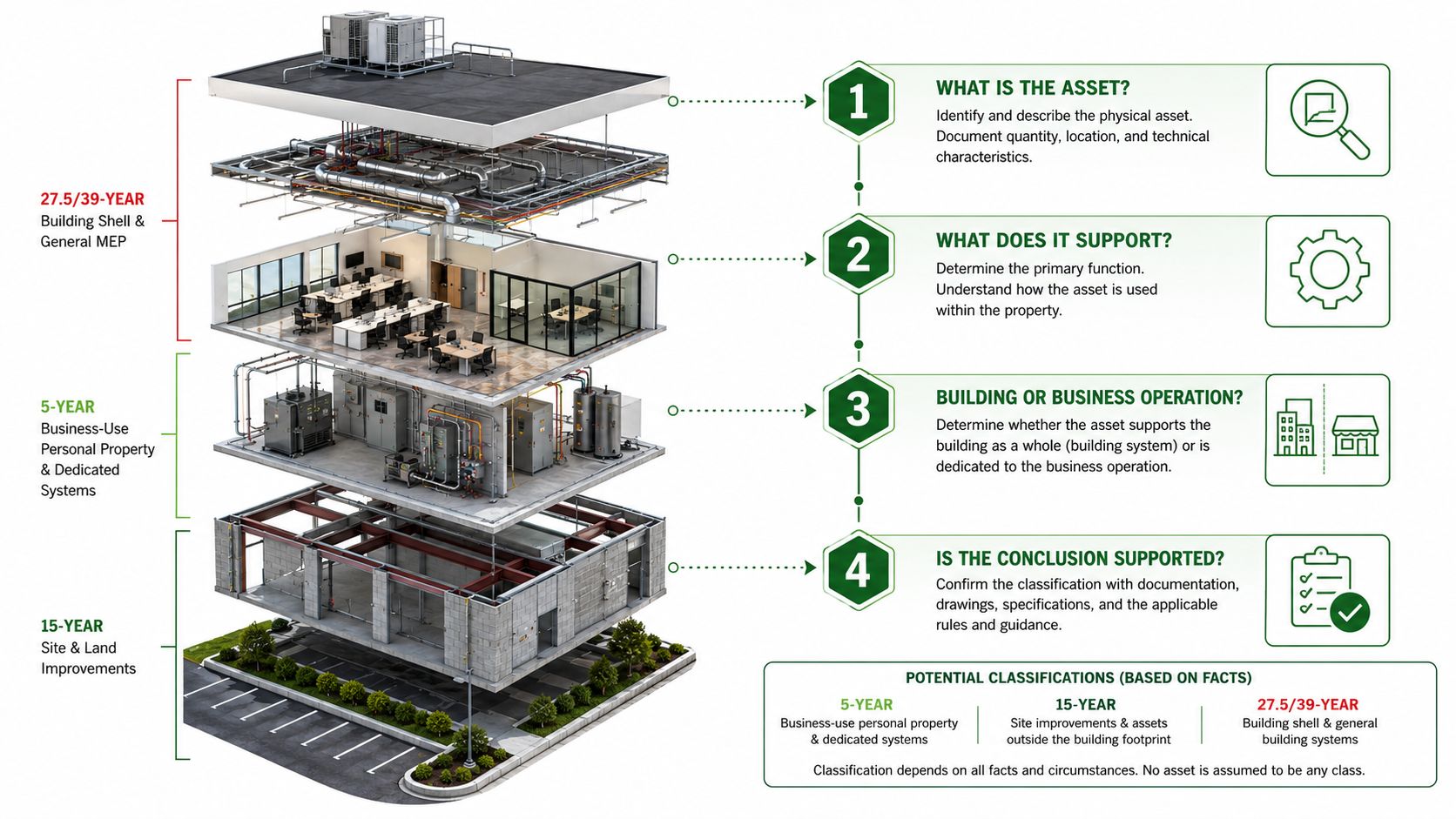
The Four Questions Every Engineer Asks
Every asset begins with the same engineering process.
Question 1: What is the asset?
Before anything else, the engineer identifies exactly what has been installed. Construction drawings, equipment schedules, photographs, specifications, invoices, and field observations help answer this question.
Question 2: What does the asset support?
This is often the most important question.
Does the asset primarily support the operation of the building?
Or does it directly support equipment, production, medical treatment, food preparation, refrigeration, manufacturing, or another specialized business activity?
Function frequently determines the next step in the analysis.
Question 3: Is the asset part of the building or the business operation?
Some assets primarily exist because the building exists.
Others primarily exist because the business exists.
That distinction often separates general building systems from assets requiring further engineering review.
Question 4: Is the conclusion supported?
Engineering conclusions must be supported by documentation.
Plans.
Specifications.
Construction records.
Equipment schedules.
Photographs.
Site observations.
Cost reconciliation.
Without support, classification becomes opinion instead of engineering.
Why Function Matters More Than Appearance
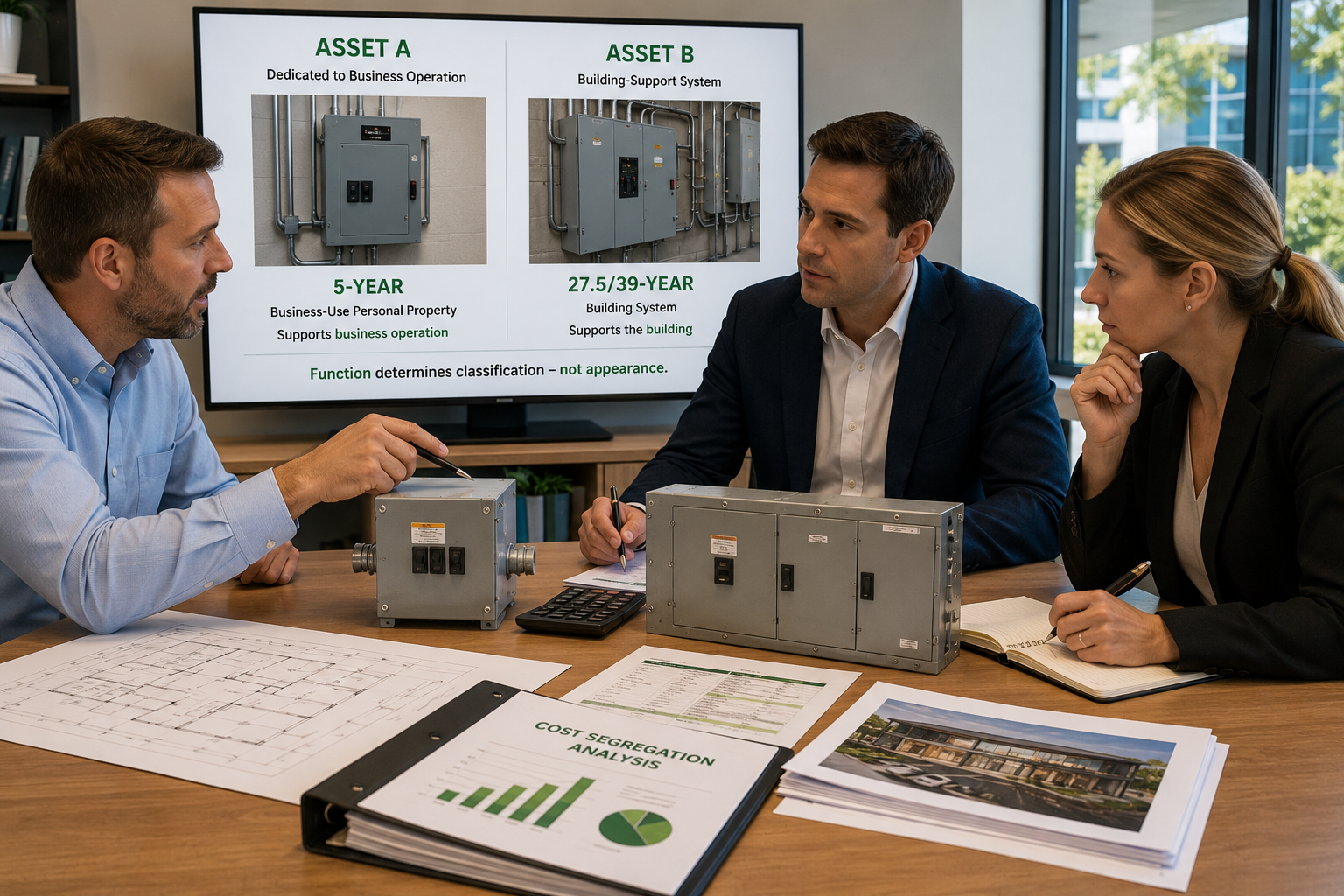
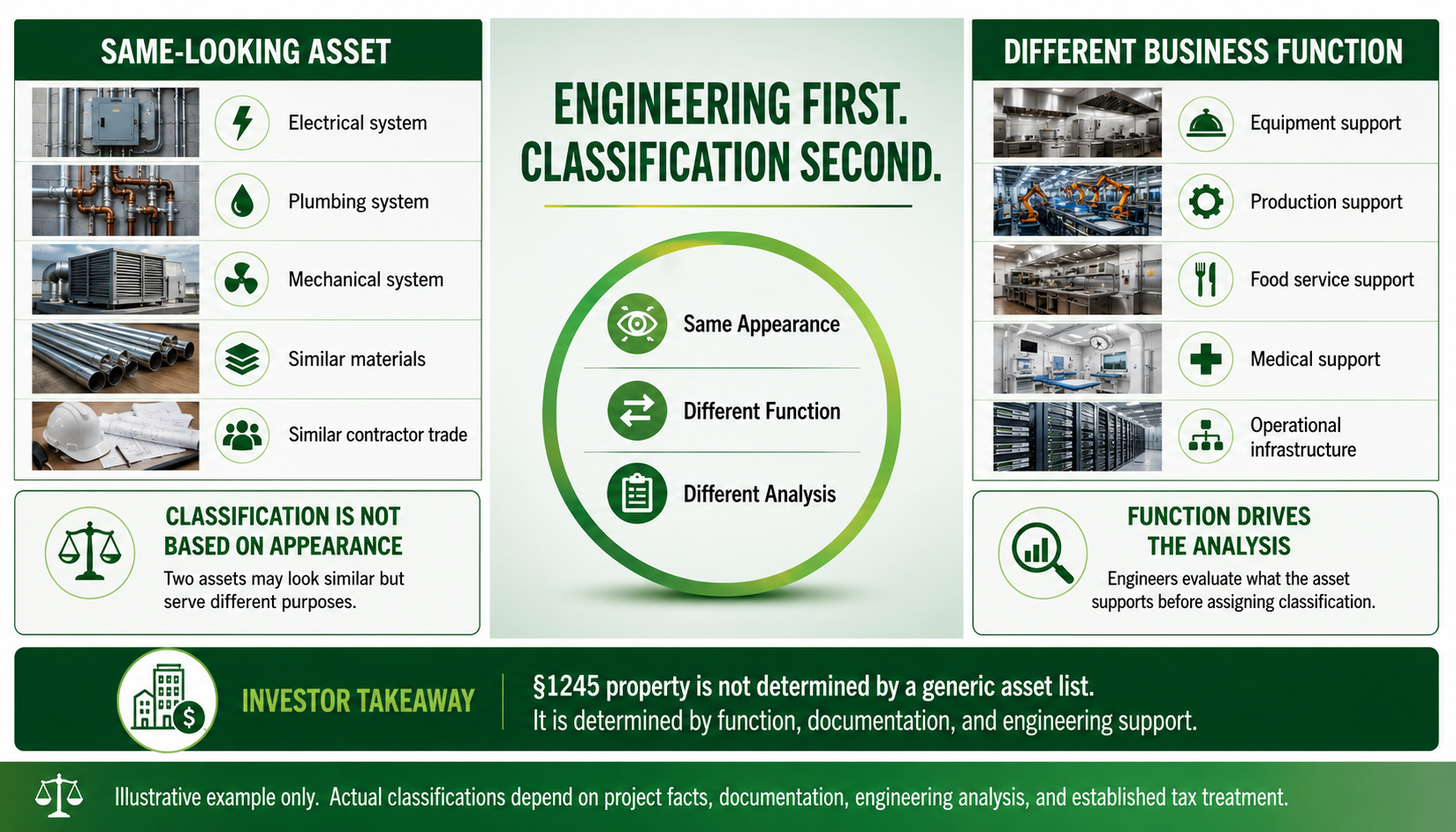
Two assets can look almost identical while serving completely different purposes.
Two electrical panels may appear the same.
Two plumbing systems may use similar materials.
Two ventilation systems may occupy similar space.
What matters is not appearance.
What matters is what each system supports.
That is why engineering methodology focuses on functional analysis rather than visual similarity. The IRS Cost Segregation Audit Technique Guide repeatedly emphasizes understanding the purpose and use of assets within the property.
This is also why articles like Electrical Distribution Systems in Cost Segregation Studies are important. The same trade can contain assets serving very different functions.
How the Four Questions Apply Across Different Properties
The engineering process remains remarkably consistent even though the properties are different.
In a restaurant, the questions may focus on cooking equipment support, refrigeration, drainage, gas distribution, and kitchen infrastructure.
In a veterinary clinic, they may involve imaging equipment, treatment rooms, kennel infrastructure, specialty plumbing, and dedicated electrical.
In a marina, they may involve shore power, dock utilities, fuel systems, pump-out stations, and waterfront infrastructure.
In a manufacturing facility, they may involve production equipment, process piping, compressed air, specialty ventilation, and machinery support.
The property changes.
The questions stay the same.
That consistency is what makes engineering methodology repeatable across every commercial property type.

Building Better Documentation
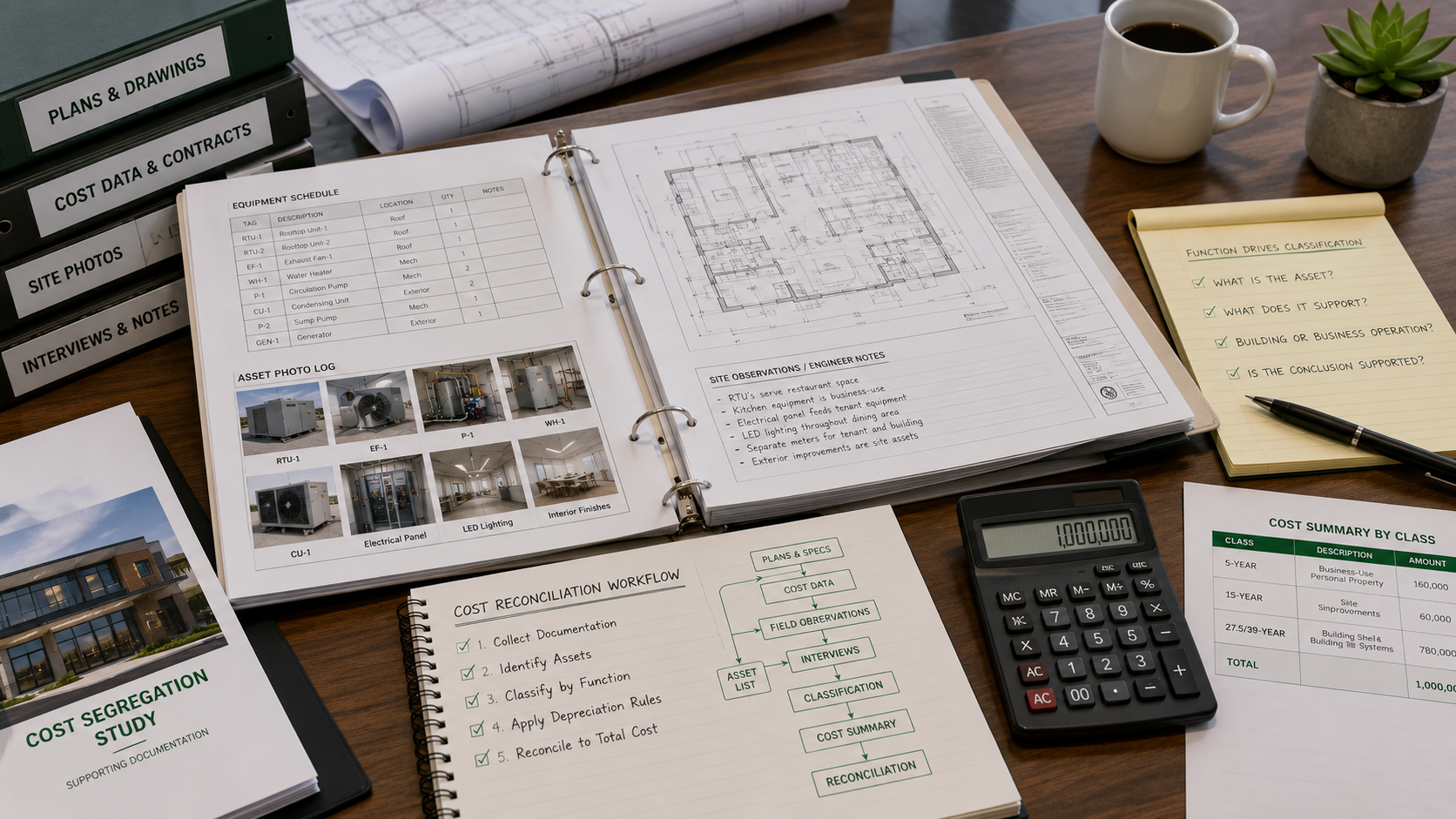
The four questions can only be answered if good documentation exists.
The strongest studies combine:
- Architectural plans
- Electrical drawings
- Mechanical drawings
- Plumbing drawings
- Equipment schedules
- Construction specifications
- Subcontractor detail
- Site observations
- Photographs
- Cost reconciliation
Good documentation allows engineering conclusions to be explained, supported, and defended.
This planning philosophy is similar to design-build cost segregation planning, where preserving information during construction often improves the final study.
Financial Example: Same Asset, Different Business Purpose
Assume two investors each purchase a $4,000,000 commercial property. Land is allocated at an estimated 20%, leaving a depreciable basis of $3,200,000 for each property.
Both buildings contain an electrical distribution system installed by an electrical contractor.
At first glance, the systems appear similar.
A percentage-based review might simply classify both systems the same way because they share the same trade.
An engineering-based review begins asking the four questions.
What is the asset?
What does it support?
Is it serving the building or the business operation?
Is the conclusion supported by documentation?
Those answers may reveal that portions of one property's electrical infrastructure directly support specialized business operations while the other primarily serves the general building.
The electrical contractor did not determine the classification.
The engineering analysis did.
The important lesson is not that the two properties produce identical or different tax outcomes. The lesson is that engineering methodology evaluates purpose before assigning classification.
Engineering First. Classification Second.
The best cost segregation studies do not begin with depreciation schedules.
They begin with questions.
Every asset is evaluated through engineering analysis before it is assigned to a recovery class. Function, documentation, construction details, and operational purpose all contribute to the final conclusion.
That is why §1245 property is not simply a list of assets.
It is the result of a disciplined engineering process that seeks to understand how every asset contributes to the business operating inside the real estate.