
Site Drainage: Where the Building Ends and the Land Improvement Begins
Sep 17, 2026Water does not care where an accounting category begins or ends. It moves off roofs, across pavement, through landscaped areas, into drains, and through underground piping based on how the property was engineered. For cost segregation, however, understanding what a drainage system actually serves can matter. ATG 2025 specifically identifies qualifying site drainage and stormwater infrastructure not directly related to the building as 15-year land improvements, while other drainage and utility components can remain associated with the building. CostSegRx engineers therefore follow the water and the physical system rather than assuming everything labeled "drainage" receives the same treatment.
Wondering how much tax you could save with cost segregation? Let’s find out. Schedule a Cost Segregation Strategy Call today.
Key Takeaways
- Site drainage can qualify as 15-year land improvements when it serves the exterior site rather than the building.
- Engineers trace where water originates, where it is collected, and what infrastructure carries it away.
- An underground pipe should not be classified from the word "drainage" alone.
- Storm piping, storm sewers, retention basins, grading, parking areas, and building drainage create different questions.
- Site plans, civil drawings, grading plans, and construction records can reveal drainage relationships hidden underground.
- A commercial property can contain both 15-year site drainage and 39-year nonresidential real property drainage components.
- The engineering question is not simply where the pipe is located, but what the drainage system serves.
What Counts as Site Drainage?
Site drainage manages water across the exterior property.
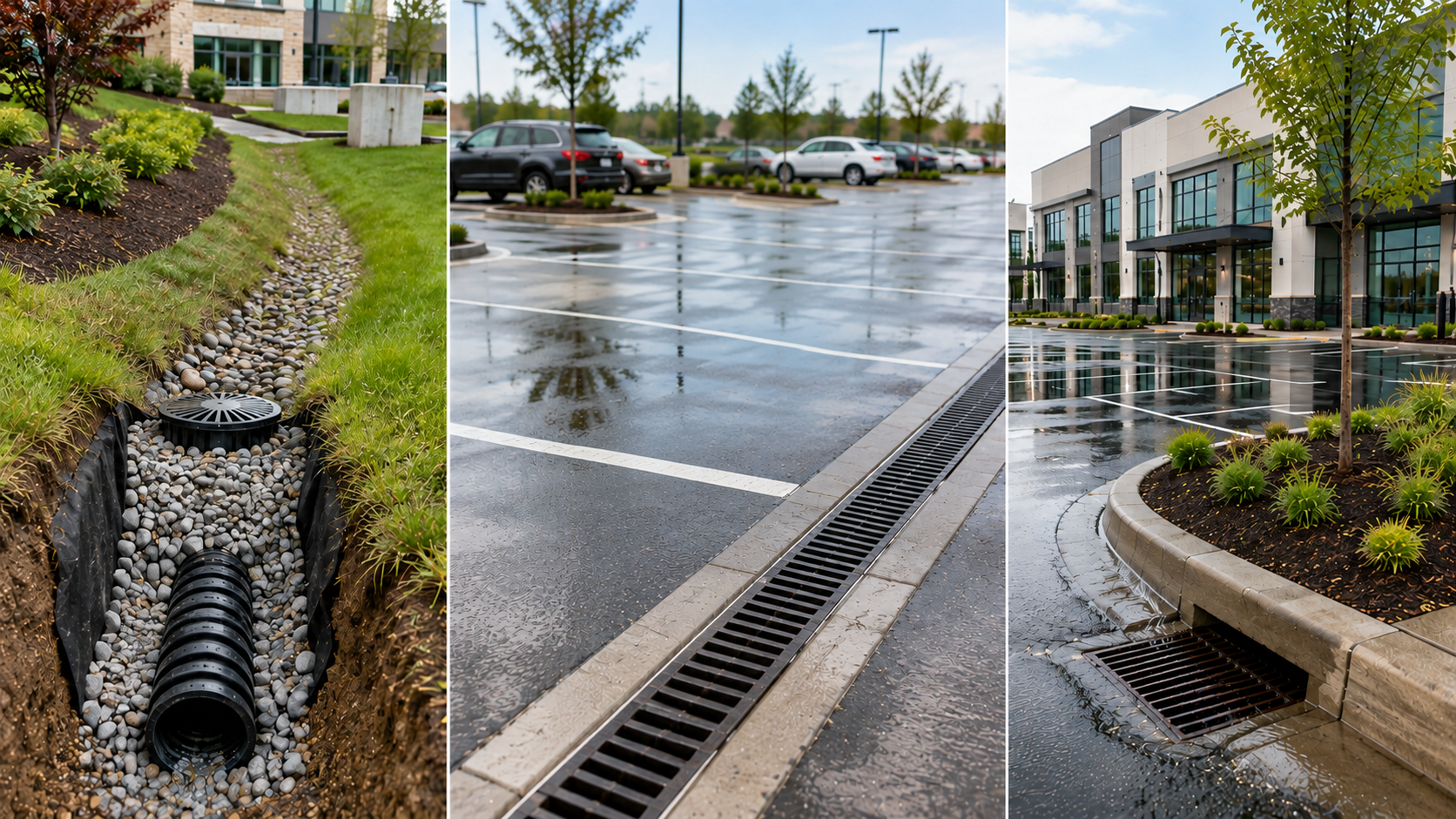
Depending on the property, that can involve storm piping, storm sewers, drainage facilities, paved areas designed to direct runoff, grading associated with depreciable site improvements, and stormwater retention infrastructure.
ATG 2025 gives investors a particularly useful distinction. Its retail guidance defines site work to include curbing, paving, general site improvements, fencing, landscaping, roads, sewers, sidewalks, site drainage, and other site improvements not directly related to the building. Those qualifying assets are identified as Asset Class 00.3 land improvements with a 15-year recovery period.
Other ATG 2025 matrices reinforce the point. Auto dealership guidance includes site drainage and stormwater retention basins not directly related to the building within 15-year land improvements. Casino guidance goes further by specifically identifying storm piping used for draining the site of rainwater as 15-year land improvements.
That places drainage within the broader opportunity investors may encounter in land improvement heavy cost segregation.
But "drain" does not automatically mean 15 years.
The system still has to be understood.
How Engineers Follow the Water
Drainage analysis becomes much clearer when you stop thinking about pipes first and start thinking about water.
Where does the water originate?
What surface or structure is being drained?
Where is the water collected?
What route does it follow?
What does the drainage system protect or serve?
Where does the site system connect to other infrastructure?
Those questions can lead an engineer through a physical chain that may be largely concealed after construction.
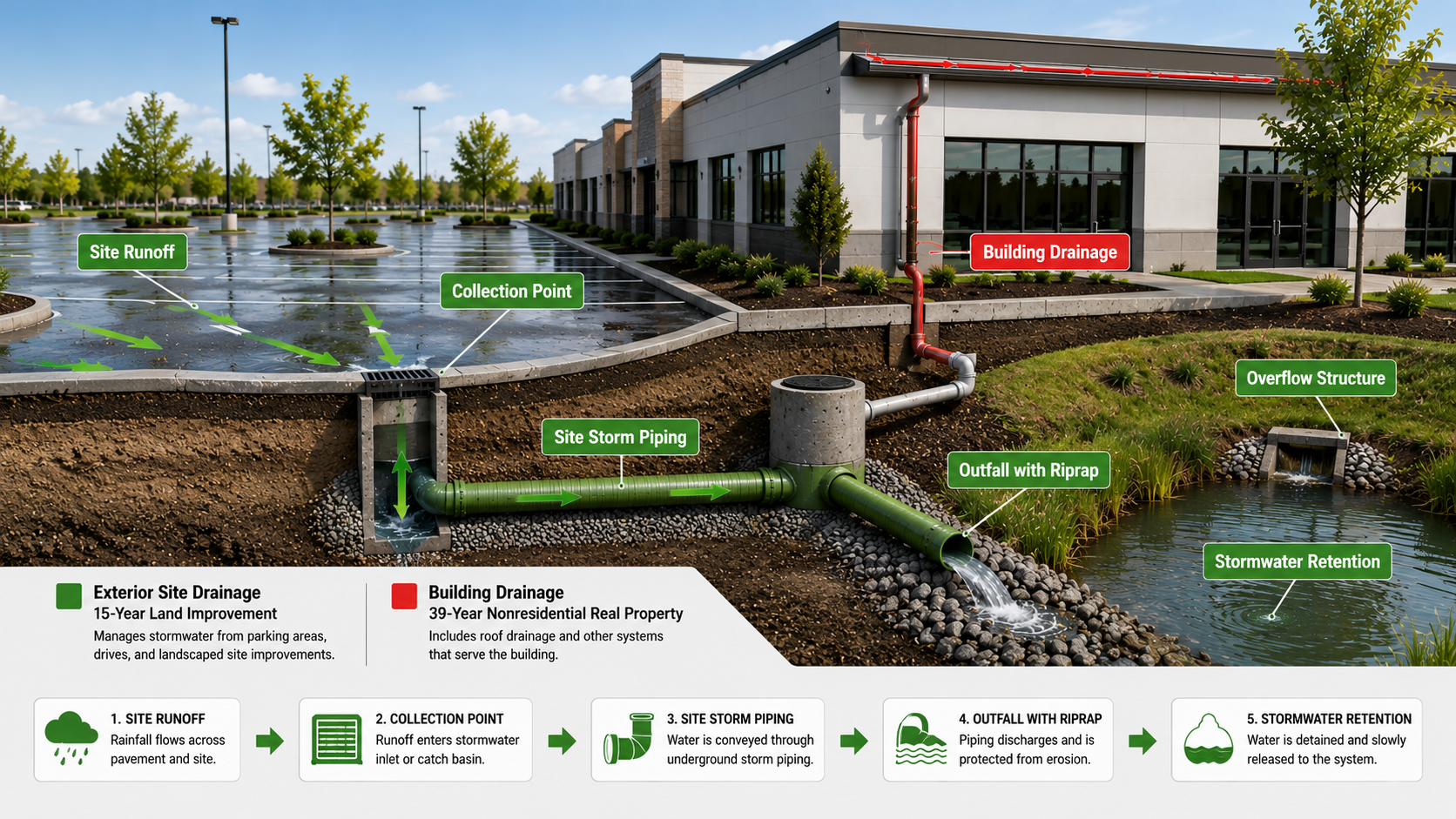
Consider runoff from a commercial parking area. The pavement and surrounding grading may direct stormwater toward collection points. From there, underground storm piping may carry the water through the site toward additional stormwater infrastructure.
ATG 2025 specifically supports storm piping used to drain the site of rainwater as 15-year land improvements in its casino guidance. It also broadly includes site drainage within Asset Class 00.3 across multiple commercial matrices.
That is an engineering system, not simply a visible drain.
CostSegRx engineers may trace the relationship from the visible collection point into concealed storm piping, downstream drainage structures, and other site infrastructure when the property facts and available documentation support that relationship.
The same mindset appears throughout the engineering cost segregation process. Engineers evaluate what exists, why it exists, how it is installed, what it serves, and what documentation supports the conclusion.
With drainage, much of that story may be underground.
Why Underground Does Not Automatically Mean 15 Years
One of the easiest mistakes is to assume that underground infrastructure is automatically a land improvement.
ATG 2025 does not support that shortcut.
For example, its retail matrix identifies site utilities used to distribute water, sanitary sewer, gas, and electrical services from the property line to the retail building as 39-year nonresidential real property. In the same matrix, site drainage and other site improvements not directly related to the building are identified as 15-year land improvements.
That creates an important distinction.
A pipe can be outside the building and underground without automatically becoming 15-year property.
Likewise, a drainage component associated with the building can remain part of the building system. ATG 2025's roof guidance, for example, includes gutters and drains among the elements of the roof in applicable commercial guidance.
The classification question is therefore not:
Is it underground?
It is:
What does this system serve?
CostSegRx engineers use that functional distinction to separate qualifying site drainage from systems serving the building rather than treating every concealed pipe as one asset category.
That distinction is consistent with the broader CostSegRx approach to MEP systems and asset classification. Location and trade labels are evidence, but function drives the engineering analysis.
Where Drainage Systems Create Different Questions
Parking Lot Drainage
Parking areas are one of the clearest places to look for site drainage.
ATG 2025 identifies grade-level surface parking areas, including associated curbs and related site elements, as 15-year land improvements.
When grading and drainage infrastructure are constructed to manage runoff from those depreciable site improvements, CostSegRx engineers can follow the relationship between the pavement, site grading, collection points, and stormwater system.
The important point is that the drainage serves the site improvement rather than being assumed to serve the building.
Storm Piping and Storm Sewers
Storm piping can be particularly important because much of the asset is invisible after construction.
ATG 2025 specifically identifies storm piping used to drain the site of rainwater as 15-year Asset Class 00.3 land improvements in applicable guidance. Other matrices include storm sewers and site drainage within site work not directly related to the building.
Civil and utility drawings can therefore become important evidence.
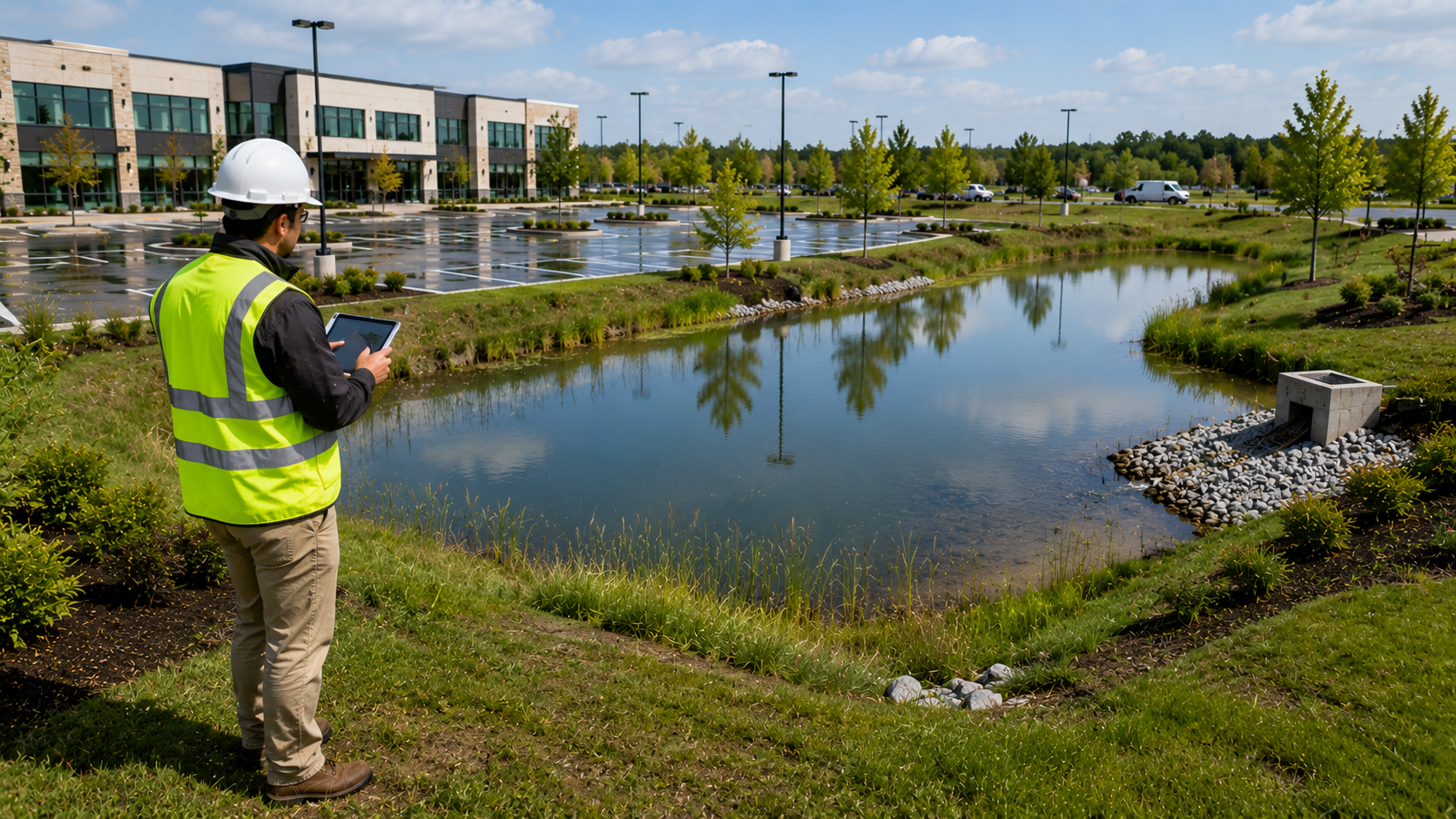
Stormwater Retention Basins
A retention basin may be physically obvious on a large site, but its tax significance is not necessarily obvious to an investor.
ATG 2025's auto dealership guidance specifically includes stormwater retention basins within site work not directly related to the building and identifies the category with 15-year land improvements.
This is another example of why a cost segregation study should inventory the entire property rather than stop at the exterior walls. CostSegRx engineers look across the site to understand how collection points, storm piping, grading, outfalls, and retention infrastructure work together.
Grading and Drainage
Grading requires additional care because not all grading receives the same treatment.
ATG 2025 distinguishes general land preparation from grading and excavation directly associated with depreciable improvements. Clearing and grading directly associated with constructing the building becomes part of the building cost. Grading directly associated with sidewalks, parking areas, roadways, and other depreciable land improvements follows the associated improvement and can be 15-year property.
That makes the reason for the earthwork important.
Building Drainage
Not every system carrying rainwater is automatically site drainage.
ATG 2025 includes drains within the roof system in applicable commercial guidance. It also identifies building plumbing and drainage components with the building in relevant matrices.
CostSegRx engineers therefore need to identify where the building-serving system ends and where qualifying site drainage begins, based on the actual property and applicable authority.
Sanitary Sewer
Stormwater and sanitary sewer should not be casually combined.
ATG 2025's retail guidance identifies sanitary sewer within site utilities serving the building and treats those utilities as 39-year nonresidential real property. Its site-work guidance specifically tells the reader to see Site Utilities for sanitary sewers.
So the word "sewer" alone does not establish the recovery period.
What the sewer carries and what it serves matter.
Preserve the Civil Engineering Story
Drainage systems are easiest to understand when the construction information is still available.
After a property is complete, an investor may see pavement, curbs, landscaping, drain openings, and a retention area. Much of the piping, grading logic, connection points, and underground infrastructure can be hidden.
That makes documentation especially valuable.
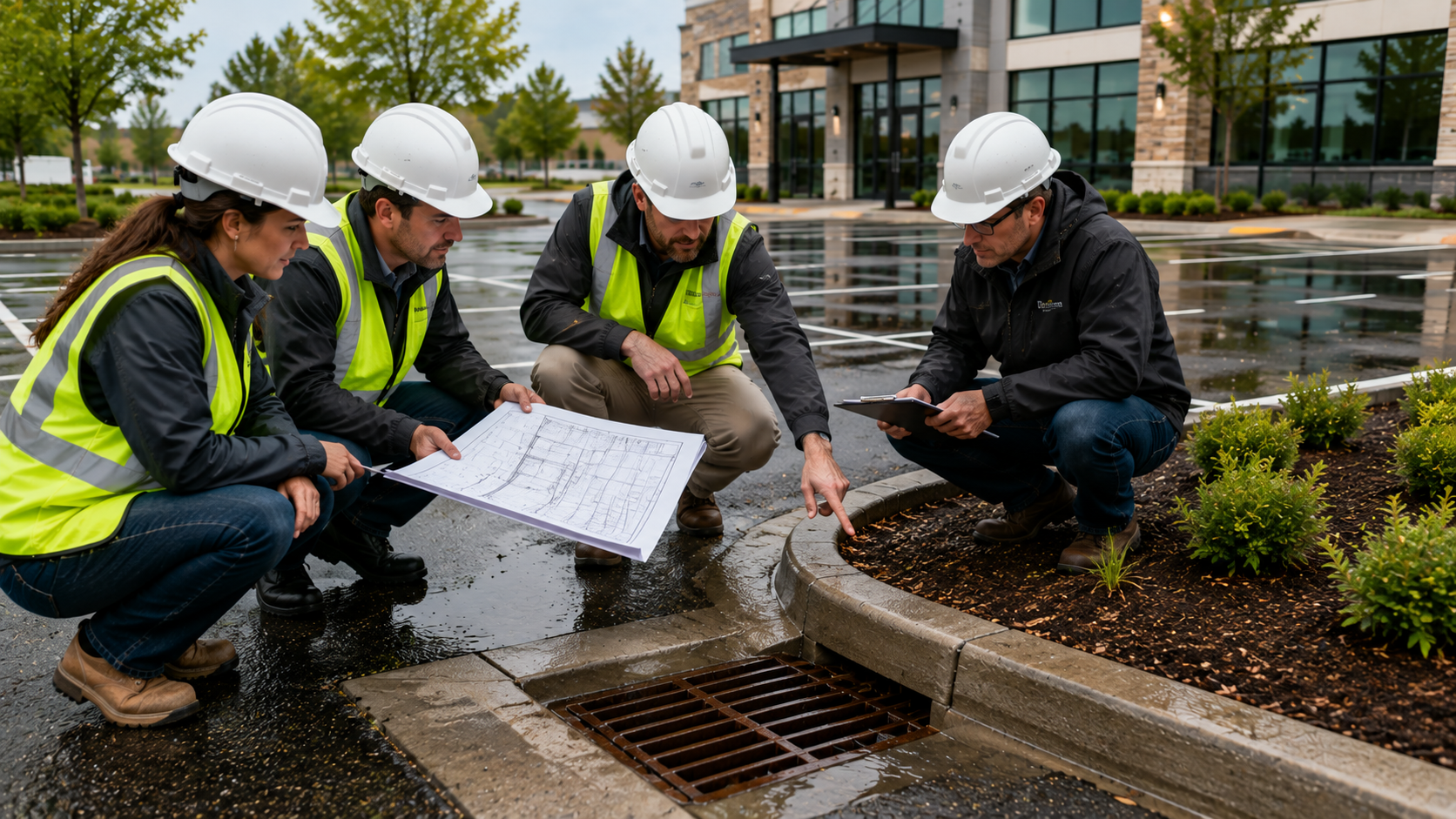
Useful records can include site plans, civil drawings, grading and drainage plans, utility plans, stormwater plans, construction specifications, contractor scopes, invoices, photographs taken during construction, and site observations.
CostSegRx engineers use those records to connect visible field conditions to the concealed drainage relationships that may no longer be observable after construction.
CostSegRx's engineering philosophy emphasizes that documentation supports conclusions. Drawings, site plans, specifications, contractor information, photographs, and field observations help establish what exists and how the components relate.
For owners planning new site work or major parking improvements, preserving those records can make future classification much easier.
It can also strengthen cost segregation audit readiness, because ATG 2025 expects a quality study to provide asset detail, recovery periods, rationale, and authority for its classifications.
Example: One Property, Two Drainage Stories
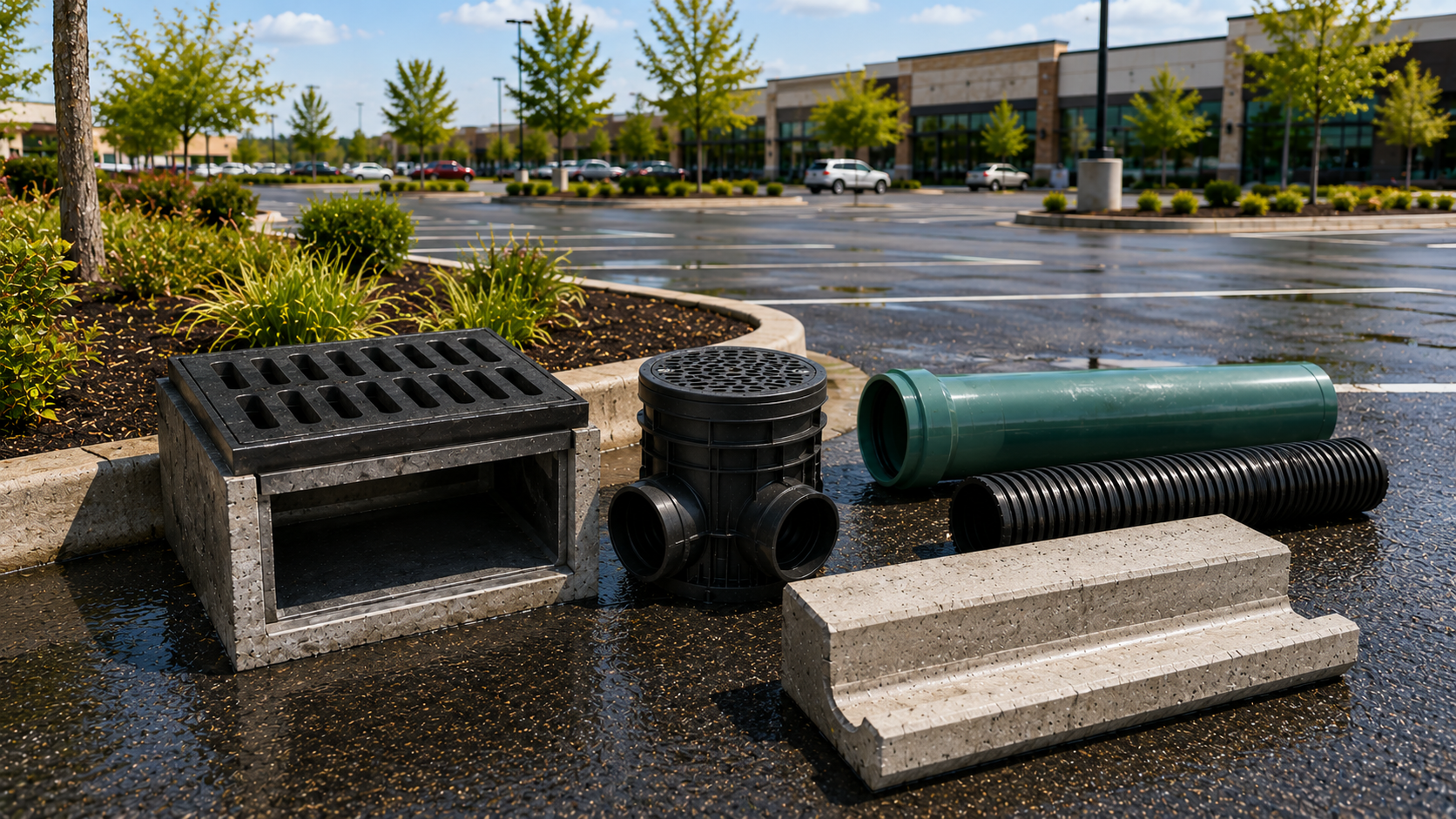
Consider a hypothetical commercial property with a large surface parking area.
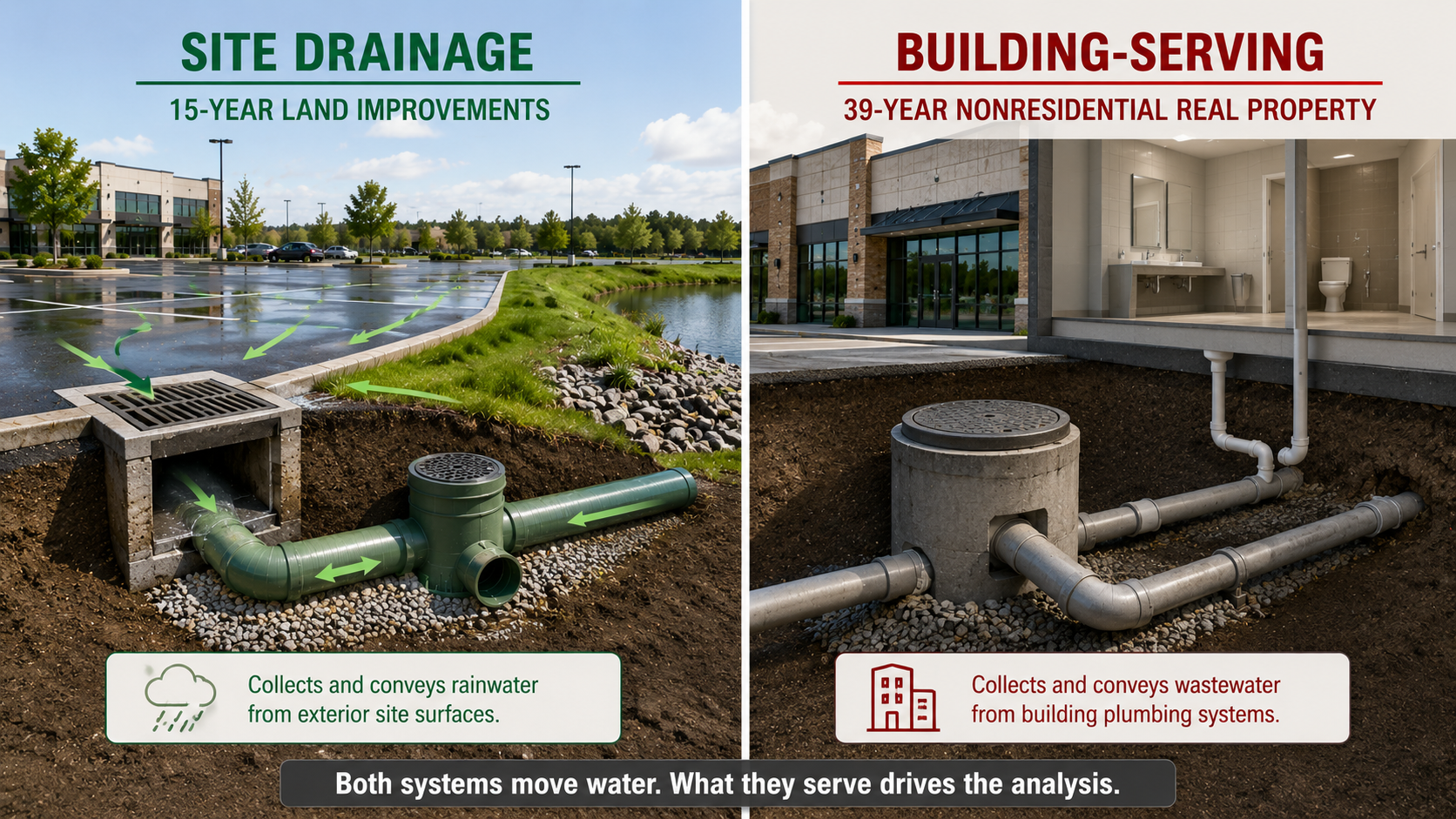
Rainwater falling on the parking lot is directed through the site's grading toward collection points. Underground storm piping then carries that site runoff through the property toward stormwater infrastructure.
Under the applicable ATG examples, site drainage and storm piping used to drain the site of rainwater can fall within Asset Class 00.3 as 15-year land improvements.
Now look at the building.
The roof has its own drainage components associated with the roof system. The property may also have sanitary sewer infrastructure serving the building.
Those systems should not automatically be combined with the parking-lot stormwater system merely because they all move water.
ATG 2025 provides the distinction: qualifying site drainage not directly related to the building can receive 15-year land improvement treatment, while applicable building-serving systems remain associated with 39-year nonresidential real property.
From above ground, an investor may see only a few drain openings.
CostSegRx engineers see two different drainage stories.
Follow the Water, Then Classify the System
Site drainage demonstrates why cost segregation cannot be reduced to a list of asset names.
"Drainage" can describe storm piping serving a parking area, a stormwater retention basin, grading associated with site improvements, a roof drainage component, or sanitary sewer infrastructure serving the building.
Those are not automatically the same asset.
ATG 2025 specifically supports qualifying site drainage, storm sewers, storm piping used to drain the site of rainwater, and certain stormwater infrastructure as 15-year land improvements. It also preserves different treatment for building-serving and sanitary sewer systems under applicable facts.
CostSegRx engineers follow the physical relationship.
Where does the water come from? What collects it? Where does it go? What does the system serve?
Follow the water, and the engineering story becomes much clearer.
Do you have a question about Cost Segregation?
Let us know how we can help
Your information is secure. We only use your details to answer your direct inquiry.