
Drive-Thrus: Following the Infrastructure Behind the Service Lane
Sep 22, 2026A drive-thru looks simple from the driver's seat: enter the lane, place an order, pay, pick up, and leave. From an engineering perspective, that short trip can cross several different property systems. The lane may involve pavement and curbs, order-taking equipment, signage, dedicated electrical connections, payment-processing equipment, a service window, and other building or site components. ATG 2025 does not treat all of those components as one asset simply because they work together as a drive-thru. For commercial real estate investors, the important lesson is to follow the infrastructure behind the service lane.
Wondering how much tax you could save with cost segregation? Let’s find out. Schedule a Cost Segregation Strategy Call today.
Key Takeaways
- A drive-thru is an operating system made from multiple physical assets.
- Engineers follow the customer path while tracing the equipment and infrastructure supporting it.
- One drive-thru project can contain 5-year property, 15-year land improvements, and 39-year nonresidential real property.
- Order systems, dedicated electrical, pavement, signage, and service windows create different classification questions.
- Owners can improve future analysis by separating drive-thru equipment, site work, and building work during construction.
- The order point and service window show why two connected parts of one drive-thru can receive different treatment.
- The drive-thru lane is the visible path through a much larger engineering system.
What Is Actually Part of a Drive-Thru?
The phrase "drive-thru" describes an operation, not one depreciable asset.
ATG 2025's restaurant matrix specifically defines drive-through equipment as systems used for order taking, food delivery, and payment processing, whether mechanical or electronic. Under the restaurant guidance, that equipment is 5-year property in Asset Class 57.0.
The same guidance makes an important exclusion.
Building elements such as drive-through doors, bays, and windows are not included within the drive-through equipment category. Exterior windows, including drive-through service windows, are treated as building components.
Now move outward from the building.
Restaurant parking lots, including associated curb cuts, curb work, striping, landscape islands, fences, and sidewalks, are identified as 15-year land improvements. Restaurant site work not directly related to the building, including curbing, paving, roads, sidewalks, and site drainage, is also included within 15-year land improvements under the applicable guidance.
The result is a useful engineering lesson.
A drive-thru may operate as one customer experience while consisting of several different depreciable assets. CostSegRx engineers look beyond the drive-thru label and identify the individual physical assets that make the operation possible.
That is consistent with the broader principle behind engineering asset classification: engineers classify what is physically present and what it serves rather than relying on a project label.
How Engineers Follow the Service Lane
A useful way to investigate a drive-thru is to follow the same path as the customer while looking beyond what the customer sees.
Start with the exterior lane.
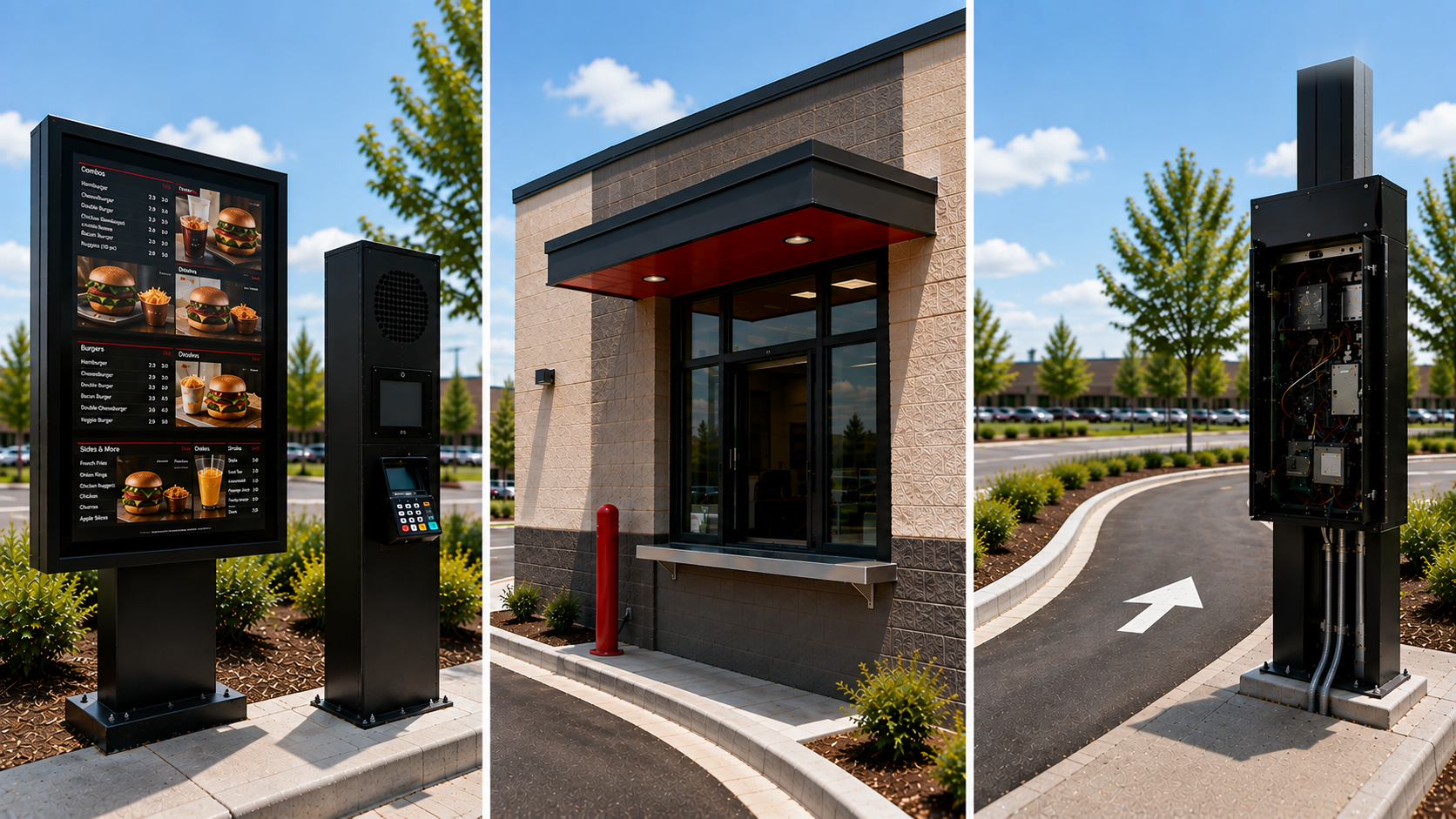
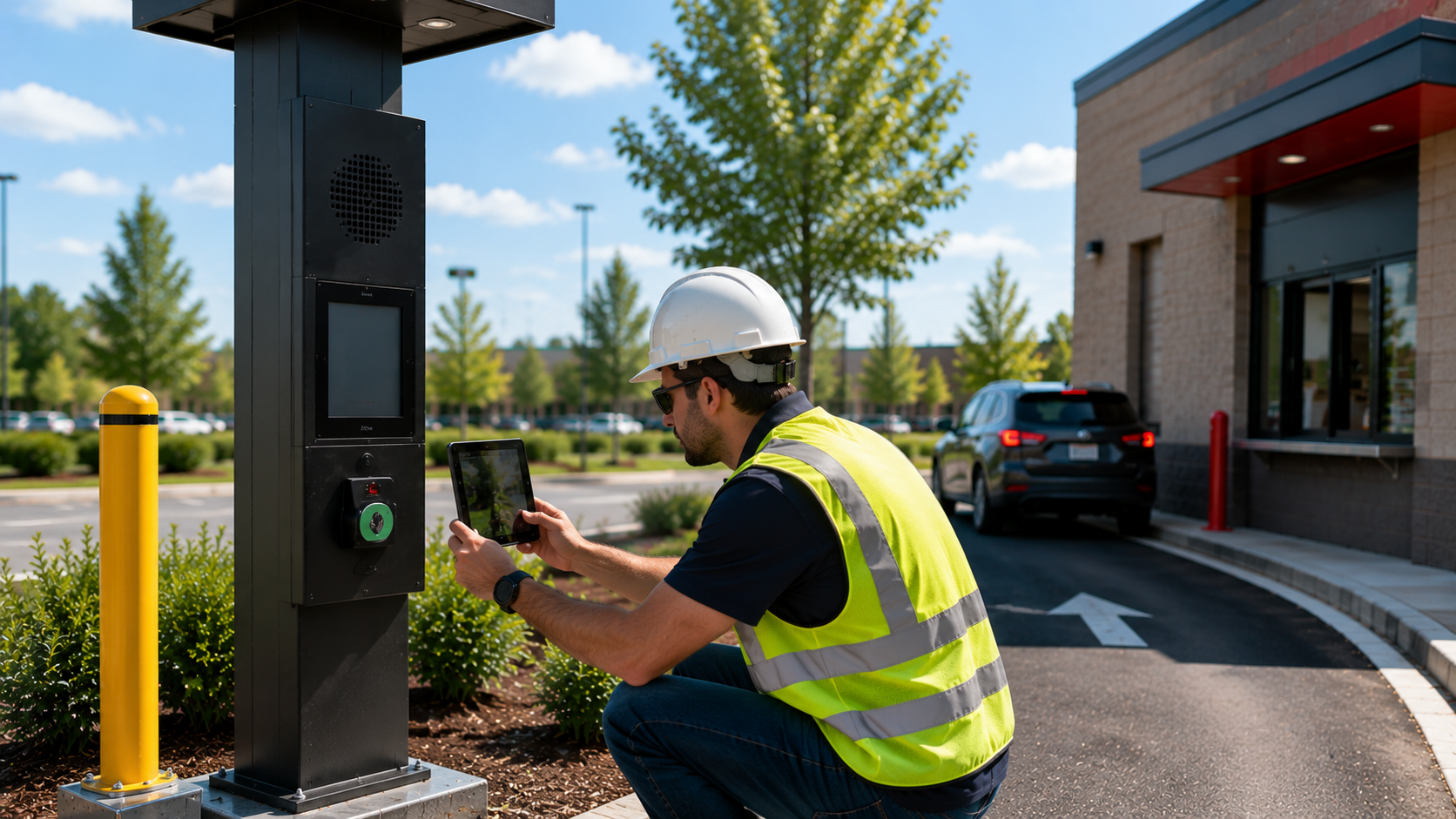
The engineer may encounter pavement, curbs, traffic patterns, site signage, and the physical order point. The order point can involve equipment used to communicate with the restaurant and support the ordering process.
But the visible device is not necessarily the entire engineering story.
If drive-through equipment requires special electrical connections necessary to and used directly with that specific equipment, ATG 2025's restaurant matrix separately recognizes dedicated outlets, wiring, conduit, and circuit breakers associated with specific machinery or equipment as 5-year property. General building electrical remains 39-year nonresidential real property.
That means CostSegRx engineers may trace a relationship such as:
Drive-thru equipment → dedicated connection → wiring or conduit → electrical distribution point
The existence and extent of that relationship must be established from the actual property and supporting records. It should not be assumed merely because equipment is present.
Continue down the lane and the customer eventually reaches the building itself.
At that point, the analysis can move from business-use equipment and site improvements to structural building components such as the exterior wall and drive-through service window.
This is the same functional approach discussed in MEP Systems in Cost Segregation: 39-Year vs 5-Year Property. The trade category alone does not determine classification. What the system serves matters.
Why One Drive-Thru Can Have Three Recovery Periods
Drive-thrus make recovery-period differences unusually easy to visualize.
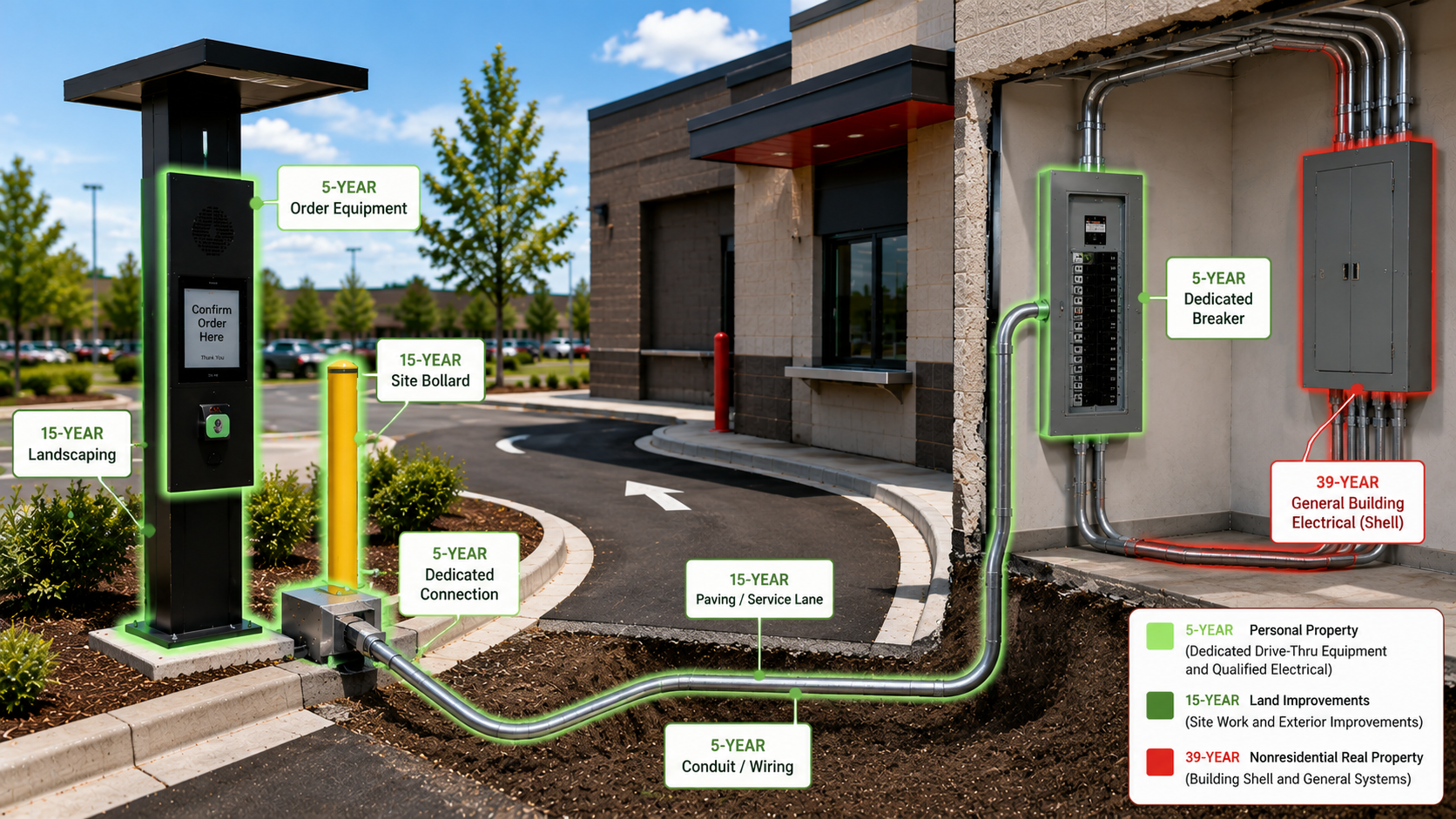
At the order point, qualifying drive-through order-taking equipment can be 5-year property under the restaurant matrix. Qualifying dedicated electrical serving specific equipment can also be 5-year property when the applicable facts are established.
Under the vehicle, the lane itself may consist of paving, curbs, striping, and related site improvements. Applicable restaurant guidance identifies those types of parking and site improvements as 15-year land improvements.
At the building, the drive-through window remains part of the building rather than becoming 5-year drive-through equipment simply because customers use it during the transaction.
That gives the investor three different categories within one operating environment:
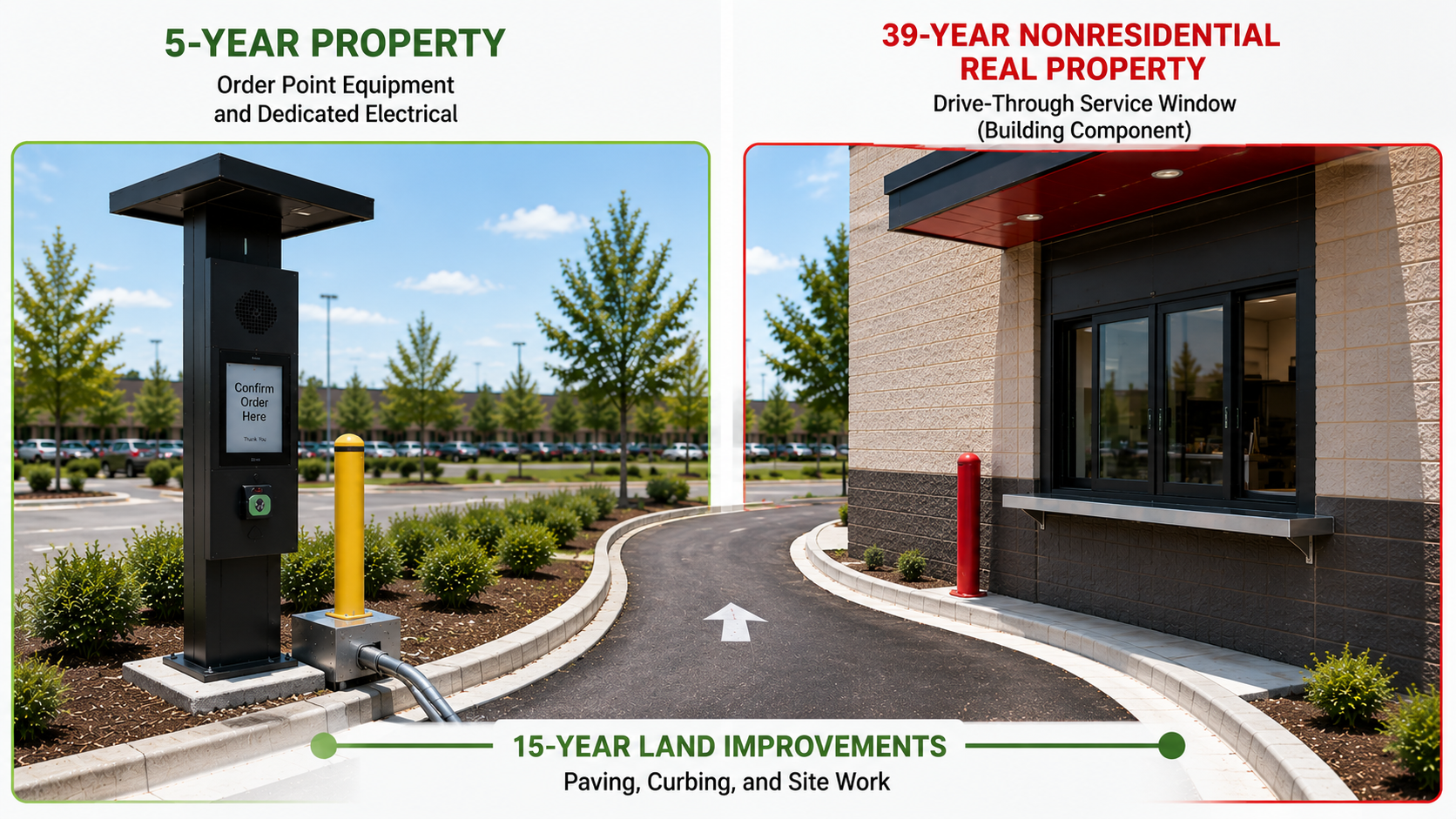
5-year property: qualifying drive-through equipment and qualifying dedicated electrical.
15-year land improvements: qualifying exterior paving, curbing, and related site work.
39-year nonresidential real property: the building and applicable building components, including the drive-through service window.
This is why a contractor line item called "Drive-Thru Package" may not provide enough information for an engineering-based classification.
CostSegRx engineers break that broader scope into the physical components that can be identified and supported.
The package has to be understood.
Where the Drive-Thru System Creates Different Questions
Order-Taking Equipment
The order point is one of the clearest business-use components.
ATG 2025 specifically includes order-taking systems within drive-through equipment and identifies the category as 5-year property under Asset Class 57.0.
The engineering investigation should still establish what equipment is actually present rather than assuming a standardized configuration. CostSegRx engineers document the installed condition and classify the equipment supported by the property-specific facts.
Payment-Processing and Delivery Systems
Payment processing and food-delivery systems are also specifically included within the ATG restaurant definition of drive-through equipment.
This reinforces the idea that the operating equipment is distinct from the structural opening through which the transaction occurs.
Dedicated Electrical
Electrical is where the visible drive-thru can lead to concealed engineering depth.
ATG 2025 distinguishes general building electrical from special electrical connections necessary to and used directly with specific machinery or equipment. Under the restaurant matrix, qualifying dedicated outlets, wiring, conduit, and circuit breakers can be 5-year property.
For CostSegRx engineers, that can mean following the electrical relationship beyond the visible drive-thru equipment to determine what the electrical infrastructure actually serves.
For investors who want a deeper look at this issue, Electrical Distribution Systems in Cost Segregation Studies explains why engineers trace electrical systems by function rather than assuming every circuit receives the same treatment.
Menu and Identity Signage
Restaurant signage introduces another supported distinction.
ATG 2025 identifies interior and exterior signs used for menu display or theme identity as 5-year property under Asset Class 57.0. For pylon signs, that category includes only the sign face, with the supporting structure evaluated separately.
A drive-thru menu display can therefore be part of the broader business-use environment, but CostSegRx engineers identify the actual asset and construction rather than assume every sign in a drive-thru receives the same treatment.
Pavement, Curbs, and Site Work
The service lane itself can represent a substantial physical improvement.
Restaurant guidance identifies grade-level parking areas and associated curbs, curb cuts, striping, landscape islands, perimeter fences, and sidewalks as 15-year land improvements. Site work not directly related to the building is likewise identified with Asset Class 00.3.
This connects the drive-thru to the larger category of 15-year land improvements.
Drive-Thru Windows and Building Openings
The service window creates perhaps the most useful contrast in the entire article.
ATG 2025 expressly excludes building elements such as doors, bays, and windows from the drive-through equipment category. Applicable guidance treats drive-through service windows as building components.
The customer may think of the window as part of the drive-thru equipment.
The engineering classification does not depend on that perception.
Separate the Drive-Thru Scope During Construction
Drive-thrus are easiest to analyze when the construction records preserve the individual scopes.
A new restaurant or drive-thru renovation may involve civil work, paving, curbing, electrical work, signage, communications equipment, payment equipment, building openings, and other construction occurring within the same project.
If all of those costs are collapsed into one line item called "drive-thru," valuable engineering detail can disappear.
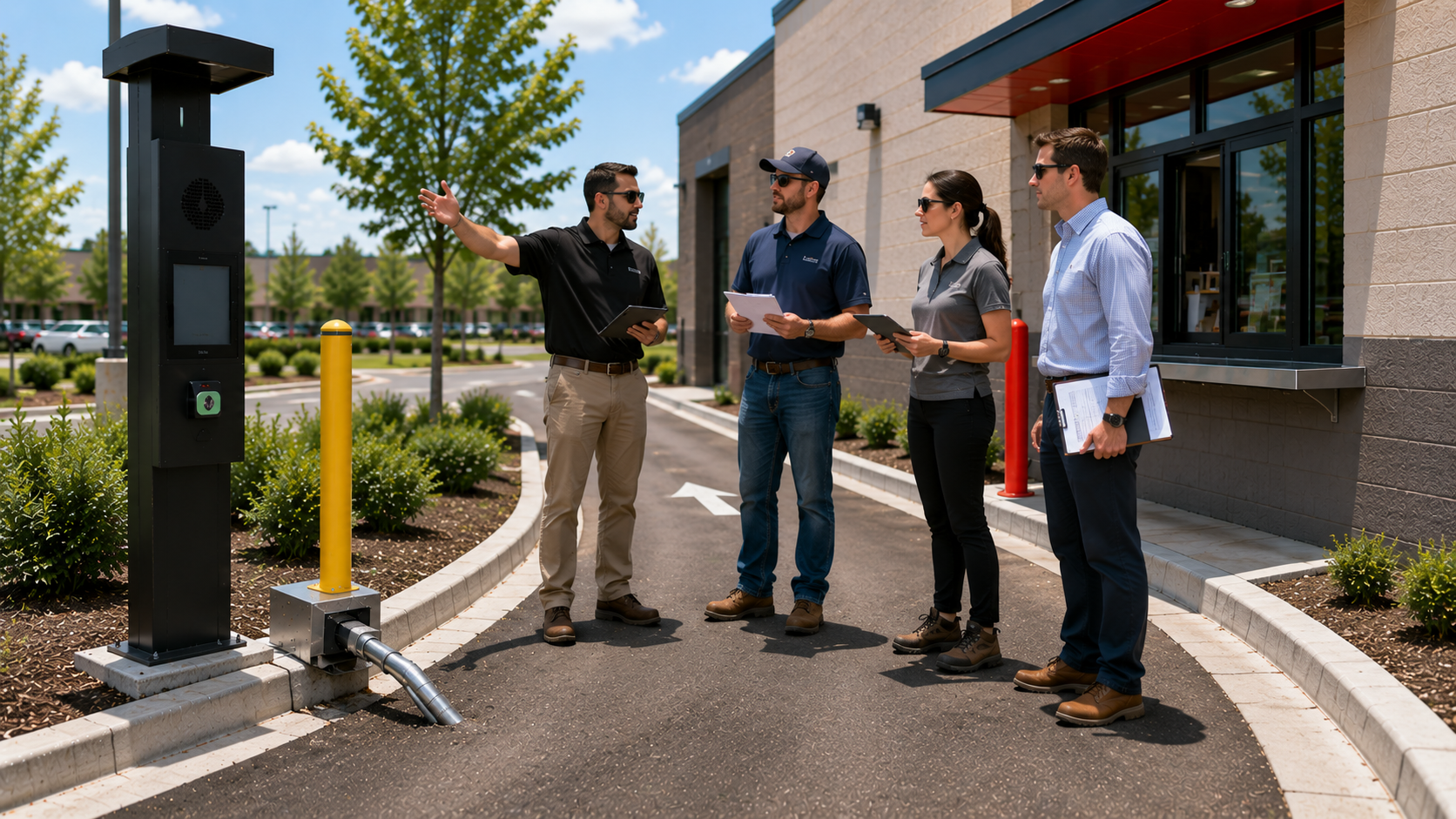
Owners and developers should preserve available site plans, civil drawings, electrical drawings, equipment schedules, signage information, contractor scopes, invoices, change orders, photographs, and final construction records.
For dedicated electrical, records can help CostSegRx engineers establish whether the connection serves specific drive-through equipment or is simply part of the restaurant's general electrical system.
For site work, drawings can help identify pavement, curb geometry, site improvements, and relationships outside the building.
For equipment, schedules and invoices can help separate the actual operating system from the building components surrounding it.
This is particularly useful during restaurant cost segregation, where the restaurant's business-specific infrastructure can extend well beyond the kitchen.
Good records allow CostSegRx engineers to reconstruct what was built instead of relying on a broad project label.
Example: The Order Point vs. the Service Window
Consider a hypothetical quick-service restaurant with a drive-thru.
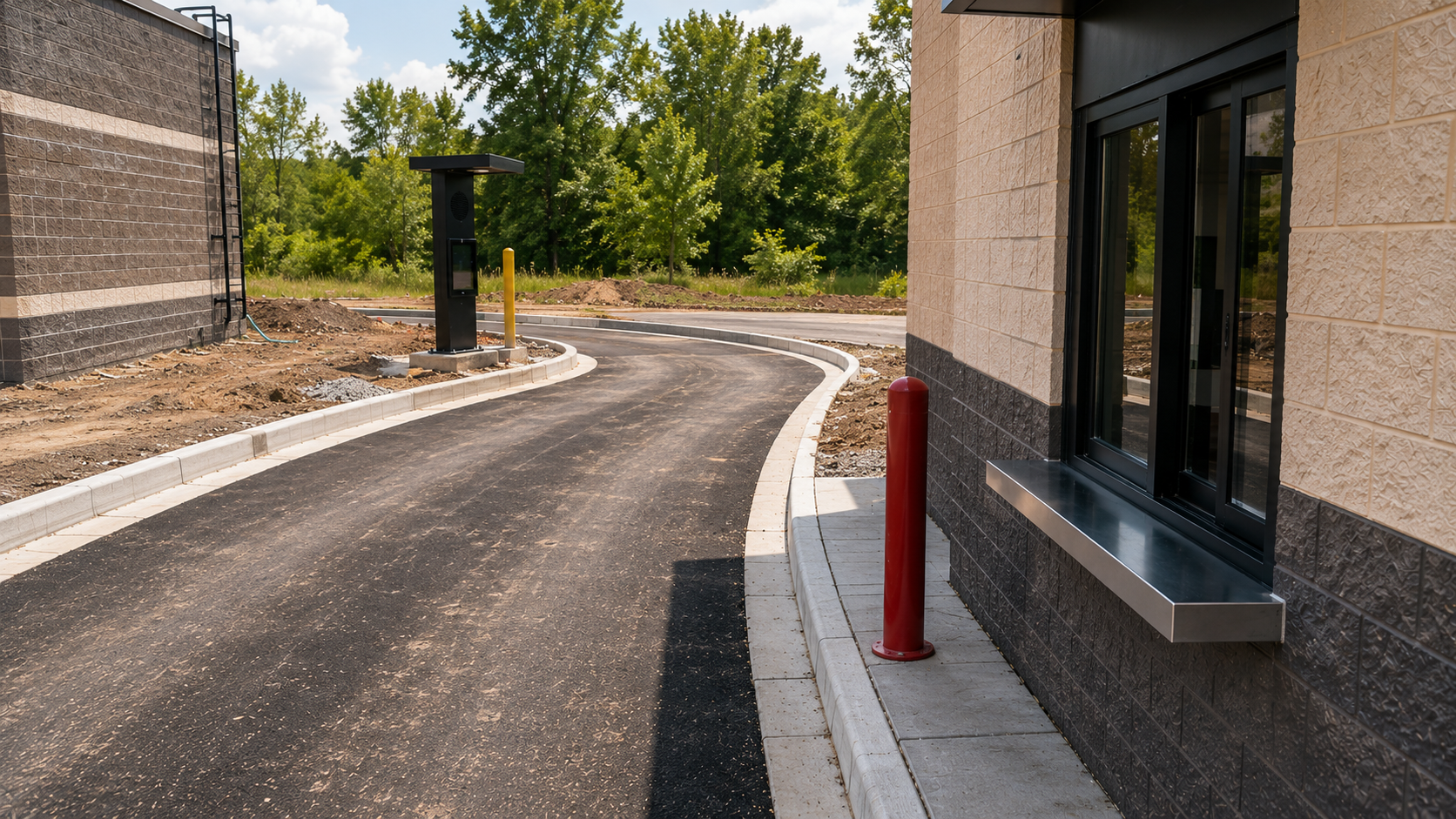
A customer enters a paved service lane and stops at the order point. The restaurant uses an electronic order-taking system to communicate with the customer. Assume the engineering review also establishes qualifying dedicated electrical connections used directly with that equipment.
Under the applicable restaurant guidance, the drive-through order-taking equipment is 5-year property. The qualifying dedicated electrical serving the specific equipment can also be 5-year property.
The customer then follows the paved lane to the restaurant.
Applicable paving, curbs, and related exterior site work can fall within 15-year land improvements under the restaurant matrix.
Finally, the customer reaches the drive-through service window.
That window is not included in the 5-year drive-through equipment category. It remains a building component and, for the nonresidential restaurant in this example, is associated with 39-year nonresidential real property.
One customer transaction has now moved through three different engineering categories.
The customer sees one drive-thru.
CostSegRx engineers see the equipment, supporting infrastructure, site improvements, and building components behind the operation.
Follow the Lane, Then Follow the Infrastructure
A drive-thru is a good reminder that commercial real estate operates as a collection of interconnected systems.
The pavement creates the path. The order equipment supports the transaction. Dedicated infrastructure may serve that equipment. Signage communicates information. The building provides the service opening. Each component contributes to the same business operation without necessarily receiving the same tax treatment.
ATG 2025 provides clear support for separating qualifying 5-year drive-through equipment and dedicated electrical, 15-year land improvements, and 39-year nonresidential real property building components in applicable restaurant fact patterns.
That is why CostSegRx engineers do more than identify the lane.
They follow the infrastructure behind it.
Do you have a question about Cost Segregation?
Let us know how we can help
Your information is secure. We only use your details to answer your direct inquiry.