
The STR Loophole: Using Real Estate Losses to Offset W-2 Income
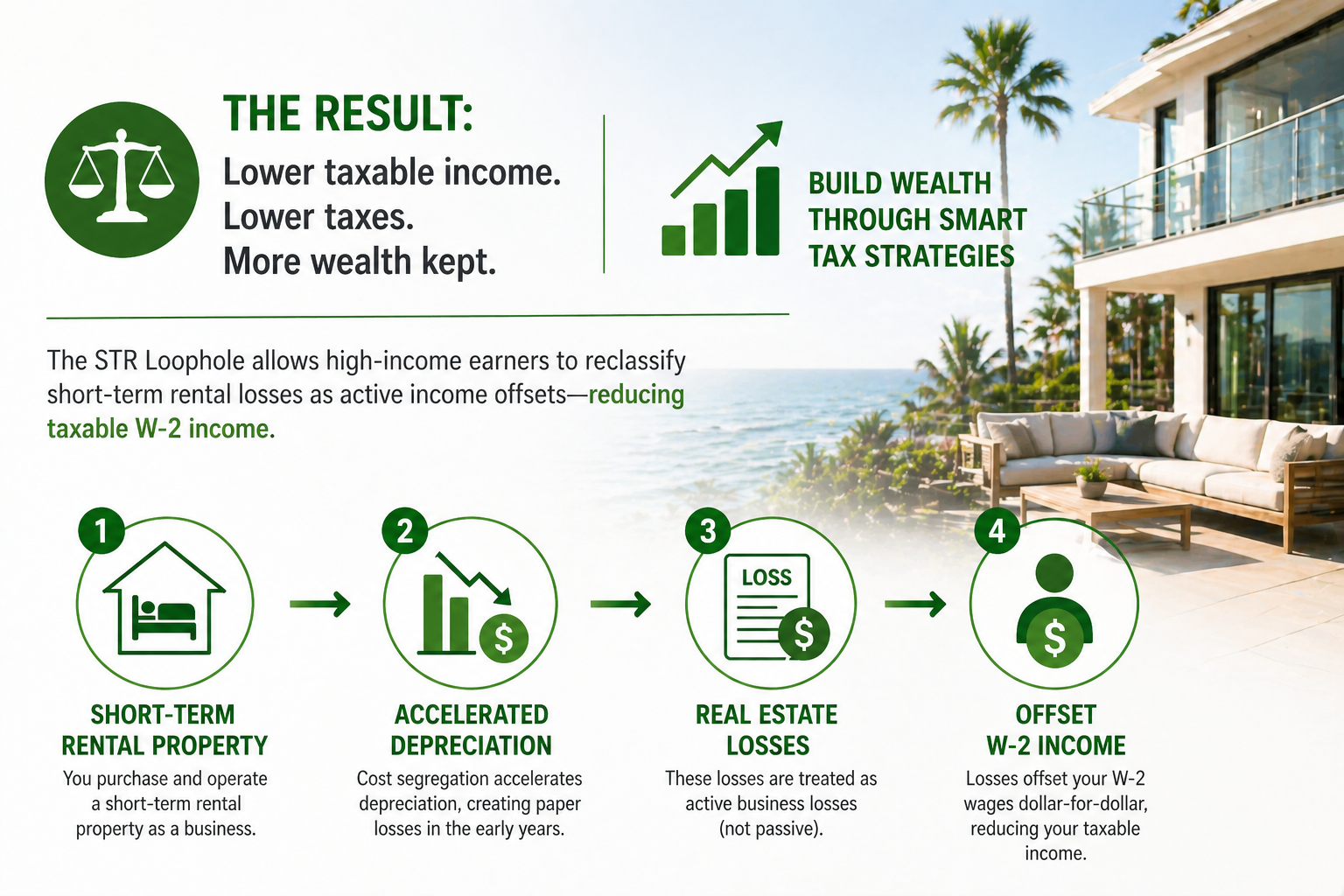
May 14, 2026High-income earners often face a structural limitation in the tax code. While real estate offers powerful depreciation benefits, passive activity loss rules typically prevent those losses from offsetting W-2 income. The STR loophole creates a narrow but highly effective exception. When executed correctly, it allows investors to reclassify rental losses as active, unlocking significant tax savings.
Key Takeaways
- The STR loophole allows short-term rental losses to offset W-2 income
- Material participation is the key requirement for qualification
- High-income earners can unlock otherwise suspended losses
- Short-term rentals must meet specific average stay thresholds
- Cost segregation accelerates losses to maximize tax impact
- Passive loss limitations do not apply when properly structured
- Time tracking and documentation are critical for compliance
- This strategy can dramatically improve after-tax cash flow
What Is the STR Loophole
The STR loophole refers to a tax strategy that allows losses from short-term rental properties to be treated as non-passive. Under standard IRS rules, rental real estate is considered passive, meaning losses cannot offset active income such as W-2 wages. However, short-term rentals with an average guest stay of seven days or less are not automatically classified as rental activities.
This distinction allows qualifying properties to bypass passive activity limitations. Instead, they are treated more like an operating business. When combined with material participation, this creates a pathway to use real estate losses against ordinary income.
Investors exploring this approach often pair it with cost segregation benefits to further enhance deductions and front-load depreciation.
How the STR Loophole Works
To qualify for the STR loophole, two primary conditions must be met. First, the property must have an average rental period of seven days or less, or in some cases up to 30 days with significant services provided. Second, the taxpayer must materially participate in the activity.
Material participation is defined through several IRS tests, but the most common threshold is 500 hours per year. Alternatively, participation can qualify if the taxpayer’s involvement exceeds that of any other individual.
This is where execution becomes critical. Investors must maintain detailed logs, calendars, and operational records to substantiate their involvement. Without this documentation, the IRS may reclassify the activity as passive.
When structured properly, this strategy integrates well with bonus depreciation and cost segregation, allowing investors to generate significant first-year losses.

Why the STR Loophole Matters for Investors
The primary value of the STR loophole lies in its ability to unlock tax losses that would otherwise be suspended. For high-income professionals, passive losses are often carried forward indefinitely with limited immediate benefit.
By converting these losses into active losses, investors can directly offset W-2 income. This creates a meaningful reduction in taxable income and improves overall investment efficiency.
The difference between passive and active classification can significantly impact returns. A properly executed strategy can turn a marginal deal into a high-performing investment by improving after-tax cash flow.
For investors comparing approaches, understanding the differences in cost segregation vs straight-line depreciation is essential to quantify the advantage.

Where the STR Loophole Applies
The STR loophole is most commonly applied to vacation rentals, Airbnb properties, and other short-term lodging assets. Markets with strong seasonal demand and high occupancy rates tend to produce the best results.
However, not all short-term rentals qualify. Properties with longer average stays or minimal owner involvement may fail to meet the requirements. Additionally, local regulations and zoning laws can impact feasibility.
This strategy is particularly effective when combined with properties that have a high concentration of 5-year property, as these assets generate accelerated depreciation deductions.
Investors should also evaluate renovation opportunities, where improvements may qualify under Qualified Improvement Property rules to further enhance deductions.

Strategic Execution for Maximum Tax Impact
Executing the STR loophole requires coordination between tax planning, property selection, and operational discipline. The most successful investors approach this as a system rather than a one-time tactic.
First, asset selection should prioritize properties with strong short-term rental demand and operational flexibility. Second, a cost segregation study should be performed early to maximize depreciation timing. Investors should carefully consider when to perform a cost segregation study to align deductions with income.
Third, documentation must be treated as a core component of the strategy. Time logs, booking records, and management activities should be consistently tracked.
Finally, investors must avoid common pitfalls outlined in cost segregation strategy mistakes, as improper classification or weak documentation can eliminate the intended tax benefits.

Accelerating Losses: A Sample STR Scenario
Consider a high-income earner purchasing a short-term rental property with a $1.5 million basis. Through a cost segregation study, 30 percent of the property is reclassified into shorter recovery periods. With bonus depreciation applied, the investor generates approximately $450,000 in first-year losses.
If the investor materially participates and qualifies under the STR loophole, those losses can be used to offset W-2 income. At a 37 percent tax rate, this results in a potential tax savings of over $160,000 in the first year alone.
Without the STR classification, these losses would remain passive and provide no immediate tax benefit.
Turning Active Participation into Tax Efficiency
The STR loophole is not a workaround or aggressive interpretation. It is a structured application of existing tax rules that rewards active involvement in short-term rental operations.
For investors willing to meet the participation requirements and maintain proper documentation, the strategy offers a powerful way to align real estate investments with broader tax planning goals. As depreciation benefits evolve, precision in execution will determine who captures the full value of this approach.
Do you have a question about Cost Segregation?
Let us know how we can help
Your information is secure. We only use your details to answer your direct inquiry.