

Site Lighting: When Exterior Electrical Becomes a Land Improvement
Aug 25, 2026Two exterior light fixtures can illuminate the same parking lot and still belong to different depreciation classes. One may be mounted directly to the building, while another stands on a pole in the parking area. To an investor reviewing an electrical invoice, both may simply look like "exterior lighting." To an engineer, their physical relationship to the property, function, installation, and supporting electrical infrastructure tell a more useful story. That distinction is why site lighting is a good example of a fundamental cost segregation principle: engineers classify assets, not contractor categories.
Wondering how much tax you could save with cost segregation? Let’s find out. Schedule a Cost Segregation Strategy Call today.
Key Takeaways
- Site lighting and building-mounted lighting are not necessarily the same asset class.
- Engineers evaluate location, function, installation, and electrical service.
- Correct classification can change the depreciation recovery period.
- Parking lots, walkways, and commercial sites show the distinction clearly.
- Good drawings and CapEx records make site lighting easier to document.
- A simple lighting project shows why separating costs matters.
- The electrical trade label never tells the entire classification story.
What Makes Site Lighting Different?
Site lighting generally refers to pole-mounted or freestanding outdoor lighting used to illuminate areas such as parking lots, sidewalks, and recreation areas. The IRS Cost Segregation Audit Technique Guide identifies this type of lighting under Asset Class 00.3, which has a 15-year recovery period. The ATG also identifies electrical branch circuits powering outdoor lighting systems for sidewalks, parking, or recreation areas under Asset Class 00.3.
That does not mean every fixture located outdoors becomes 15-year land improvements.
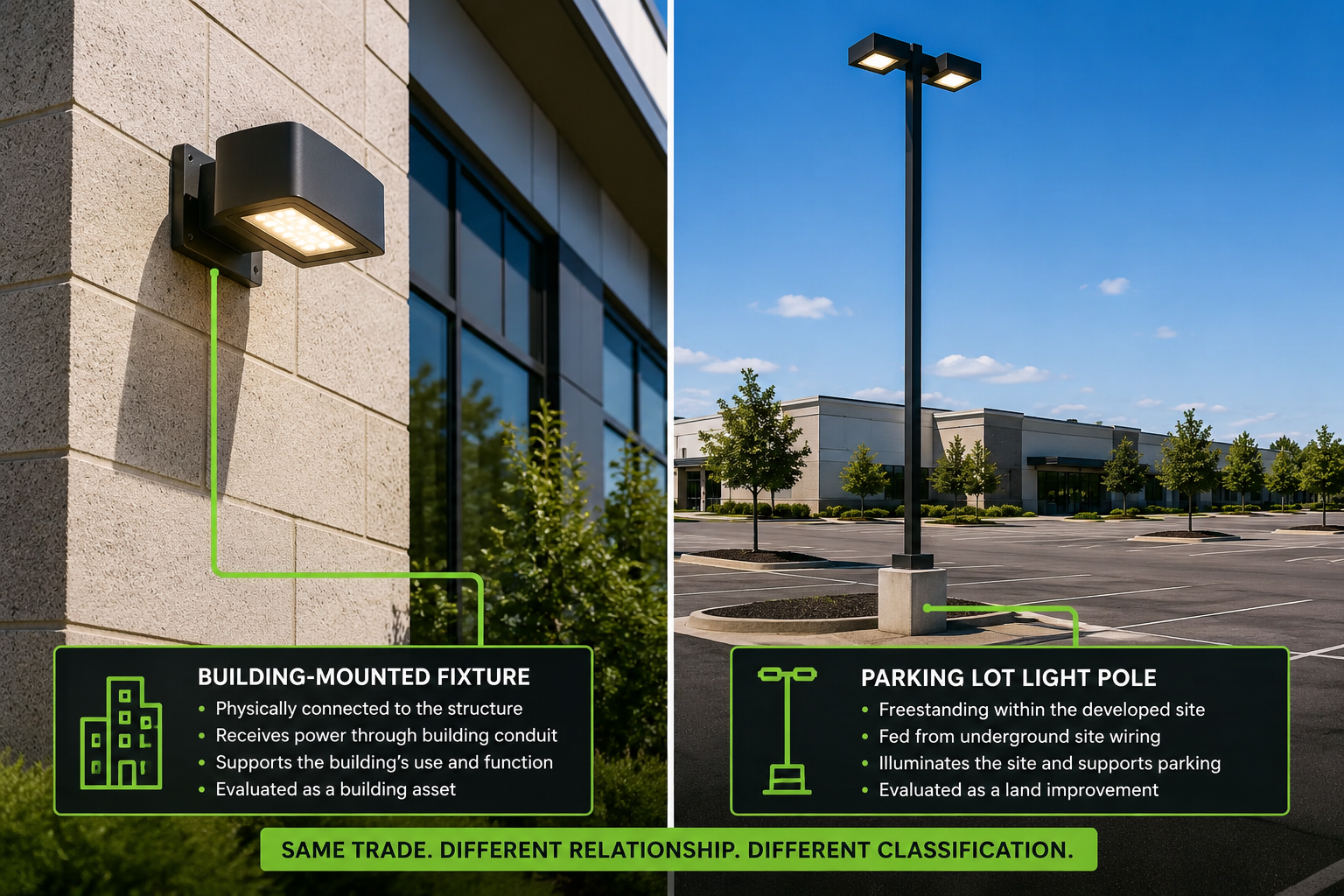
The ATG separately identifies exterior lighting fixtures mounted on a nonresidential building and used to illuminate walkways, entrances, and similar areas as building property with a 39-year recovery period. This is the distinction investors need to understand. "Exterior lighting" describes where a fixture is used. It does not, by itself, establish how the asset should be classified.
This reflects the broader principle behind MEP asset classification: engineers evaluate what an installed system actually does and how it relates to the property rather than assuming everything installed by one trade receives identical treatment.
How Engineers Analyze Site Lighting
A CostSegRx engineer does not begin with the assumption that every line item labeled "site lighting" belongs in the same depreciation class. The analysis begins with the physical property.
Where is the fixture installed? Is it attached to the building or supported by a freestanding pole? What area does it illuminate? How is the pole installed? What electrical branch circuit serves it? Which panels, conduit, wiring, and controls are associated with the system?
Those questions turn a contractor's electrical scope into an engineering inventory.
For pole-mounted or freestanding site lighting, the engineer may review civil drawings, electrical plans, site plans, fixture schedules, invoices, photographs, and field conditions. The ATG specifically recommends field inspection for quality studies and identifies site lighting among the land improvements that should be documented during that inspection.
The electrical side deserves equal attention. A site lighting system may involve more than the visible pole and fixture. Branch wiring, conduit, controls, and related electrical infrastructure may need to be traced so the engineer understands what those components actually support. That same functional approach is central to electrical distribution systems in cost segregation.
This is why the electrical contractor's invoice is useful documentation, but not the final classification methodology. Contractors build electrical systems. Engineers determine how individual assets function within the property.

Why the Distinction Matters to Investors
For a commercial property, building-mounted exterior lighting associated with building operation or maintenance may remain 39-year nonresidential real property, while qualifying pole-mounted or freestanding site lighting may fall within Asset Class 00.3 as 15-year land improvements.
The difference affects when depreciation deductions are recognized.
But the larger lesson is not simply that one category depreciates faster. The lesson is that a commercial property contains multiple assets performing different jobs. A parking lot, light pole, building-mounted wall pack, electrical feeder, landscaping system, and building structure may all appear on the same property and may even be installed during the same construction project. That does not make them one depreciation asset.
This is where engineering-based cost segregation becomes valuable. Instead of treating the property as one large building cost, the study identifies what actually exists and develops supportable classifications from the property facts.
That approach also supports a stronger quality cost segregation study. The ATG describes quality studies as accurate and well documented, with asset classifications, supporting rationale, and substantiated cost basis.

Where Investors Commonly Encounter Site Lighting
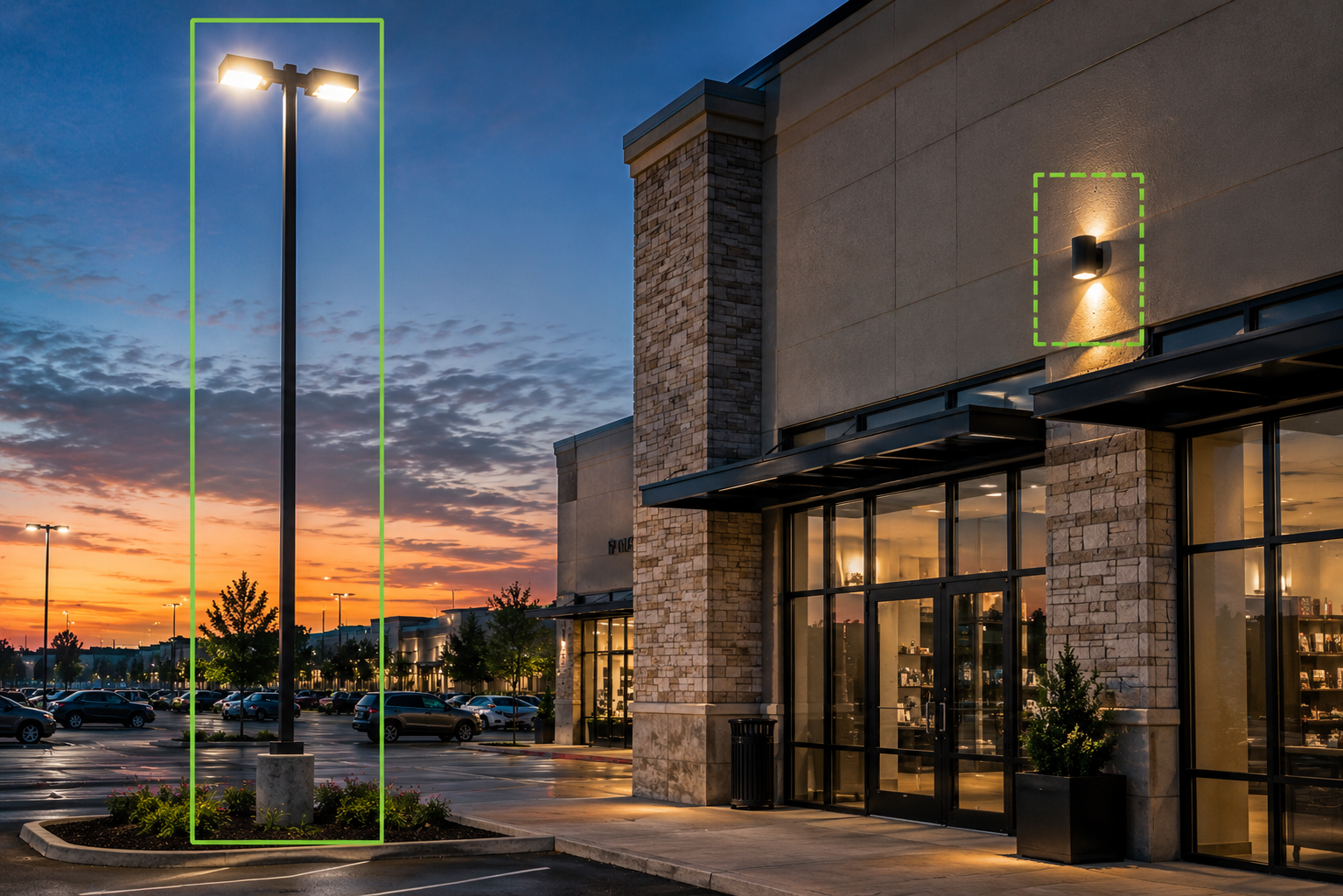
Consider a neighborhood shopping center. Wall-mounted fixtures may illuminate tenant entrances and the sidewalk immediately adjacent to the building. Farther into the parking field, freestanding poles illuminate parking stalls and vehicle circulation areas.
Those lights may have been installed by the same electrical contractor.
They may appear under the same electrical division in the construction documents.
They may even be controlled from related electrical equipment.
But their physical relationships to the property are different. The wall-mounted fixtures serve the building, while the freestanding poles are part of the developed site. The ATG specifically distinguishes building-mounted exterior lighting from pole-mounted or freestanding lighting used for parking, sidewalks, and recreation areas.
The same issue can appear at self-storage facilities, industrial properties, hotels, restaurants, medical facilities, apartment communities, dealerships, and other properties with substantial exterior areas.
It becomes particularly important for properties with significant site infrastructure. Investors who own these properties should understand that 15-year land improvements can include more than paving and sidewalks. The electrical infrastructure serving those improvements also deserves engineering attention.

A Better Ownership Strategy for Site Lighting
The best time to document site lighting is when the information is easy to obtain.
During new construction, retain electrical drawings, civil plans, lighting schedules, contractor scopes, change orders, and invoices. If parking lot lighting is added later, record what was installed, where it was installed, why the project was completed, and which electrical infrastructure was added or modified.
Those records become part of the property's capital improvement history.
For an acquired property, documentation may be more limited. In that situation, field analysis becomes especially important. An engineer can inspect the lighting layout, identify freestanding poles and building-mounted fixtures, examine accessible electrical infrastructure, compare field conditions with available plans, and develop the engineering basis for the study.
This is also why investors should resist percentage-based assumptions. A study should not simply decide that a certain percentage of "electrical" is site lighting. The ATG cautions against unsupported standard electrical percentages and emphasizes functional analysis and supporting documentation for electrical allocations.
The better question is: What electrical assets are actually serving the site lighting?
That question produces a defensible engineering conclusion instead of a convenient estimate.

Financial Example: One Lighting Project, Two Classifications
Illustrative example only. Figures shown are estimated for demonstrative purposes only. Actual land allocations, asset classifications, depreciation, and tax results depend on the specific property, supporting documentation, engineering analysis, and taxpayer circumstances.
Assume an investor acquires a commercial property where the engineering analysis identifies $80,000 of exterior lighting-related depreciable basis.
After reviewing the site, drawings, electrical information, and installation conditions, the engineer determines that $20,000 relates to building-mounted exterior fixtures serving entrances and building walkways. The remaining $60,000 relates to qualifying pole-mounted site lighting and its associated site electrical components serving the parking area.
The lesson is not that $60,000 should automatically be classified as site lighting on another property. It should not.
The lesson is that separating the assets allows the property facts to drive the analysis. In this illustration, the $20,000 associated with building-mounted lighting would remain 39-year nonresidential real property, while the $60,000 supported as qualifying site lighting would be classified as 15-year land improvements.
If the investor's accounting records simply contained an $80,000 "exterior electrical" line item, that engineering distinction could easily disappear.
Good documentation preserves it.
The Electrical Label Is Only the Starting Point
Site lighting demonstrates why cost segregation cannot be reduced to reading contractor invoices and assigning depreciation classes by trade.
Two fixtures can both be outdoors. Both can illuminate the same general property. Both can be installed by the same electrical contractor. Yet their classification may differ because their installation and relationship to the property differ.
CostSegRx engineers start with the physical assets, trace what they support, review the available documentation, and then develop the classification.
That is the principle worth remembering: the electrical label tells you who installed the asset. Engineering tells you what the asset actually is.
Do you have a question about Cost Segregation?
Let us know how we can help
Your information is secure. We only use your details to answer your direct inquiry.