
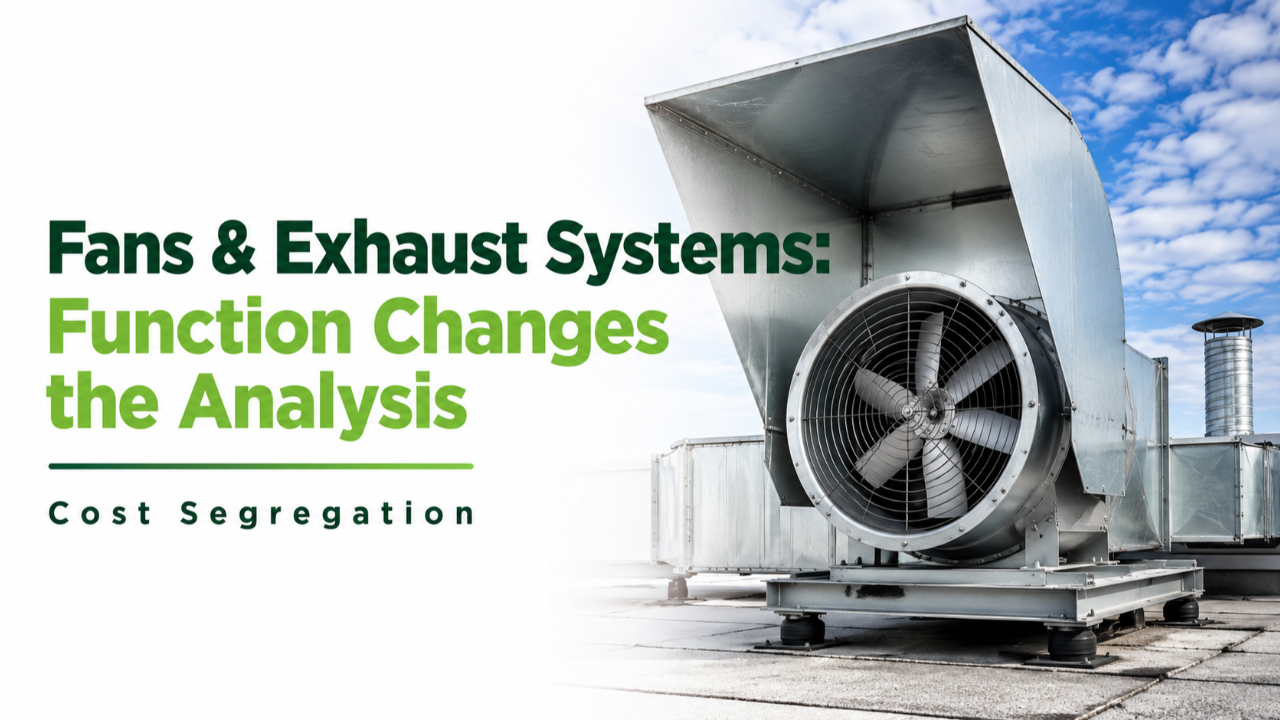
Fans & Exhaust Systems: Function Changes the Analysis
Oct 08, 2026Fans are everywhere in real estate, but the word “fan” tells an engineer surprisingly little about how an asset should be classified. A decorative ceiling fan in an apartment, a bathroom exhaust fan, a commercial kitchen exhaust system, and a warehouse ventilation fan can all move air while serving fundamentally different functions. Their relationship to the building, its occupants, specialized equipment, and a business process can matter more than their superficial similarity. That is why a cost segregation study should begin by identifying what the fan actually does and what system it belongs to. CostSegRx engineers approach these components as physical systems first and classification questions second.
Wondering how much tax you could save with cost segregation? Let’s find out. Schedule a Cost Segregation Strategy Call today.
Key Takeaways
- A fan's name or appearance does not determine its depreciation classification.
- Engineers trace what the fan serves and whether it belongs to general building ventilation or a specialized system.
- Similar-looking fans can require different treatment because their physical functions are different.
- Residential, bathroom, restaurant, and warehouse fans illustrate why property context and function both matter.
- Documentation should identify the fan, its system, its function, and relevant connections before classification.
- A commercial kitchen exhaust system provides a useful comparison with general building ventilation.
- Defensible classification starts with the physical system, not the word “fan.”
What Are We Actually Calling a Fan?
At its simplest, a fan is mechanical equipment that moves air. That description is not enough for cost segregation because the equipment can perform very different jobs.
Consider four conditions:
A ceiling fan in a residential rental unit may circulate room air and incorporate lighting. A bathroom exhaust fan may remove moisture and odors as part of the dwelling's ventilation. A commercial kitchen exhaust system may remove heat, smoke, grease-laden vapors, and other cooking-related contaminants from an equipment area. A large warehouse fan or exhaust system may provide general ventilation for the building, or in a different fact pattern it may support a specialized process.
These differences are why engineering asset classification starts with function rather than an asset label.
ATG 2025 provides useful examples of this principle. In its residential rental property guidance, a ceiling fan typically equipped with attached lighting, where that lighting is generally the primary artificial illumination in the room, is treated as § 1250 property and 27.5-year residential rental property. The same residential guidance treats a built-in stove hood as part of the ventilation system of the unit or building, also within 27.5-year residential rental property.
The lesson is important: decorative appearance, a motor, spinning blades, or the ability to move air does not independently create 5-year property.
Follow the Airflow and the Function
When engineers encounter a fan, they need to understand the larger system.
What space does it serve? Why was it installed? Is it circulating or exhausting air for ordinary occupants? Is it part of the building's general ventilation? Does it serve specific machinery or equipment? Is it part of a specialized exhaust arrangement? What other components are necessary for that system to function?
That system-level analysis is especially important for MEP systems cost segregation.
General building HVAC can include fans along with air-handling equipment, ductwork, heating and cooling equipment, and other components. ATG industry guidance describes building HVAC as systems serving the operation or maintenance of the building and providing general ventilation, heating, or cooling. In the nonresidential industry example, those building systems are treated as 39-year nonresidential real property.
This is particularly relevant to warehouse exhaust.
A wall-mounted or roof-mounted warehouse exhaust fan should not be assumed to be 5-year property simply because it is industrial-looking or moves a large volume of air. If the system provides general building ventilation, that function points toward treatment as a building component. A specialized system serving a particular process requires separate analysis, and industry-specific ATG examples should not be transferred automatically to a different property or business.
The physical investigation comes first.
Why Commercial Kitchen Exhaust Is Different
Commercial kitchens demonstrate how function can change the analysis.
The restaurant guidance in ATG 2025 distinguishes central HVAC serving purposes such as customer comfort and ventilation from certain specialized kitchen systems. General restaurant HVAC is identified as a building component and 39-year nonresidential real property.
The same restaurant guidance separately addresses kitchen equipment hook-ups. It includes an equipment exhaust hood and a ventilation system or kitchen air makeup unit when the system is solely maintaining specific ventilation requirements essential to the operation of kitchen equipment. That restaurant-specific condition is identified as § 1245 property in Asset Class 57.0, with 5-year treatment.
That distinction is more meaningful than simply asking whether the property contains a kitchen fan.
It asks what the ventilation system actually serves.
This is why restaurant kitchen infrastructure classifications can require detailed engineering review. A restaurant may contain general comfort HVAC, restroom exhaust, kitchen exhaust, makeup air, equipment connections, and other mechanical systems. Those components should not automatically be grouped together simply because a mechanical contractor installed them.
Four Fan Applications, Four Engineering Questions
Residential Decorative Ceiling Fans
ATG 2025 specifically addresses ceiling fans in its residential rental property matrix. A typical ceiling fan with attached lighting, where the lighting is generally the primary artificial illumination in the room, is identified as § 1250 property and 27.5-year residential rental property.
Calling the fan decorative does not override that guidance. Decorative appearance alone is not a classification test.
Bathroom Exhaust Fans
A bathroom exhaust fan generally raises a different physical question. The engineer needs to determine whether the fan is functioning as part of the building's ordinary ventilation for the occupants and space.
ATG 2025 states that residential HVAC systems primarily installed for the temperature, humidity, and ventilation of the residence and its occupants are building components.
The ATG material reviewed for this article does not provide a separate bathroom-exhaust-fan classification entry. Accordingly, the classification should not be invented from the asset name. The actual system and applicable residential guidance need to be considered.
Commercial Kitchen Exhaust
Restaurant kitchen exhaust can present a materially different condition. Where the restaurant-specific requirements are satisfied, ATG 2025 identifies equipment exhaust hoods and ventilation or kitchen air makeup systems solely maintaining ventilation requirements essential for kitchen equipment as 5-year property.
That conclusion should not be generalized to every kitchen fan. In the residential rental matrix, for example, a built-in stove hood is treated as part of the unit or building ventilation system and as 27.5-year residential rental property.
Two pieces of equipment can both sit over cooking appliances and still require different analysis because the authoritative fact patterns are different.
Warehouse Exhaust Fans
Warehouse ventilation requires the same discipline.
If an exhaust system serves general building ventilation, an industrial setting does not by itself convert it into equipment. ATG guidance for building HVAC specifically includes fans and describes general building ventilation systems as building structural components.
Specialized process ventilation may present another question, but the facts and applicable industry authority must support that conclusion. For example, ATG 2025 separately identifies specialized body-shop and service-area exhaust removal systems in its auto dealership guidance. That is an industry-specific example, not permission to classify every warehouse exhaust fan the same way.
Build the Classification From Physical Evidence
For property owners, the practical strategy is not to create a list labeled “fans” and assign one recovery period to the entire category.
Instead, document each relevant system according to what it actually does.
CostSegRx engineers may evaluate the equipment location, function, areas served, relationship to other equipment, available mechanical drawings, visible connections, and other physical evidence relevant to the classification question. The goal is to establish whether the component belongs to general building service or whether authority supports treating a specialized condition differently.
That approach also improves cost segregation audit readiness. A defensible study can explain why a classification was reached rather than relying on an equipment name or a broad assumption.
This becomes particularly important when a property has several ventilation systems. A restaurant, industrial facility, mixed-use building, or warehouse can contain multiple fans serving different purposes. Grouping all of them together can erase the physical distinctions that matter.
Example: Four Fans That Should Not Be Grouped Together
Imagine an engineering inventory identifies four fan-related conditions across different properties.
The first is a typical ceiling fan with integrated lighting in a residential rental unit. ATG 2025 specifically places the described residential condition in § 1250 and 27.5-year residential rental property.
The second is a bathroom exhaust fan serving ordinary residential ventilation. Rather than assuming a result because it is called an exhaust fan, the engineer evaluates it within the residential ventilation system and the applicable building-component guidance.
The third is an equipment exhaust hood in a restaurant kitchen. If the actual installation satisfies the restaurant-specific ATG condition for ventilation essential to kitchen equipment, the ATG identifies that condition as 5-year property.
The fourth is a warehouse exhaust fan providing general ventilation to the building. Its large size, industrial construction, or roof location does not establish shorter-life treatment. General building ventilation points toward treatment as part of 39-year nonresidential real property, subject to the actual property facts and applicable authority.
The engineering lesson is not that one type of fan is always favorable and another is not. It is that four assets capable of moving air can occupy four different functional contexts, and those contexts must be understood before classification.
Start With What the Fan Serves
Fans are a useful reminder that cost segregation is not classification by appearance.
A decorative ceiling fan, bathroom exhaust fan, restaurant equipment exhaust hood, and warehouse exhaust fan may share motors, blades, housings, electrical connections, or the basic purpose of moving air. Those similarities do not answer the tax question.
The more important question is what each system does within the property.
When CostSegRx engineers trace the physical function first, they can distinguish general building ventilation from supported specialized equipment conditions without forcing a desired result. That is the foundation of a defensible engineering-based cost segregation study.
Do you have a question about Cost Segregation?
Let us know how we can help
Your information is secure. We only use your details to answer your direct inquiry.