
Marina Cost Segregation: Where Waterfront Infrastructure Matters
Jun 30, 2026Marinas are not typical commercial properties. Investors may focus on slips, waterfront access, occupancy, storage income, and boating demand, but a cost segregation engineer sees a much more complex asset environment. Docks, gangways, shore power, pump-out systems, boat storage, fuel infrastructure, service areas, utilities, paving, fencing, lighting, and waterfront improvements can all require detailed review. That is why marina cost segregation depends on engineering analysis, documentation, and asset-specific classification rather than broad property labels.
Wondering how much tax you could save with cost segregation? Let’s find out. Schedule a Cost Segregation Strategy call today.
Key Takeaways
- Understand why marinas require infrastructure-focused cost segregation
- See how engineers classify waterfront marina assets
- Learn why marina infrastructure can affect cash flow
- Review common marina assets that need deeper analysis
- Plan documentation around docks, utilities, and storage areas
- See how marina basis can shift across classifications
- Use engineering support for waterfront property decisions
Why Marina Cost Segregation Starts With Infrastructure
A marina cost segregation study evaluates how the property functions as a waterfront business. Unlike a basic office or retail building, a marina may include land-based improvements, floating or fixed waterfront systems, utility distribution, boat storage, service areas, fuel systems, and customer facilities.
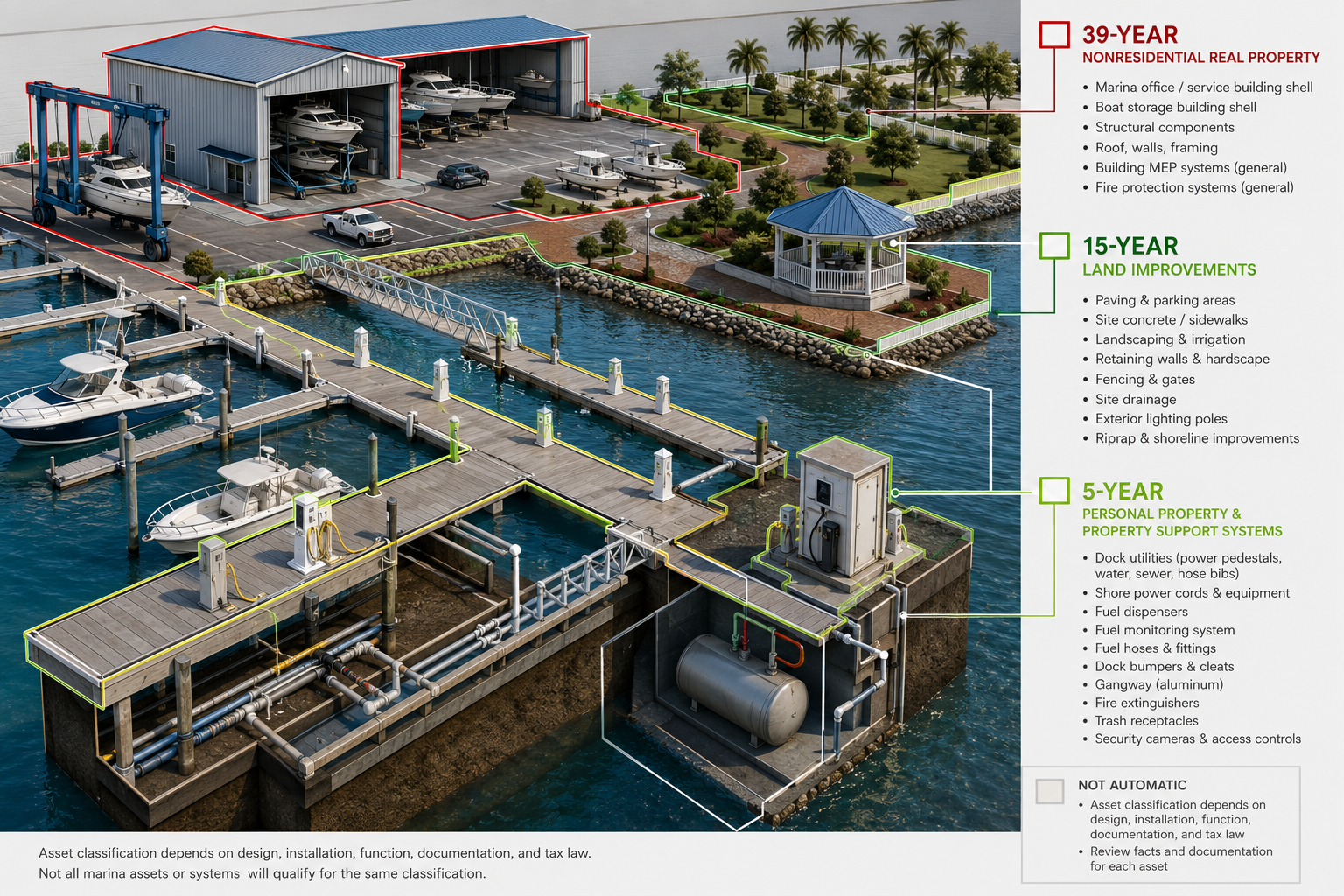
The tax classification is not based only on whether an asset is near the water. Engineers review what the asset is, how it is installed, what it supports, and whether it is better classified as 5-year property, 15-year land improvements, QIP 15-year property when applicable, or 39-year nonresidential real property.
This is why marinas fit naturally into the broader category of land improvement heavy cost segregation. Many marina properties contain substantial exterior and waterfront infrastructure that can materially affect the depreciation analysis when properly documented.
How Engineers Classify Waterfront Marina Assets
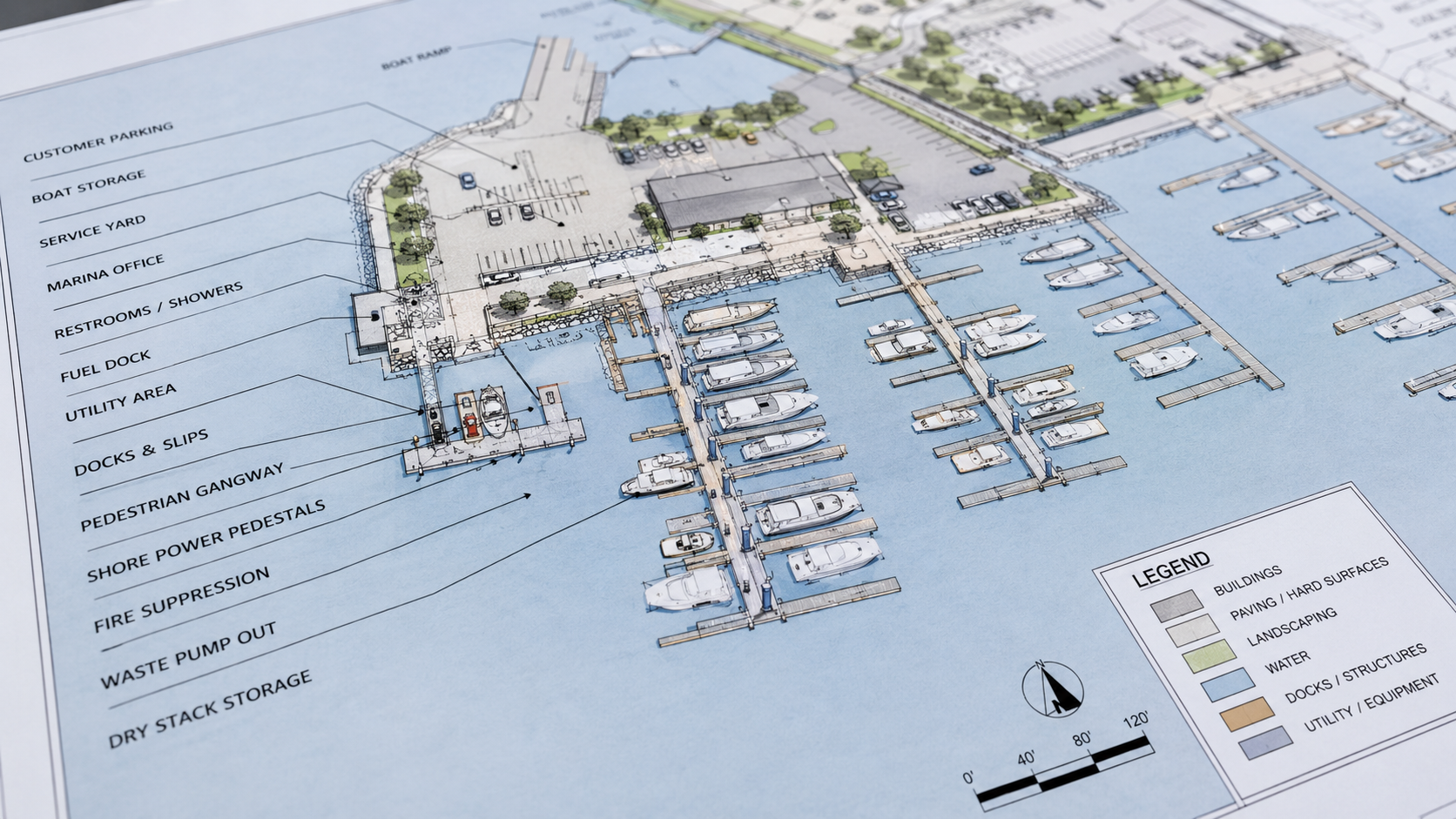
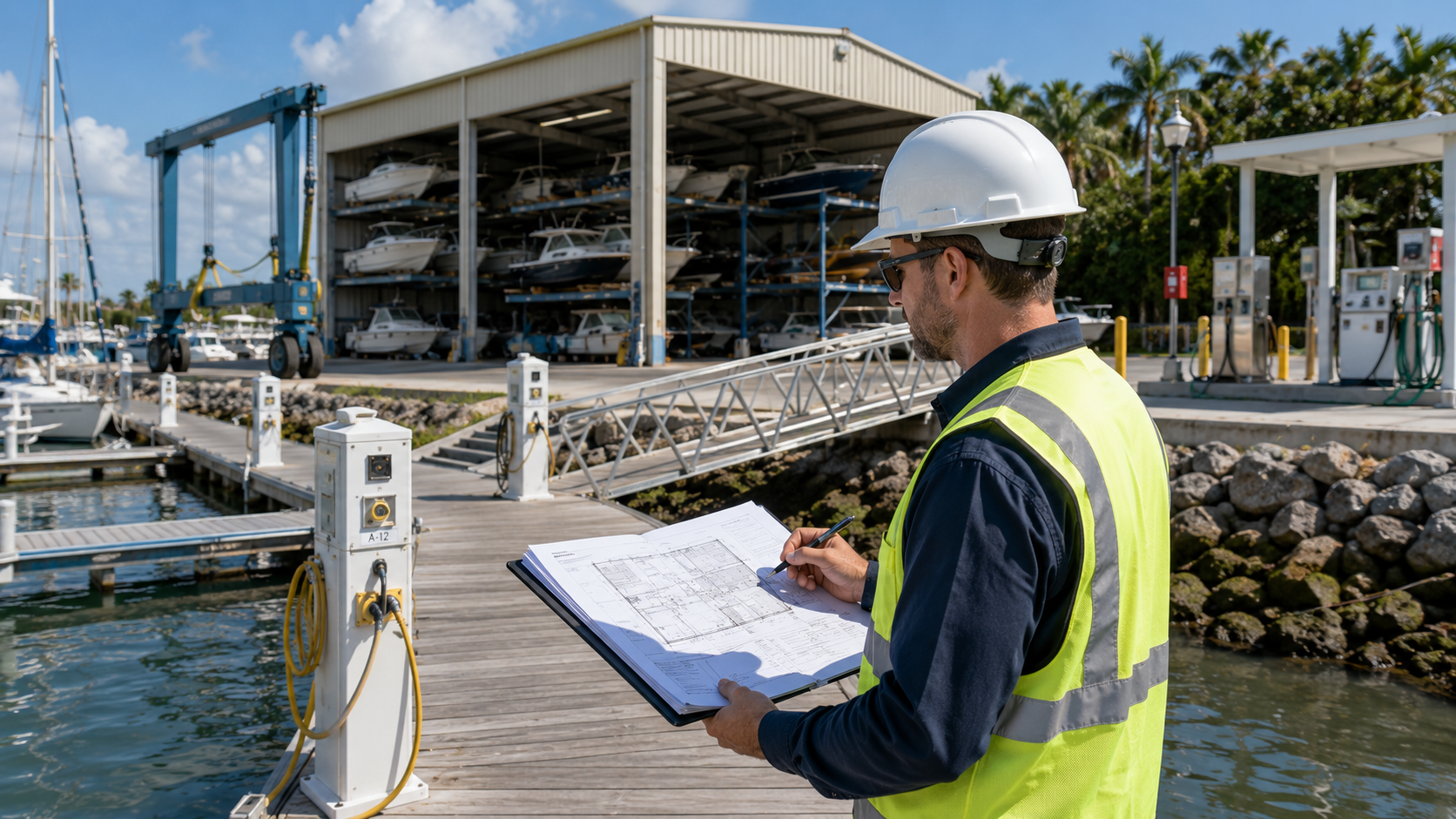
Marina classification is fact-specific. A cost segregation study may review fixed docks, floating docks, finger piers, gangways, dock utilities, shore power systems, water service, pump-out stations, fuel infrastructure, boat ramps, dry storage areas, service facilities, and site improvements.
Some assets may be evaluated as 5-year property when they function as tangible personal property or directly support qualifying equipment. Other assets may be evaluated as 15-year land improvements when they are depreciable improvements made directly to or added to land. Buildings, structural components, marina offices, restrooms, shower facilities, and general building systems generally remain 39-year nonresidential real property.
The important point is that no marina asset should be classified by name alone. A dock, utility system, boat storage component, or service feature may require detailed review of design, installation, function, documentation, and applicable tax treatment.
Why Marina Infrastructure Matters for Investor Cash Flow
Marinas often involve large capital investments outside the main office or clubhouse. A significant portion of value may sit in waterfront infrastructure, utility systems, exterior improvements, boat storage, and operational support assets.
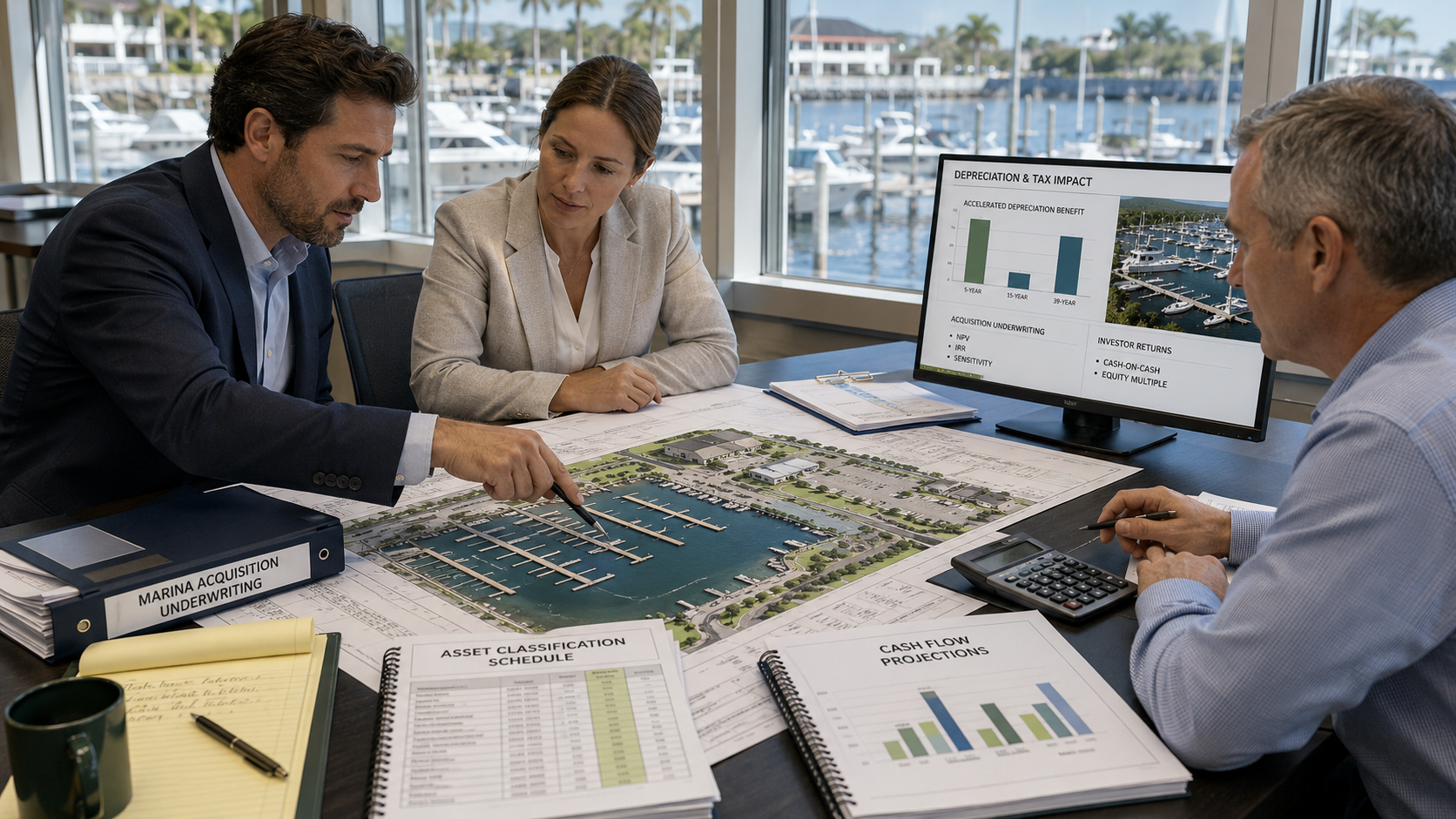
If those costs are grouped into broad building or site categories without analysis, the depreciation schedule may not reflect how the property actually operates. Proper classification can improve early-year deductions, cash-flow planning, acquisition underwriting, and return modeling.
The goal is not to force every waterfront asset into a favorable classification. The goal is to identify what legitimately qualifies based on facts and engineering support. This is the same reason a quality cost segregation study should explain methodology, asset descriptions, cost support, and classification logic clearly.
What Engineers Look for in Marina Properties
Marina studies can vary widely because no two waterfront properties are exactly alike. A small recreational marina, a dry-stack boat storage facility, a full-service marina with fuel and repairs, and a mixed-use waterfront property can all produce different classification questions.
Docks, Slips, and Gangways
Fixed docks, floating docks, finger piers, ramps, gangways, and slip systems may require careful review. The classification depends on construction, attachment, function, asset design, and supporting documentation.
Shore Power and Dock Utilities
Marinas often include electrical distribution and water service running to slips or service areas. Engineers may evaluate whether portions support general site operations, customer use, or qualifying equipment. This can overlap with broader concepts discussed in electrical distribution systems in cost segregation.
Fuel and Pump-Out Systems
Fuel docks, tanks, dispensers, pumps, piping, and pump-out systems often require asset-specific review. These systems may be central to marina operations, but their classification depends on how each component functions and is installed.
Boat Storage and Service Areas
Dry-stack storage, covered storage, open storage yards, service bays, wash-down areas, marine travel lifts, and hoist support systems can create unique classification questions. Boat storage facilities may also share planning concepts with self-storage cost segregation, especially where site improvements, access, and storage infrastructure drive value.
Site Improvements
Parking lots, trailer storage areas, fencing, security gates, site lighting, drainage, landscaping, signage, and exterior concrete may be evaluated as possible 15-year land improvements when supported.
Buildings and Customer Facilities
Marina offices, clubhouses, ship stores, restaurants, restrooms, shower facilities, and storage buildings may include assets in multiple classes, but structural components and general building systems usually remain 39-year nonresidential real property.
How to Plan a Marina Cost Segregation Study
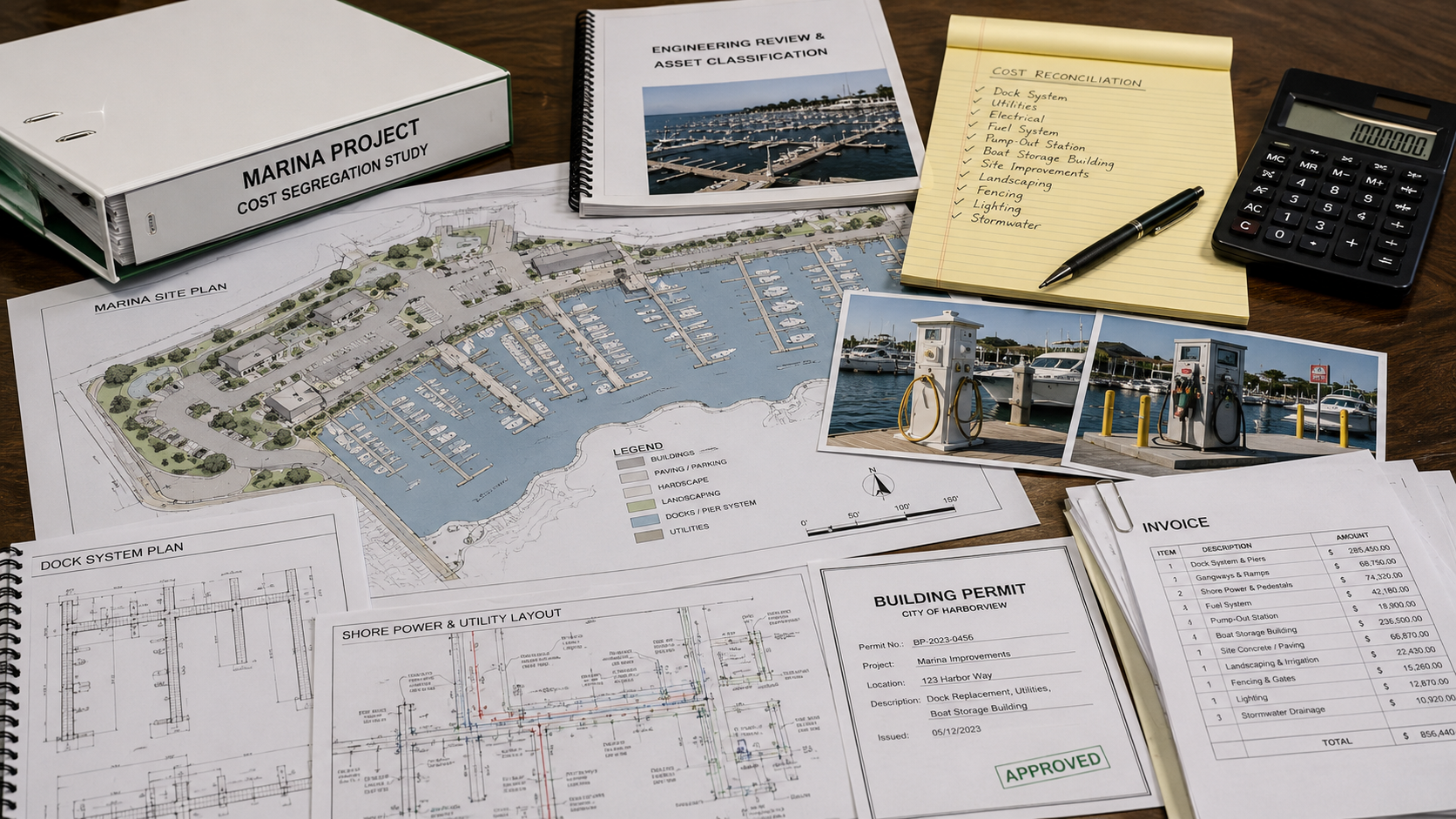
The strongest marina studies start with complete documentation. Waterfront properties often have construction records, dock plans, utility drawings, site plans, permits, engineering drawings, equipment schedules, vendor invoices, and repair histories that help support classification.
For acquired marinas, documentation may be incomplete. In those cases, an engineering-based study may rely on site observations, photos, plans if available, interviews, cost estimating, and reconciliation to the purchase price and depreciable basis.
For new construction or major renovations, planning early can make a major difference. Owners should preserve detail around dock construction, shore power, water lines, pump-out systems, fuel systems, boat storage, site improvements, and service infrastructure before costs are compressed into broad contractor categories.
The best approach is to preserve the records that explain which assets exist, what they support, how they were installed, and how costs should be reasonably allocated.
Financial Example: Marina Infrastructure Allocation
Assume an investor purchases a marina for $6,000,000. Land is allocated at an estimated 20%, or $1,200,000. That leaves a depreciable basis of $4,800,000.
Without a cost segregation study the entire $4,800,000 would be depreciated over 39 years.
With a cost segregation study that identifies that 44% of the property qualifies for accelerated depreciation, $2,112,000 is reclassified into 5-year property and 15-year land improvements, leaving just $2,688,000 in the 39 year bucket.
By leveraging this reclassification alongside bonus depreciation, an investor could unlock a Year 1 depreciation deduction of over $2,000,000.
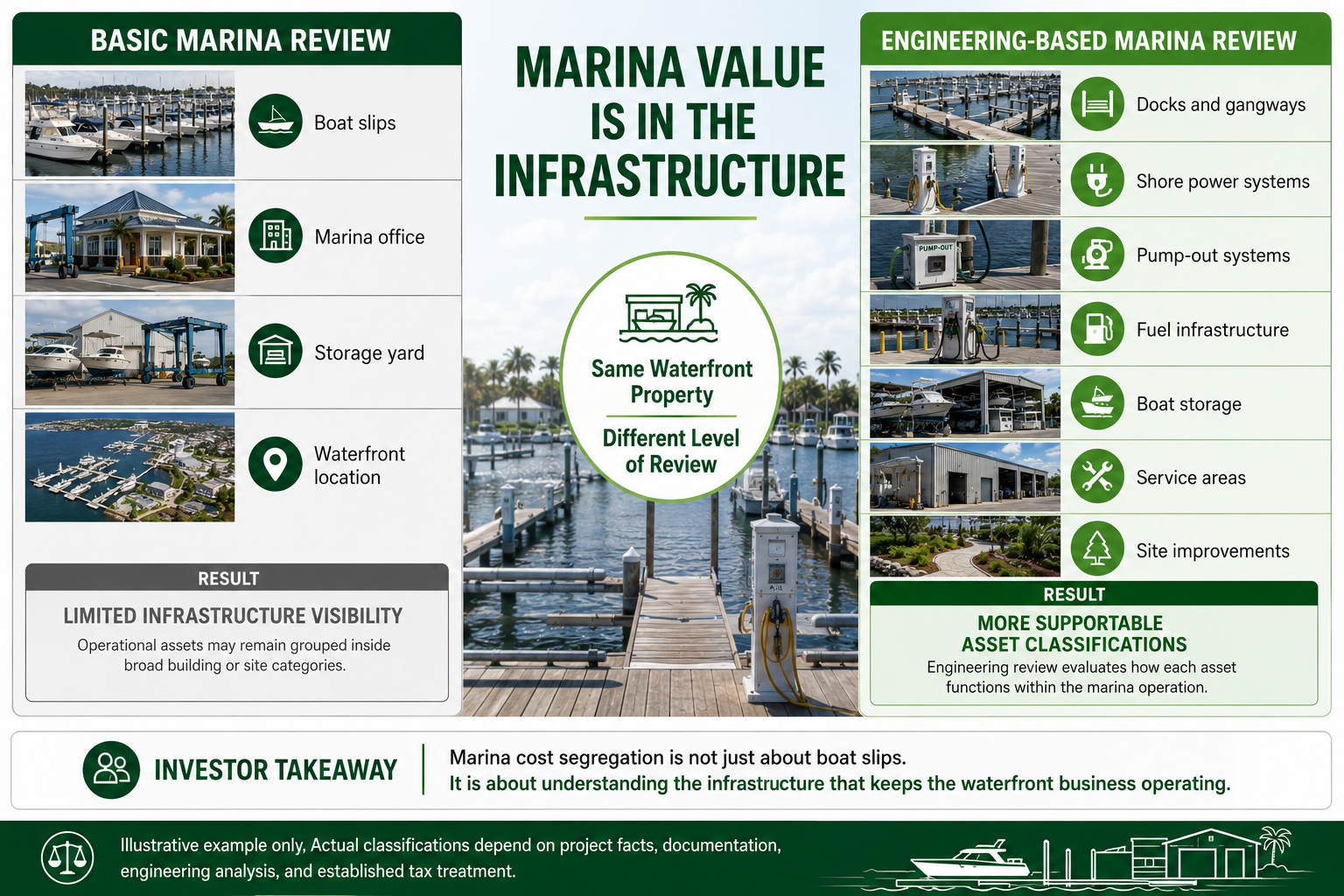
An engineering-based cost segregation study looks deeper. The review evaluates docks, shore power systems, water service, pump-out systems, fuel infrastructure, storage areas, fencing, paving, lighting, drainage, service areas, and customer facilities. Based on the facts, documentation, and asset condition, the study identifies supported reclassification.
The Real Lesson Behind Marina Cost Segregation
Marina cost segregation is not just about counting boat slips. It is about understanding how a waterfront property operates.
Docks, utilities, shore power, fuel systems, pump-out stations, storage areas, service infrastructure, site improvements, and customer facilities may all affect the classification analysis. Some assets may support 5-year property. Some exterior improvements may support 15-year land improvements. Buildings and structural components generally remain 39-year nonresidential real property.
The strongest marina studies combine engineering analysis, documentation, site review, cost reconciliation, and established tax treatment. For marina investors, that means the most important depreciation opportunities may be found not only at the waterline, but throughout the infrastructure that keeps the marina operating.
Do you have a question about Cost Segregation?
Let us know how we can help
Your information is secure. We only use your details to answer your direct inquiry.