

Indirect Costs and Impact Fees in Cost Segregation Studies
Jun 09, 2026Indirect costs can quietly change the outcome of a cost segregation study. Investors usually focus on obvious assets like flooring, dedicated electrical, land improvements, cabinetry, appliances, and specialty systems, but project soft costs can also affect depreciable basis. Impact fees, permit costs, engineering fees, design costs, general conditions, contractor overhead, insurance, bonds, and similar costs may need to be reviewed before the final allocation is complete. When those costs are handled correctly, the study is more accurate, more defensible, and more useful for tax planning.
Let us walk you through your property. Schedule a call today.
Key Takeaways
- Indirect costs can materially change depreciable basis and asset allocation.
- Impact fees must be tied to the property benefit created.
- Soft cost treatment can affect deductions, cash flow, and audit support.
- Developers, renovators, and acquisition investors should review these costs early.
- A defensible study explains allocation logic before depreciation is calculated.
- Basis math shows why indirect costs deserve careful review.
- Engineering-based allocation supports cleaner reporting and better tax planning.
Why Indirect Costs Are Part of the Cost Segregation Conversation
A cost segregation study does more than identify visible assets. It also reviews the cost basis attached to those assets. That means a quality study should consider both direct costs and indirect costs.
Direct costs are easier to understand. They are the labor and material costs tied to a specific item or asset, such as paving, flooring, electrical work, plumbing work, appliances, or site improvements.
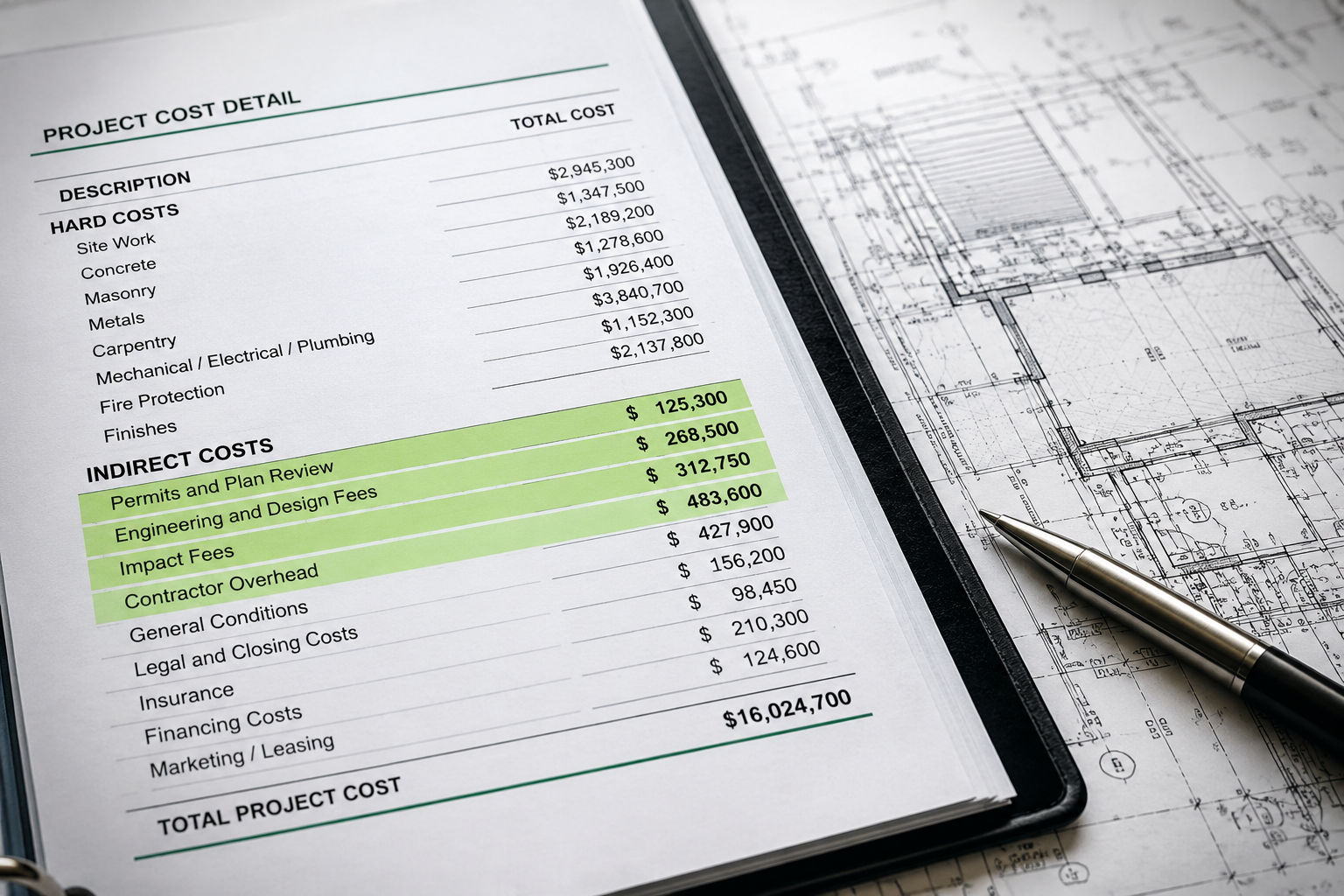
Indirect costs are different. They are costs that are incident to the construction, acquisition, or development of a facility but are not always tied to one obvious physical asset. The IRS ATG describes these as allocable costs that must be assigned proportionately to the basis of the specific assets to which they relate. It also notes that a quality study should explain the treatment of indirect costs because this area is often controversial.
Common examples can include architectural fees, engineering fees, permit costs, plan review fees, general conditions, contractor overhead and profit, insurance, bonds, certain taxes, utilities during construction, bidding costs, and capitalized interest where applicable. For investors comparing depreciation outcomes, this is one reason a quality cost segregation study should not stop at a surface-level asset list.
Impact fees fit into this discussion because they are often paid as part of development, construction, or major renovation activity. Depending on the facts, an impact fee may relate to land, a building, site improvements, utility capacity, municipal infrastructure, or the right to develop the project. The key question is not simply, “Was a fee paid?” The better question is, “What asset or property benefit did the fee create?”
How Soft Costs and Impact Fees Are Allocated
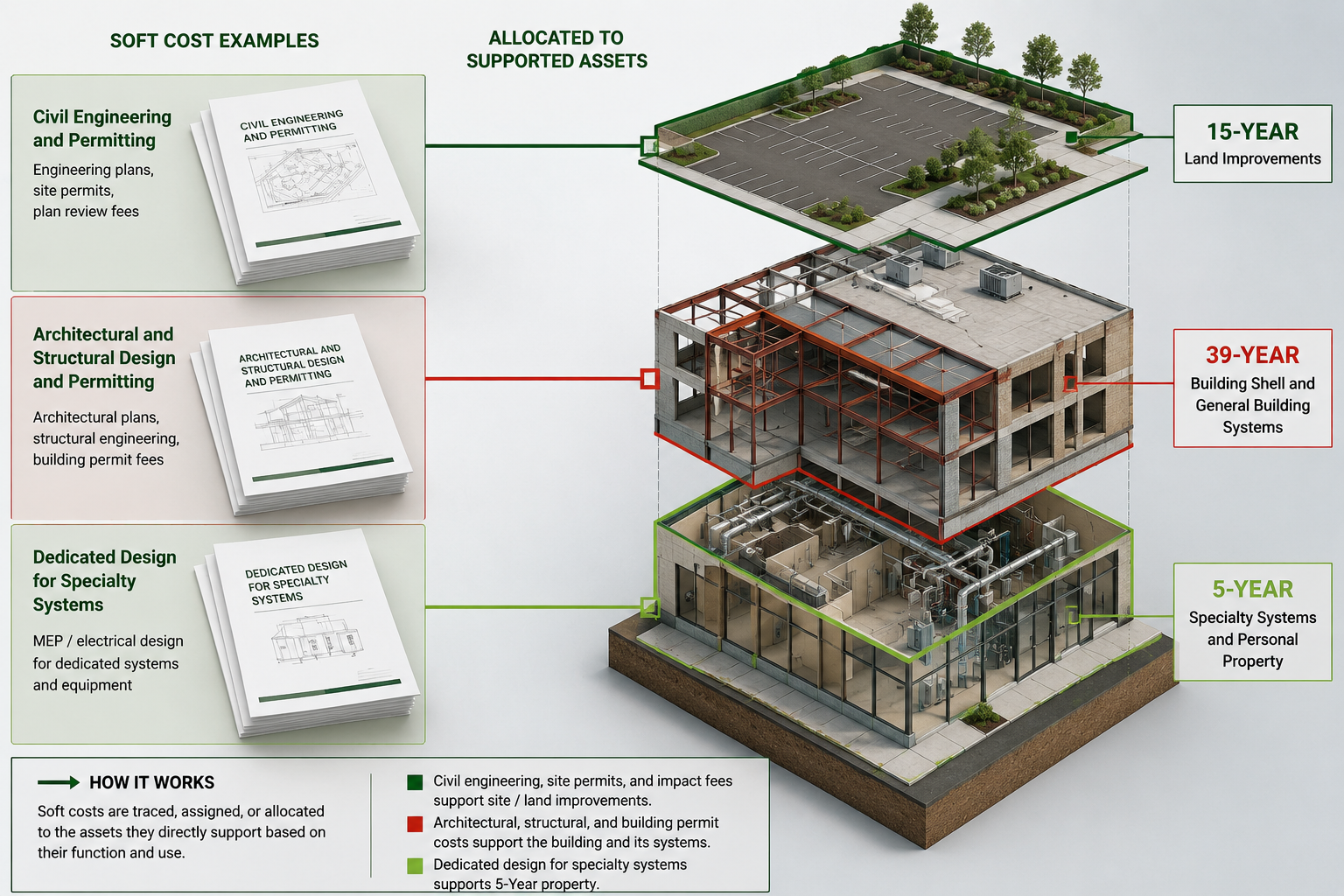
In a cost segregation study, indirect costs should be traced, assigned, or allocated based on what they support. Some costs belong only to land. Some costs belong to the building. Some costs may be allocated across multiple depreciable property classes. Some costs may be assigned directly to shorter-life property when the documentation supports that treatment.
The ATG gives helpful examples. Costs to survey and subdivide land, along with general grading, are typically allocable only to land. Building permits, general conditions, and contractor overhead and profit are typically allocated to assets on a pro-rata basis. Costs for special consultants, such as computer wiring or process engineering, may be assigned directly to the related personal property when the facts support that connection.
Impact fees require the same type of logic. If a fee is paid for a general development right, zoning condition, land entitlement, or community infrastructure burden, it may not automatically belong in 5-year or 15-year depreciable property. If the fee relates to a specific depreciable improvement, utility connection, site improvement, or building system, the study should evaluate whether some or all of that cost belongs with the asset class that received the benefit.
This is where engineering method matters. A study should review invoices, development agreements, permit records, cost ledgers, construction draws, site plans, utility documents, and project schedules. For new construction, actual cost records are often available and can help identify whether an impact fee was tied to land development, building construction, site work, or a specific system. For acquisitions, the study may need to estimate replacement cost new less depreciation and reconcile the allocation to the purchase price.
The same idea applies to other soft costs. A design fee for a general apartment building usually does not belong entirely to 5-year property. But a design fee for specialty process equipment, dedicated computer wiring, or a specific operational system may support a direct allocation to §1245 property. That distinction is also why short-life asset classification risks often increase when indirect costs are applied too broadly.
Why This Can Change Tax Savings and Cash Flow
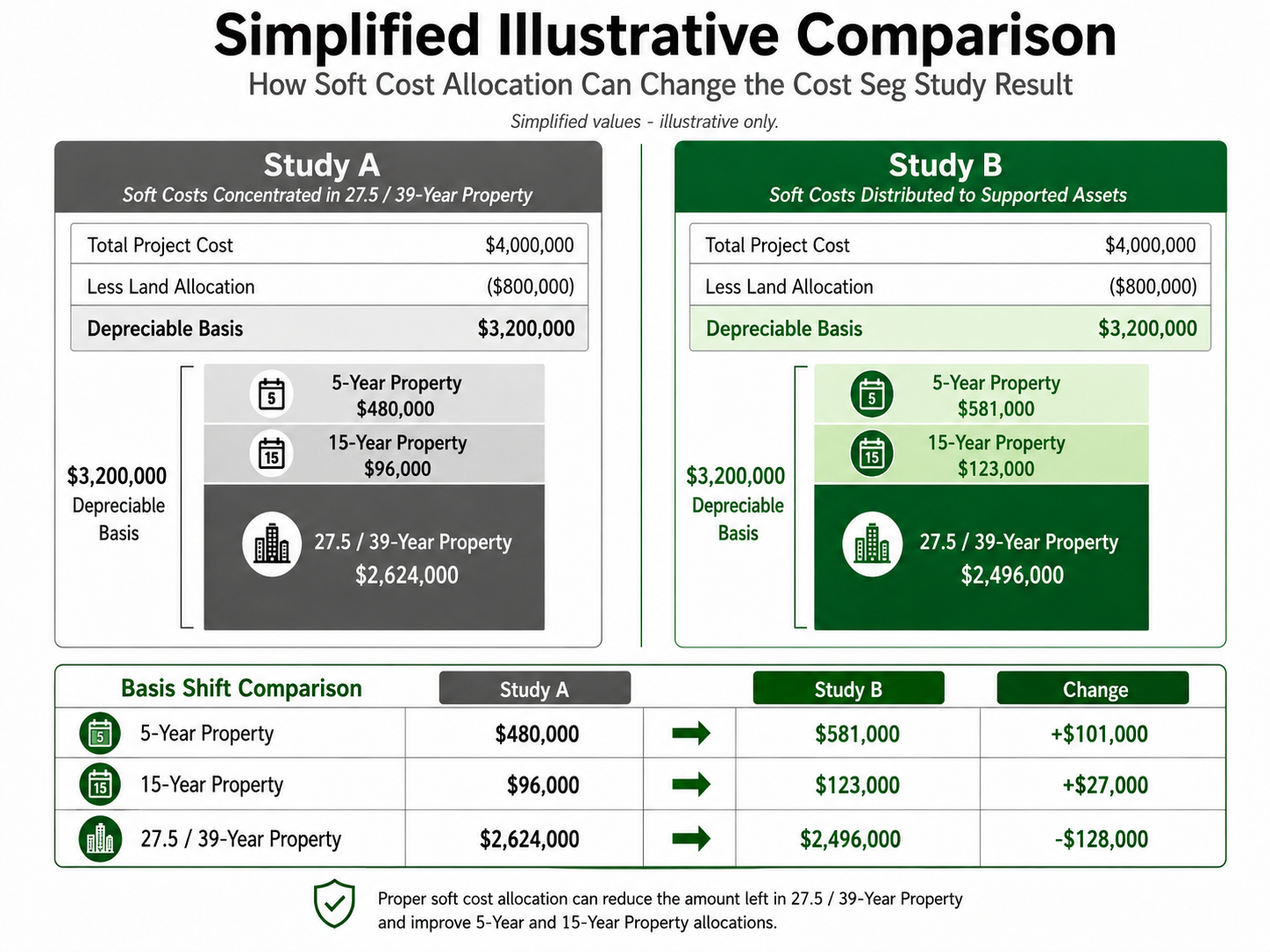
Indirect costs matter because they can increase or decrease the depreciable basis assigned to each recovery period. When more supported basis is assigned to 5-year, 7-year, or 15-year property, investors may accelerate more depreciation. When costs are assigned to 27.5-year residential rental property, 39-year nonresidential real property, or nondepreciable land, the timing of deductions changes.
That timing difference affects cash flow. A dollar of basis assigned to 5-year property generally produces deductions much faster than a dollar assigned to 39-year building property. With bonus depreciation in the picture, the timing benefit can be even more significant when the asset qualifies.
But the opposite is also true. If a study pushes indirect costs into short-life categories without support, it may overstate accelerated depreciation. That creates tax reporting risk, especially if the study does not explain how soft costs were treated. The ATG says a quality report should list direct and indirect costs, clearly identify and explain indirect costs allocated to §1245 property, discuss separately acquired assets to avoid duplication, and address costs subject to §263A.
For investors, this is not just a technical issue. It can affect acquisition underwriting, renovation planning, partner projections, tax distributions, and year-end strategy. The goal is not to force every soft cost into faster depreciation. The goal is to assign each cost to the property benefit it actually supports.

Where Investors Commonly See These Costs
Indirect costs and impact fees show up in many property types. Multifamily developers may see municipal impact fees, utility connection fees, engineering fees, plan review charges, stormwater review costs, traffic-related fees, and building permit costs. Commercial renovation owners may see architectural fees, permit fees, engineering fees, construction management costs, general conditions, contractor overhead, and inspection fees.
Self-storage, RV park, mobile home park, hotel, industrial, medical office, restaurant, and mixed-use projects may have even more complexity. A project may include land development, building shells, site utilities, paving, landscaping, signage, fencing, specialty electrical, dedicated plumbing, equipment foundations, security systems, and tenant-specific improvements. Each of those categories may receive a different tax treatment.
For example, a self-storage development may include grading, asphalt paving, fencing, access control, lighting, drainage, office buildout, and storage structures. Some site work may be land, some may be 15-year land improvement property, and some may belong to the building. If the project also includes municipal impact fees, the study should evaluate whether those fees relate to general land development, utility infrastructure, building approval, or a specific depreciable improvement.
Commercial renovation projects deserve special attention too. Some interior improvements may involve Qualified Improvement Property, while certain personal property and land improvements may qualify for shorter recovery periods. When soft costs are tied to renovation work, it is important to coordinate the cost segregation analysis with commercial renovation tax planning before year-end decisions are made.
Residential rental projects have their own considerations. The ATG’s residential rental property guidance notes that indirect costs should be allocated according to the ATG’s treatment and that indirect costs are rarely allocated to furniture and fixtures because those items are typically acquired under separate contracts. That matters for apartment, build-to-rent, student housing, and furnished rental projects where owners may separately purchase furniture, appliances, clubhouse equipment, or leasing office assets.

How to Plan for Better Indirect Cost Treatment
The best time to think about indirect costs is before the study begins. Investors should gather the project documents that explain what was paid, who was paid, and what each fee supported. This includes closing statements, purchase agreements, construction contracts, AIA payment applications, general ledgers, development budgets, municipal invoices, permit records, impact fee schedules, utility invoices, engineering proposals, architectural contracts, and contractor change orders.
A strong study should reconcile allocated costs to actual costs. That means the final asset schedule should not simply create a preferred tax answer. It should tie back to the project cost, purchase price, or depreciable basis being studied. The ATG identifies reconciliation of total allocated costs to total actual costs as a principal element of a quality study.
Investors should also separate costs that were acquired under different contracts. Furniture, fixtures, appliances, and movable equipment are often purchased separately from construction. If those items were not included in the project cost being allocated, the study should not duplicate them by assigning additional indirect costs that do not belong there.
Impact fees should be reviewed line by line. A fee labeled “impact fee” may not tell the whole story. One fee may support road capacity. Another may relate to water or sewer capacity. Another may be a school, park, traffic, utility, or general development fee. The study should document the fee’s purpose and decide whether it belongs to land, land improvements, building, or another property class.
Timing is also important. Cost segregation is often most powerful when coordinated with acquisition, construction closeout, renovation completion, tax planning, and placed-in-service dates. Investors who are still deciding when to start should review when to perform a cost segregation study so the right records are available before the project trail gets cold.

A Simple Example of Basis Impact
Assume an investor develops a small commercial property for $4,000,000. Land is allocated at 20%, or $800,000. That leaves a depreciable building and improvement basis of $3,200,000.
During the study, the project records show $250,000 of indirect costs and fees included in the capitalized project total. The list includes building permits, plan review fees, general conditions, contractor overhead, engineering fees, utility-related fees, and municipal impact fees.
After reviewing the documentation, the study determines that some of those costs relate to the building, some relate to depreciable site improvements, and some relate to land or general development rights. The engineer does not automatically push the full $250,000 into short-life property. Instead, the study assigns costs based on what each fee supports.
For illustration, assume the supported reclassification result is 22% of depreciable basis into shorter-life property. That would equal $704,000 of the $3,200,000 depreciable basis. Most of that accelerated amount is 5-year property, with a smaller portion assigned to 15-year land improvements. The remaining basis stays in longer-life building property.
Now assume the same project ignored indirect costs or treated all impact fees as land without review. The accelerated basis could be understated. On the other hand, if the study allocated every fee to 5-year property without support, the accelerated basis could be overstated. Either error can distort tax planning.
This is why indirect cost treatment is not a minor spreadsheet detail. It can change depreciation timing, bonus depreciation exposure, partner projections, and after-tax cash flow. The right answer depends on documentation, engineering judgment, tax classification, and reconciliation to total basis.
The Bottom Line for Investors
Indirect costs and impact fees play a real role in cost segregation because they affect the basis assigned to each recovery period. A defensible study should identify those costs, explain their purpose, allocate them to the assets they support, and reconcile the full result to the project cost or purchase price.
The IRS ATG does not require one single study format, but it repeatedly emphasizes accuracy, documentation, asset classification, cost reconciliation, and clear treatment of indirect costs. That is exactly where an engineering-based method helps. It connects the tax result to the physical property, the construction records, and the cost trail behind the project.
For investors, the practical takeaway is simple. Do not overlook soft costs. Do not assume every impact fee belongs in one bucket. And do not rely on a study that accelerates costs without explaining how the allocation was made.
A good cost segregation study should support faster depreciation where the facts allow it, protect against overreach where they do not, and give your tax team a cleaner basis for planning.