

Cost Segregation Mistakes: Classifying Assets by Trade
Sep 03, 2026Construction documents are built around trades because trades make construction easier to organize. Electrical work goes in one category, plumbing in another, mechanical somewhere else, and finishes have their own divisions. The mistake happens when those construction categories are treated as depreciation classifications. A contractor's schedule can tell an investor who installed something and where the cost was recorded, but it may not answer what the asset does or what it serves. CostSegRx engineers use construction information as evidence, then move deeper into function, installation, and the physical relationship between assets before classification.
Wondering how much tax you could save with cost segregation? Let’s find out. Schedule a Cost Segregation Strategy Call today.
Key Takeaways
- A construction trade category is not automatically a depreciation classification.
- Engineers move from trade information to individual assets and their functions.
- Trade-level assumptions can overlook important differences inside the same scope of work.
- Electrical, plumbing, HVAC, lighting, and millwork show why function matters.
- Investors should preserve trade records without treating them as the final classification analysis.
- One electrical trade package can contain very different functional relationships.
- Contractors organize the work. Engineers classify the assets.
Why Trade Categories Are Not Tax Classifications
Construction needs an organizational system. Contractors, architects, engineers, and estimators need a common way to describe scopes of work, specifications, materials, and costs.
ATG 2025 discusses the Construction Specifications Institute MasterFormat as a system used throughout the construction industry to organize detailed construction information. Historically, its divisions included categories such as concrete, masonry, finishes, mechanical, and electrical. The modern system has expanded substantially, but the basic purpose remains organization and communication within construction.
That organization is valuable in a cost segregation study. It can help an engineer locate costs, understand scopes, reconcile construction information, and identify areas requiring additional investigation.
But organization and classification are two different jobs.
An electrical contractor can install systems serving the building and systems serving specific business equipment. A plumbing contractor can install ordinary building plumbing and other connections associated with equipment or processes. Millwork can include general building components as well as decorative items receiving different treatment under applicable facts. ATG 2025 itself contains examples where assets within these broad construction categories receive different treatment.
This is why MEP systems cost segregation cannot begin and end with the words electrical, mechanical, or plumbing.
The trade label tells you where to start looking. It does not necessarily tell you where the classification analysis ends.

How Engineers Move From Trade to Function
CostSegRx engineers begin with the physical property.
What is the asset? What does it do? What does it serve? Where is it located? How is it installed? What components support its function?
Those questions move the analysis from a construction category toward an individual asset or functional system.
Available documentation can then help establish the engineering story. Construction drawings, specifications, equipment schedules, contractor scopes, pay applications, invoices, photographs, site observations, and other records may provide evidence about what was installed and why.
ATG 2025 recognizes the value of standard construction numbering and nomenclature in a quality study. It also explains that proper classification can be intensely factual and that legal analysis should connect the applicable authority to the specific facts and circumstances of the property.
That distinction matters.
The construction records may say "electrical." Engineering asks which electrical components.
The records may say "plumbing." Engineering asks what the plumbing serves.
The records may say "HVAC." Engineering asks whether the system provides general building service or whether the facts support another identified function.
The records may say "millwork." Engineering asks what kind of millwork exists and what role it performs.
This functional approach is central to understanding what makes an asset §1245 property. The classification should follow the asset and the applicable facts, not simply the heading under which a contractor billed the work.
Why Trade-Level Classification Can Create Problems
Imagine acquiring a commercial property and receiving a construction cost schedule with one large line labeled "electrical."
That line may be accurate construction accounting. It still does not establish that every dollar underneath it represents the same type of depreciable property.
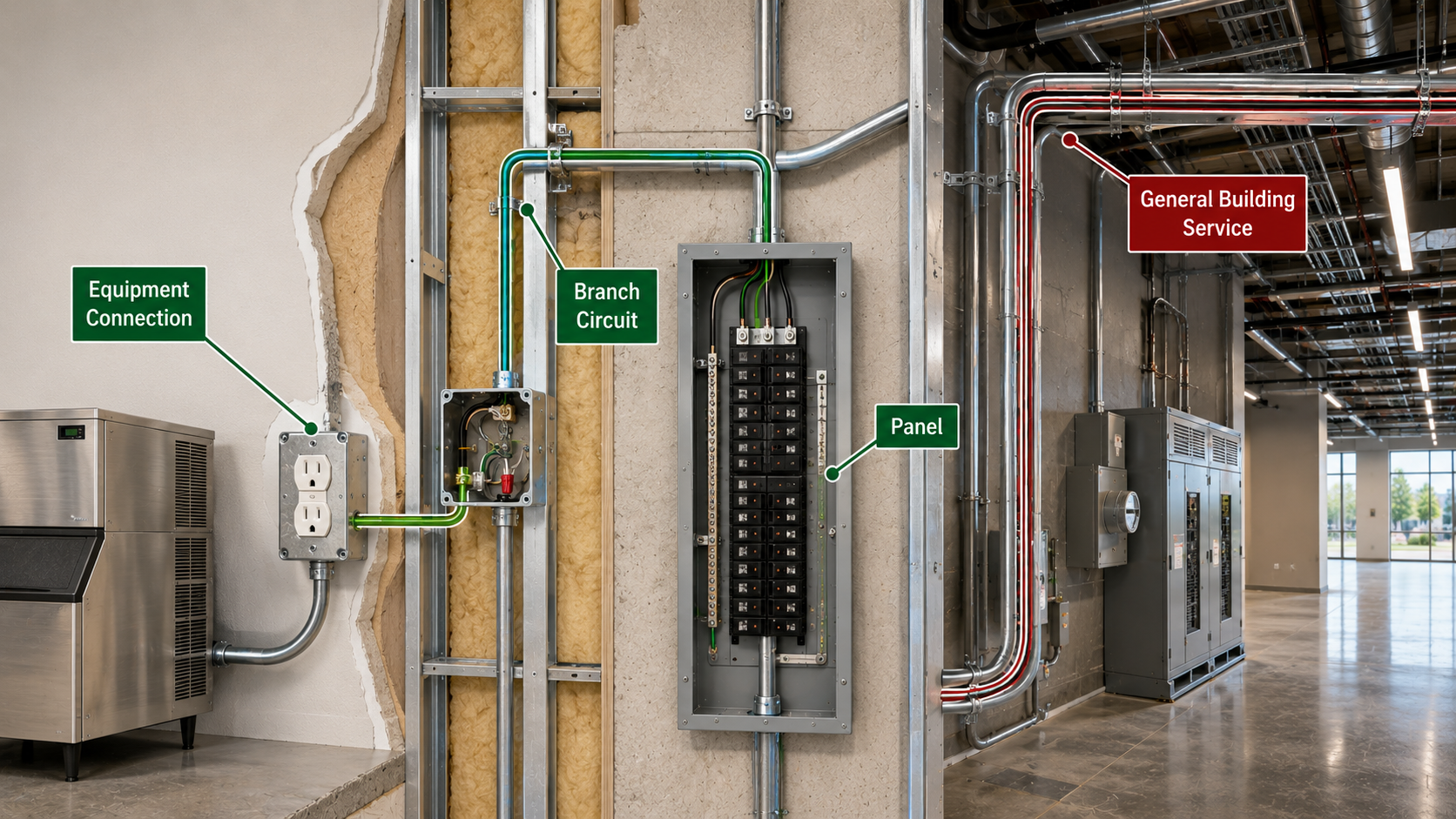
ATG 2025's electrical distribution system discussion demonstrates the problem clearly. Electrical hook-ups and branch circuits serving building-related items such as general-use power outlets, lighting, HVAC, and other building services are associated with the building recovery period. The ATG separately discusses hook-ups and branch circuits supplying dedicated machinery and equipment used as an integral part of the taxpayer's business.
So "electrical" is not enough information.
The same principle applies more broadly. The CostSegRx editorial and engineering standards specifically distinguish general building-serving MEP from supported dedicated or business-use relationships. They also prohibit assuming that all MEP can simply be segmented into 5-year property.
This cuts both ways. Treating an entire trade as 39-year nonresidential real property without examining the underlying assets can miss supported distinctions. Treating an entire trade as 5-year property because portions appear connected to business equipment can create unsupported classifications.
Good engineering avoids both shortcuts.

Where Trade Labels Break Down
Electrical
Electrical is one of the clearest examples because a commercial building may contain a large interconnected electrical distribution system.
Some components provide general building service. Others may have identifiable relationships to machinery or equipment. ATG 2025 describes a functional allocation approach for evaluating those relationships and notes that applying it correctly can require analyzing hook-ups, branch circuits, portions of secondary distribution, primary distribution, and overall electrical demand.
That is much deeper than reading "Division 26 Electrical" on a construction schedule.
Plumbing
Plumbing presents the same basic problem.
General building plumbing can include piping, drains, valves, fixtures, and other components necessary for building operation. But applicable ATG matrices also contain examples of plumbing associated directly with specific equipment or processes.
The lesson is not that plumbing should automatically become 5-year property. The lesson is that the word "plumbing" does not complete the analysis.
HVAC
HVAC is another trade where the system's function matters. General systems providing heating, ventilation, and air conditioning for the building and its occupants are building components under applicable guidance.
Specialized situations require their own factual analysis. An engineer should not infer treatment merely because a mechanical contractor installed the equipment.
Lighting
Lighting can also illustrate why labels need context. General building lighting serves the operation of the building, while tax authority recognizes certain fact-specific distinctions for other types of lighting. The correct analysis therefore requires understanding what the lighting does rather than assuming every fixture follows one result simply because it appears on the electrical drawings.
Millwork
Even millwork demonstrates the same principle. ATG 2025 distinguishes general millwork used as building material from certain decorative millwork in applicable industry guidance.
Same trade family. Different functions. Potentially different treatment.
The broader engineering cost segregation process is designed to uncover exactly these kinds of distinctions.

Use Contractor Records as Evidence, Not the Final Answer
Investors should not discard trade-level construction records. They are valuable.
The better strategy is to preserve them and understand their proper role.
Keep contractor schedules of values, specifications, drawings, change orders, equipment schedules, invoices, pay applications, and other available project records. These documents can help an engineer reconcile costs and understand how the property was constructed.
ATG 2025 specifically notes that standard numbering systems can help a quality study remain consistent with contract bid documents and pay requests. It also emphasizes common nomenclature, appropriate documentation, engineering take-offs, and support for classification conclusions.
The mistake is not using contractor information.
The mistake is asking contractor information to answer an engineering and tax classification question it was never designed to answer by itself.
For investors, this distinction can also improve cost segregation audit readiness. A classification is easier to understand when the report can show the underlying asset, its function, supporting documentation, methodology, and reasoning instead of relying on a broad trade description.

Example: The Electrical Contractor Installed All of It
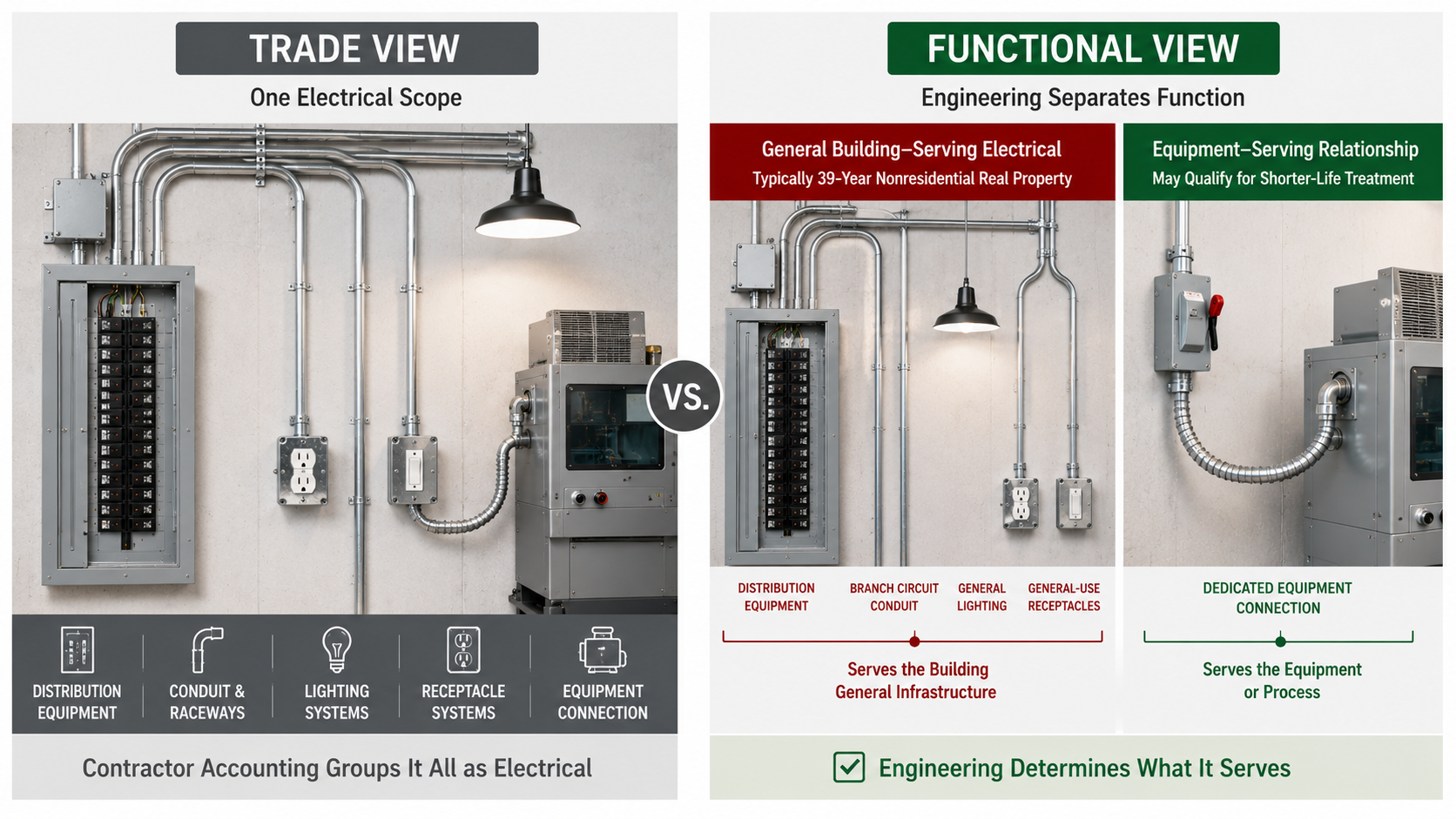
Consider a commercial property where one electrical contractor installs the building's electrical work.
The contractor's records may legitimately group that work together because it was performed under one electrical scope. From the contractor's perspective, that organization makes sense.
Now look at the same property through an engineering-based cost segregation analysis.
One portion of the electrical system may serve general lighting. Another may serve general-use receptacles. Other identifiable hook-ups or branch circuits may serve dedicated machinery or equipment used in the taxpayer's business.
ATG 2025 explains that hook-ups and branch circuits serving building-related items such as HVAC, general-use outlets, lighting, and other building services are recovered over the building's recovery period. It separately addresses hook-ups and branch circuits supplying dedicated machinery and equipment and explains the functional allocation analysis that may extend into primary and secondary electrical distribution.
The contractor did not make a mistake by calling all of it electrical.
The investor would make the mistake by assuming that "electrical" is the classification.
That is the difference between organizing construction and analyzing depreciable assets.
Contractors Build. Engineers Classify.
Construction trades tell an important part of a property's story. They show how the work was organized, who performed it, where costs were recorded, and how project documentation was structured.
Cost segregation asks a different set of questions.
Engineers need to understand the individual asset, its function, its use, its installation, its relationship to the building or business activity, and the documentation supporting the conclusion. Only then can the applicable tax treatment be evaluated.
That is why CostSegRx engineers do not classify a building by contractor divisions.
The trade label is evidence.
Function drives the analysis.
Do you have a question about Cost Segregation?
Let us know how we can help
Your information is secure. We only use your details to answer your direct inquiry.