
Call Systems vs. Building Security
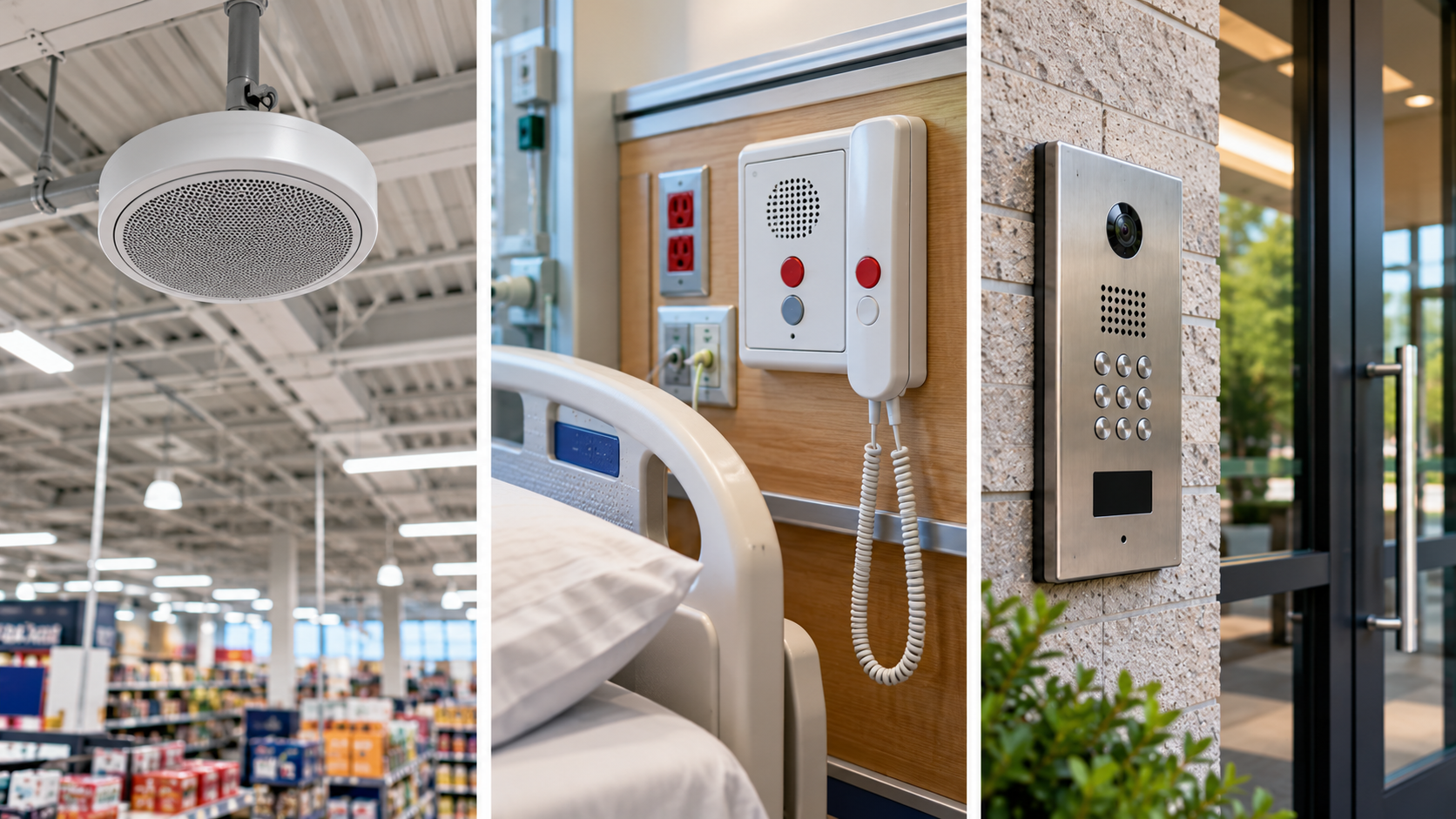
Nov 05, 2026A ceiling-mounted paging speaker in a warehouse, a nurse-call station in a hospital, and an intercom at a secured building entrance may all transmit sound, but they do not necessarily perform the same function. Some systems help employees communicate, coordinate business activities, or respond to patients, while others help protect the building and control who can enter. These physical and operational differences can affect whether installed equipment is classified as §1245 personal property or §1250 building property during a cost segregation study. The IRS Cost Segregation Audit Technique Guide (ATG 2025) provides useful examples of both classifications, including communication equipment, public-address systems, and building security installations. Understanding what the equipment serves, how it operates, and where its connections lead is essential to reaching a defensible classification.
Wondering how much tax you could save with cost segregation? Let’s find out. Schedule a Cost Segregation Strategy Call today.
Key Takeaways
- What communication, paging, and building security systems physically include
- How call systems operate differently from electronic access control
- When §1245 or §1250 classification may apply under ATG guidance
- Where communication and security systems appear in commercial properties
- How CostSegRx engineers investigate equipment functions and connections
- An engineering comparison of operational paging and secured-entry intercoms
- Why the system's documented purpose determines the classification analysis
What Are Communication, Call, and Building Security Systems?
Communication and call systems are installations that allow people to transmit messages, request assistance, or make announcements within a property.
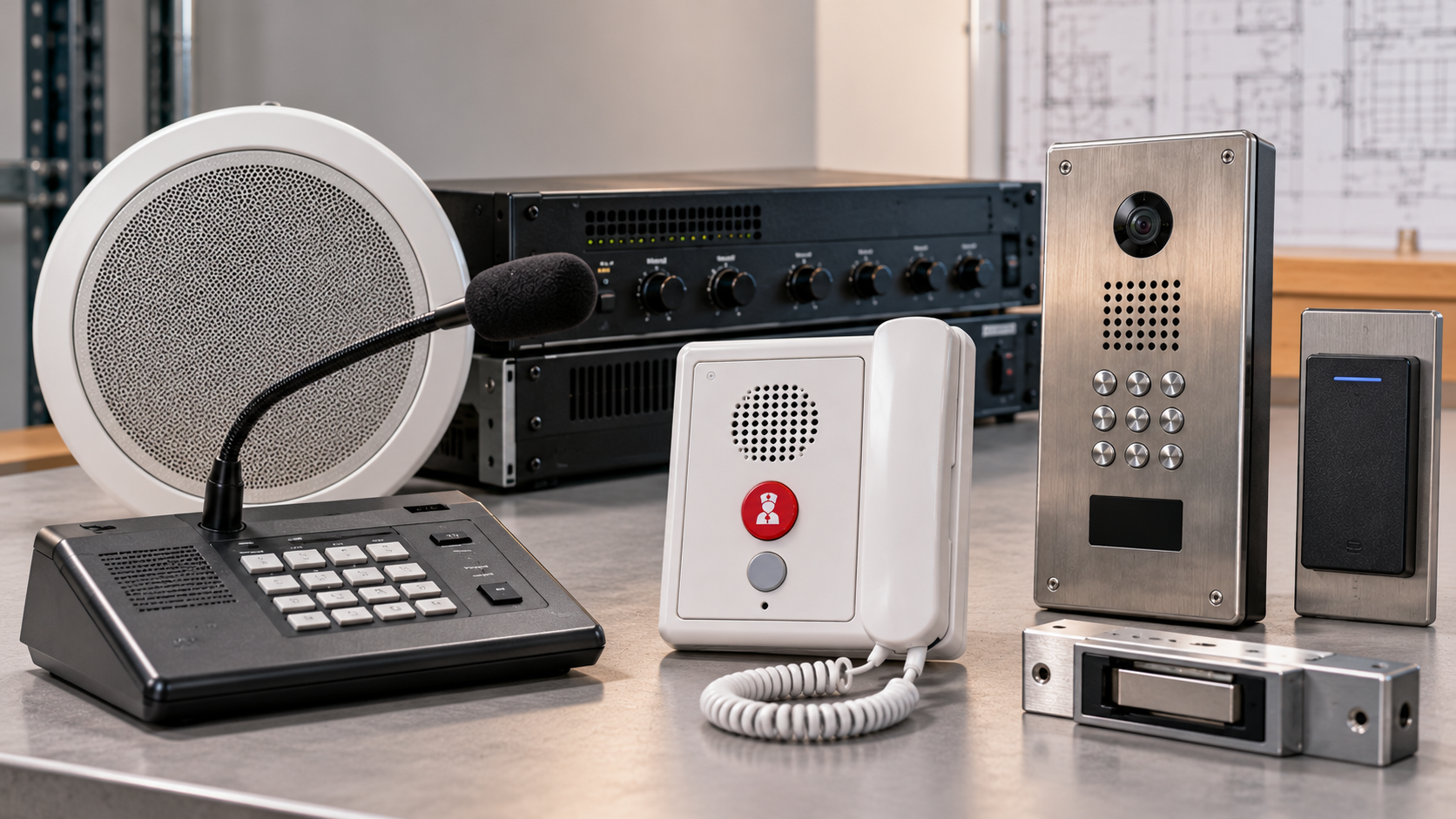
They may include speakers, microphones, calling stations, amplifiers, electronic controllers, and associated communication wiring.
The equipment varies depending on its purpose.
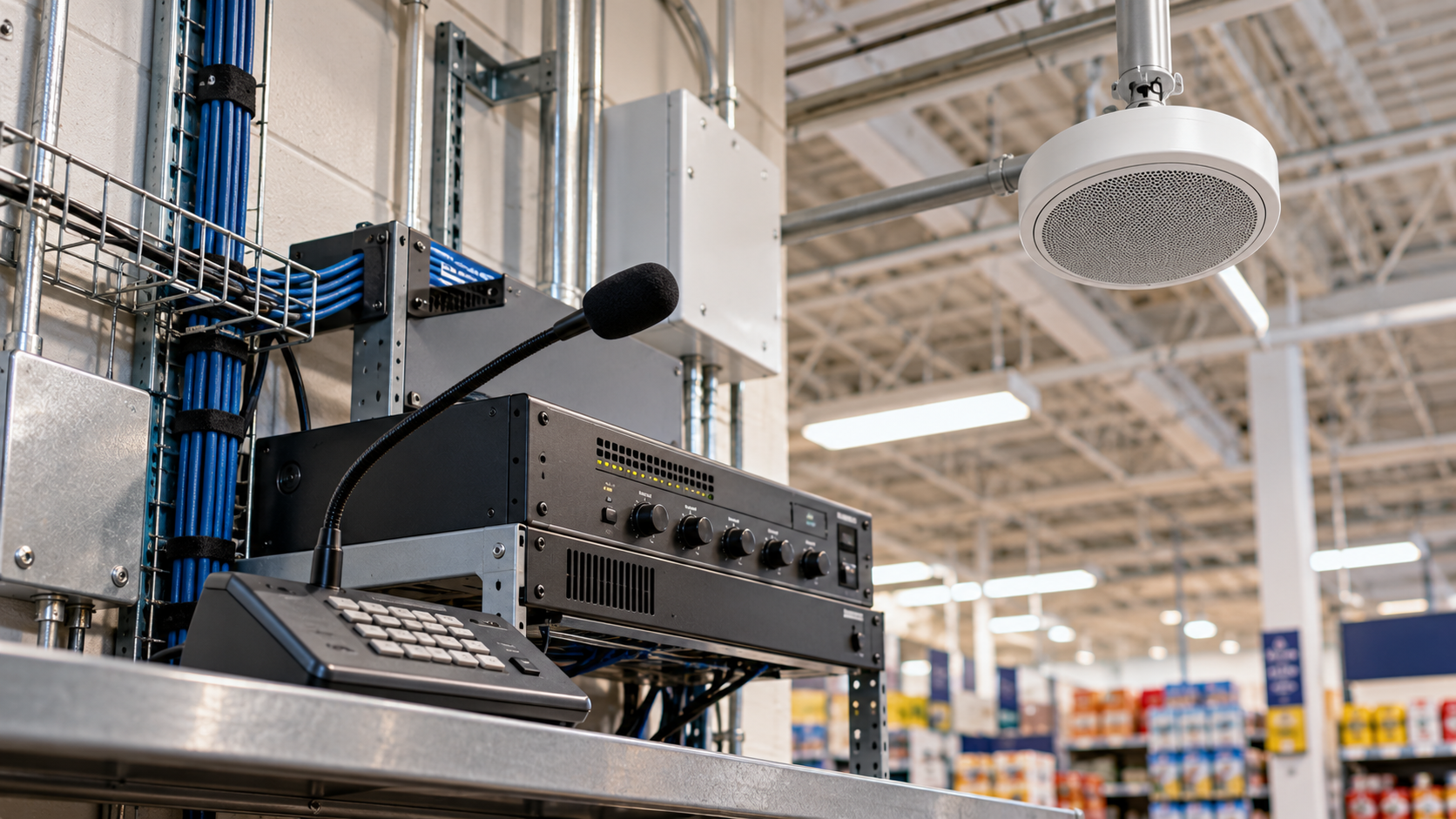
Public-address and paging equipment
A public-address system delivers announcements through installed speakers.
In a warehouse, this might allow supervisors to page employees. In a retail store, it might allow workers to request customer assistance.
A representative installation may contain:
- Ceiling-mounted or wall-mounted speakers
- A microphone or paging station
- An amplifier or audio controller
- Associated communication wiring
The primary function is sound communication.
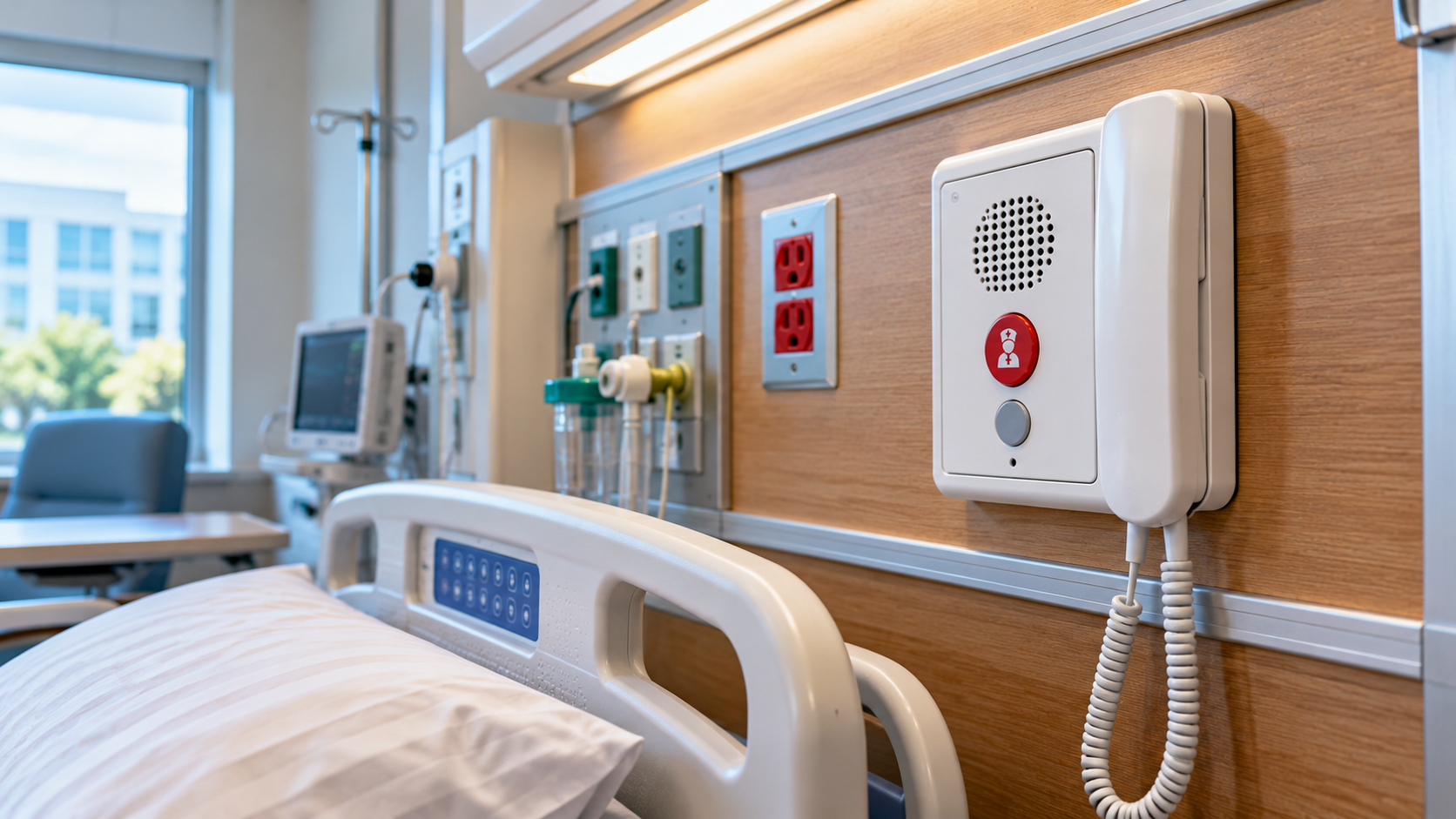
Hospital nurse-call equipment
A hospital nurse-call installation allows patients to request assistance or communicate with healthcare personnel.
Depending on its design, the system may include bedside calling devices, corridor indicators, staff receiving stations, communication electronics, and associated wiring.
The relevant engineering function is communication and response coordination within a healthcare environment.
A nurse-call installation should not automatically be treated as ordinary building security equipment simply because it is permanently installed.
Building security and entry-control equipment
A secured-entry system serves a different purpose.
Its function includes controlling access to the building.
Representative components can include electronic door locks, access-control readers, intercom stations, electronic controllers, and security wiring.
An intercom may be part of that installation when authorized occupants use it to communicate with visitors and release an entrance.
The critical distinction is not whether the equipment has a speaker or microphone. It is what the installed system actually does.
This reflects the engineering cost segregation process, which begins with observable physical conditions and the functions those assets perform.
How Call Systems and Security Systems Operate Differently
Although these systems may contain similar electronic components, their physical connections and operational purposes can be materially different.
Warehouse paging equipment
Consider a warehouse public-address system used to contact employees throughout the facility.
A person makes an announcement through a microphone or paging station.
An audio controller or amplifier distributes the message to installed speakers.
The speakers reproduce the announcement in the designated areas.
The system's operating purpose is communication during warehouse activities.
It does not necessarily control entry doors, operate security locks, or form part of the building's alarm infrastructure.
That separation is important when evaluating whether the sound equipment qualifies as §1245 property.
However, the engineering facts must be established for the actual installation. A warehouse location alone does not establish its classification or recovery period.
Hospital nurse-call communication
In a hospital, a patient activates a call device to request assistance.
The request is delivered to designated nursing staff through the installed call system.
Some installations also support two-way communication.
The relevant physical components are those involved in initiating, transmitting, receiving, and indicating a patient call.
This equipment serves patient-care communication rather than simply controlling access to the building.
The connection between the calling device and staff receiving equipment may therefore be important to the §1245 analysis.
Intercoms connected to electronic door locks
Now consider an intercom installed at a controlled commercial entrance.
A visitor activates the intercom, an authorized occupant responds, and an access-control command releases the electronic lock.
This installation includes a building access-control function.
An engineer would evaluate the intercom station, electronic locking device, associated control equipment, and supported connections.
Where the equipment functions as part of a building-protection security system, that relationship supports investigating §1250 building-component treatment.
A door-release connection is relevant evidence, but it does not automatically determine the classification of every connected component.
The actual system boundaries, equipment functions, and applicable authority still matter.
The same principle applies to electrical distribution systems in cost segregation, where an engineer must determine what the installed electrical components serve before considering a separate classification.
Why §1245 and §1250 Classifications Matter for Call Systems
The IRS ATG 2025 recognizes an important distinction between equipment used for communication and equipment used to protect a building.
That distinction can affect the applicable depreciation recovery period.
However, the ATG provides industry-specific guidance, not a universal rule that applies identically to every property or installation.
§1245 property: Communication and operational sound systems
Section 1245 generally includes qualifying depreciable personal property.
The ATG contains several useful examples involving communication equipment and sound systems.
1. Retail public-address and paging systems
The ATG's retail industry table identifies equipment and apparatus used for amplified sound, including associated wiring, as §1245 property.
The description includes public-address paging and background music systems.
For the covered retail application, the ATG identifies this equipment as 5-year property under asset class 57.0, Distributive Trades and Services.
The category excludes applications linked to fire protection and alarm systems.
This is a direct ATG example of installed communication equipment receiving shorter-life treatment.
2. Hospital intercom equipment and call systems
The ATG's historical case classification table identifies intercom equipment and call systems as §1245 property in connection with Hospital Corporation of America v. Commissioner.
This reference provides important support for examining hospital communication and patient-call equipment as personal property.
However, the historical case listing does not establish that every modern hospital nurse-call installation automatically qualifies as §1245 property.
The IRS also did not accept every asset-specific conclusion in the HCA decision.
The engineer must still evaluate the actual installation and applicable authority.
3. Pharmaceutical and biotechnology facility sound systems
The ATG identifies equipment used for amplified sound, paging, and background music as §1245 property in its pharmaceutical and biotechnology industry examples.
Importantly, the recovery period in that table is seven years for personal property without a class life, rather than five years.
This demonstrates that §1245 property does not automatically mean 5-year property.
The proper recovery period must be established separately.
§1250 property: Building security and access control
Section 1250 generally covers depreciable real property other than §1245 property, including qualifying building components.
The ATG's relevant industry tables identify security installations used to protect buildings, their contents, and occupants.
Examples include:
- Electronic access-control systems
- Keyless building entry systems
- Card-key access equipment
- Building security cameras and related recording equipment
- Window and door locks
- Intrusion alarm systems
- Security system wiring and conduit
These building-protection systems are identified as §1250 building components in the applicable tables.
For nonresidential buildings, the corresponding classification is generally 39-year nonresidential real property.
An intercom that forms part of the building's security and entry-control function may therefore support §1250 treatment.
But an intercom's proximity to a secured door does not automatically establish that classification.
The engineering analysis must determine what the intercom and its associated equipment actually serve.
The classification difference
| Physical function | Classification direction |
|---|---|
| Retail customer paging system within the ATG's covered category | §1245, 5-year property |
| Hospital intercom or nurse-call installation | Investigate §1245 under the HCA reference and applicable authority |
| Pharmaceutical facility operational paging within the ATG's covered category | §1245, seven-year property |
| Warehouse employee announcement system | Potential §1245, subject to equipment and asset-class analysis |
| Electronic security system controlling a building entrance | Potential §1250 building component |
| Intercom integrated with building security and door-release controls | Evaluate under §1250 building-security guidance and any applicable separate-equipment rules |
The lesson is not that every speaker qualifies as personal property or every door intercom is a building component.
It is that function, physical integration, and applicable authority determine the supported treatment.
For additional context, see what makes an asset §1245 property.
Authority: IRS Publication 5653, Cost Segregation Audit Technique Guide, revised February 6, 2025. Relevant sources include the retail, pharmaceutical/biotechnology, and building-security industry tables, plus the HCA historical case classification table.

Where Communication and Security Systems Appear in Commercial Properties
Communication and security equipment can appear in many commercial environments, but each installation should be evaluated according to its actual function.
Warehouse employee paging systems
A warehouse may use overhead speakers to broadcast operational instructions, employee announcements, or requests for assistance.
If the system operates as separate public-address equipment, the engineering analysis may support a §1245 classification.
The ATG's examples of operational sound systems provide useful comparisons.
However, a warehouse paging installation does not automatically inherit the five-year recovery period assigned to qualifying retail systems.
The applicable industry and asset classification must be determined.
Hospital patient communication systems
A hospital may contain bedside calling devices, staff communication stations, and related equipment used to coordinate patient care.
These installations present an important §1245 classification question because the ATG includes the HCA intercom and call-system reference.
The engineer must identify the physical components and determine which equipment serves patient communication.
Associated building electrical equipment, alarm functions, or security equipment should not automatically be included in the same classification.
Retail stores and commercial showrooms
Retail properties may use public-address equipment to announce customer assistance, page employees, or provide background music.
The ATG's retail sound-system category directly supports §1245 treatment for equipment satisfying the described conditions.
The included wiring must correspond to the qualifying installation.
Fire-protection and alarm-linked applications are outside that specific category.
Office building secured entrances
An office building may use a video intercom that allows reception personnel to identify visitors and release an electronic entrance lock.
Here, the intercom performs both communication and building access-control functions.
The engineer must evaluate whether the equipment operates as an integrated building security installation or whether any components warrant separate analysis.
A building-protection function supports considering §1250 building-component treatment.
Manufacturing and industrial facilities
Industrial properties may use paging speakers to coordinate production activities, communicate operating instructions, or contact employees.
A separate operational communication system may warrant §1245 analysis.
The applicable classification depends on the actual equipment and relevant recovery-period rules.
If an announcement system also serves building fire protection, emergency notification, or other alarm-related functions, those relationships must be evaluated separately rather than assuming the ordinary paging-system treatment applies.
Across these environments, the building type provides context. The installed system's documented function supplies the engineering evidence.
How CostSegRx Engineers Evaluate Communication and Security Systems
CostSegRx engineers approach these installations by identifying the physical equipment, documenting its operating purpose, and examining supported system connections.
The objective is to determine the appropriate classification, not to force every electronic component into a shorter recovery period.
1. Identify the installed components
The engineer begins with the equipment itself.
Depending on the system, this may include paging speakers, amplifiers, call stations, receiving devices, electronic control equipment, intercoms, or compatible access-control components.
The equipment should be identified according to its actual installation and available documentation.
2. Determine what the system serves
The engineer must establish whether the equipment supports operational communication, patient calls, building security, or a combination of functions.
A speaker used to page employees presents a different functional question from an intercom controlling entry through a secured building door.
That difference may affect the applicable asset classification.
3. Examine physical connections and system boundaries
Where supported by evidence, the engineer evaluates relevant wiring, controls, terminations, and equipment relationships.
Important questions include:
- Does the system provide communication only?
- Does it operate electronic entrance locks?
- Is it connected to building security equipment?
- Does it serve general building alarms or fire protection?
- Can communication equipment be separately identified?
- Are the functions and boundaries supported by construction or equipment documentation?
A connection does not automatically establish the tax treatment of every component.
The relevant classification depends on the actual installation and governing authority.
4. Match the physical facts to applicable authority
Once the equipment and its function are established, the engineer evaluates the applicable §1245 or §1250 provisions.
The ATG's industry-specific examples are useful classification references.
However, they must be applied within their proper context.
For example, the five-year retail paging classification should not automatically be transferred to a hospital or warehouse installation without an independently supported basis.
5. Document the classification and recovery period
Relevant records may include equipment schedules, installation photographs, construction drawings, system specifications, wiring documentation, and cost information.
The engineering analysis should explain why the particular system qualifies for its assigned classification and recovery period.
When available evidence is incomplete, the conclusion should reflect that limitation.
This is part of producing a quality cost segregation study that supports both shorter-life and long-life property findings.
Engineering Example: Operational Paging vs. Building Security
Consider two representative electronic communication installations.
Both use speakers and electronic equipment to transmit sound.
However, the systems perform different functions.
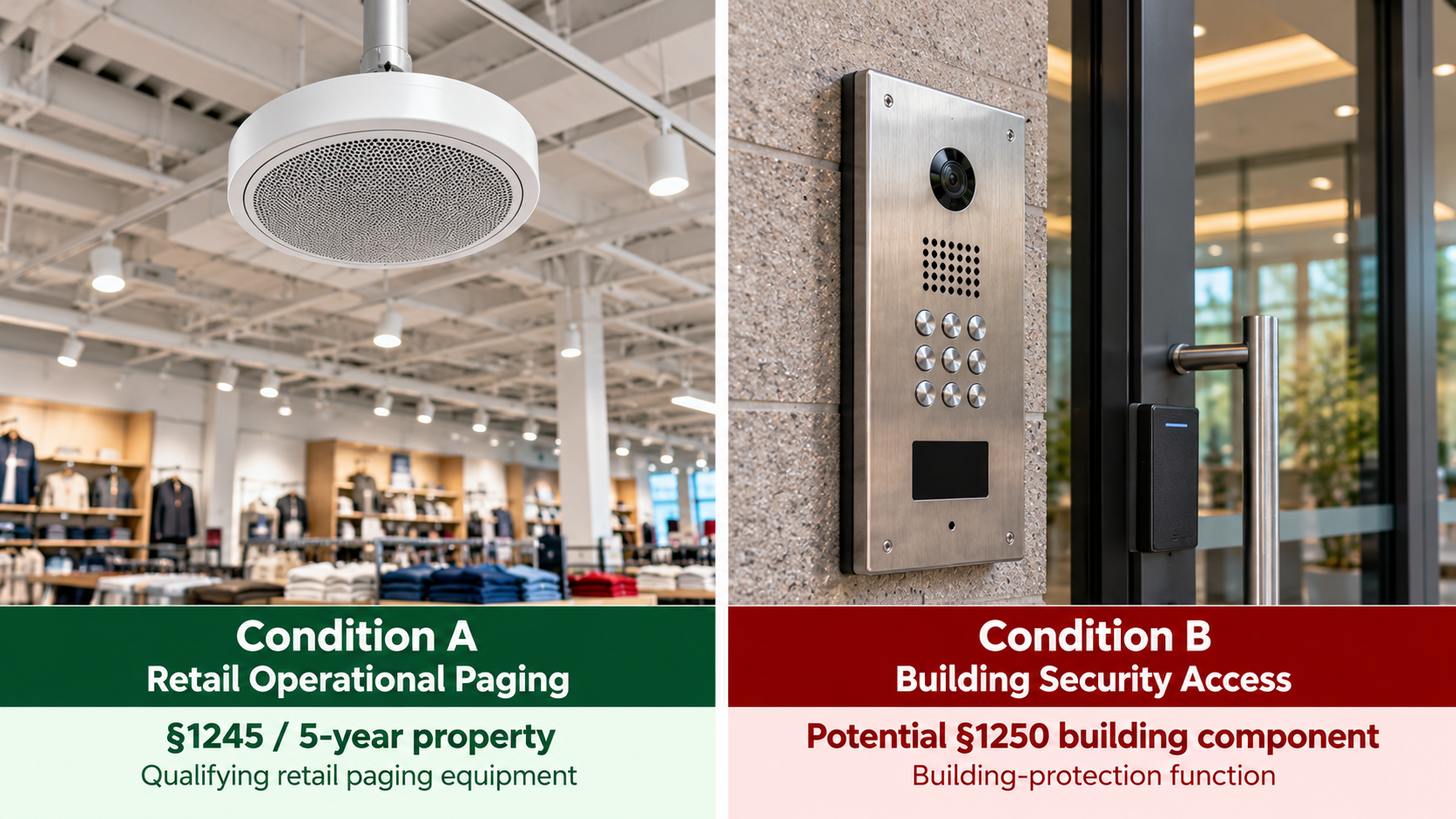
Condition A: Retail public-address paging system
A retail store has ceiling-mounted speakers connected to a paging and amplification system.
Store employees use the system to announce customer assistance and contact other personnel.
The equipment is not connected to building fire-protection or alarm systems.
Engineering interpretation:
This example matches the operational sound-system category described in the ATG's retail industry table, assuming the identified equipment and its actual installation satisfy that category.
The applicable guidance supports:
- §1245 personal property
- 5-year property under asset class 57.0
- Inclusion of qualifying sound equipment and associated wiring
The conclusion follows the system's documented function and the applicable industry-specific authority.
Condition B: Office building secured-entry intercom
An office building has an intercom installed beside its main entrance.
Visitors use the station to communicate with reception personnel.
The system is also connected to electronic access-control equipment that permits authorized release of the secured entrance.
Engineering interpretation:
The documented installation includes a building security and access-control function.
The ATG's building-protection security examples support investigating §1250 treatment.
When the equipment qualifies as part of the building's security system, the applicable nonresidential building classification is generally 39-year nonresidential real property.
Any component proposed for separate personal-property treatment must have its own supporting facts and authority.
What changes the classification analysis?
The difference is not simply the presence of a microphone or speaker.
Condition A provides amplified sound for retail business operations within an expressly described ATG category.
Condition B combines visitor communication with secured building access.
The relevant engineering distinctions include:
- What the equipment serves
- Whether it participates in building access control
- Whether the communication system can be separately identified
- Which connections are documented
- Which tax authority applies to the actual installation
These examples demonstrate how similar electronic technology can require different classification analysis without implying that every paging system or secured-entry intercom automatically receives the same treatment.
Accurate Classification Starts With the System's Function
Communication and call systems are an important example of why engineering-based cost segregation requires more than identifying equipment by name.
A warehouse paging speaker, hospital nurse-call station, retail public-address system, and secured-entry intercom may all contain communication technology.
Yet their purposes and relationships to the building can differ.
ATG 2025 provides specific support for §1245 treatment of qualifying operational sound equipment, along with historical precedent involving hospital intercom and call systems.
The guide also identifies building-protection security and access-control installations as §1250 building components in applicable industry tables.
For commercial real estate investors, the important question is not whether an installation contains electronic equipment.
It is whether the physical evidence and applicable authority support treating that equipment as separate personal property or as part of the building.
CostSegRx engineers evaluate equipment functions, supported connections, and system boundaries before determining the appropriate classification.
Communication equipment can qualify as §1245 property. Building security equipment can qualify as §1250 property. The actual installation determines which analysis applies.
A defensible cost segregation study documents that difference rather than assuming the shortest available depreciation period.