
Millwork Cost Segregation: Residential vs. Commercial
Sep 29, 2026Millwork can look simple when you walk through a property: cabinets, counters, baseboard, crown molding, door trim, paneling, and other finished carpentry. But in a cost segregation study, the word "millwork" does not determine the depreciation classification. The analysis can change depending on the property's use, the function of the asset, how it is installed, and the authority applicable to that particular fact pattern. That distinction becomes especially important when comparing traditional residential rental property with commercial property or an STR properly treated as nonresidential real property. It can also influence the amount of 5-year property ultimately identified as a percentage of depreciable basis.
Wondering how much tax you could save with cost segregation? Let’s find out. Schedule a Cost Segregation Strategy Call today.
Key Takeaways
- Millwork describes a construction category, not a depreciation conclusion.
- CostSegRx engineers evaluate function, permanence, installation, property use, and applicable authority before classification.
- Residential and commercial millwork can produce different classification outcomes, which can affect total 5-year property findings.
- ATG 2025 provides specific residential guidance while commercial applications can require industry-specific and fact-specific analysis.
- Investors should evaluate the support behind millwork classifications instead of comparing studies only by their 5-year percentages.
- Similar-looking cabinets and trim can require different analysis depending on where they are installed and what function they serve.
- The percentage of depreciable basis identified as 5-year property should be the result of engineering, not the target.
What Is Millwork?
In construction, millwork is a broad term for finished woodwork and similar fabricated finish components installed in a building. Depending on the project, that can include doors and frames, window frames, panel work, stairways, cabinets, counters, door jambs, baseboard, crown molding, trim, and special woodwork.
ATG 2025 uses these terms throughout its industry-specific asset matrices. Importantly, it does not classify every item carrying the "millwork" label the same way.
That distinction captures an important principle of engineering asset classification: a construction description is not automatically a tax classification.
A contractor may group several items under finish carpentry or millwork. That information helps explain how the building was constructed, but it does not by itself answer whether an individual asset is § 1245 property or § 1250 property.
CostSegRx engineers look beyond the trade label. They consider what the asset is, what it does, where it is used, how it is installed, whether it serves the building or another function, what documentation is available, and what applicable tax authority says about the particular asset and property environment.
That distinction is particularly important with millwork because ATG 2025 contains examples where general building millwork remains § 1250 property and other fact patterns where decorative millwork is identified as § 1245 property. The classification is not established merely because an item is made of wood, decorative, removable, or called cabinetry.

How Engineers Analyze Millwork
The starting point is not, "How much millwork can we classify as 5-year property?"
The starting point is, "What exactly is this asset?"
That is consistent with the broader engineering cost segregation process. CostSegRx engineers classify individual assets rather than assigning a conclusion to an entire construction trade.
The Whiteco Permanence Analysis
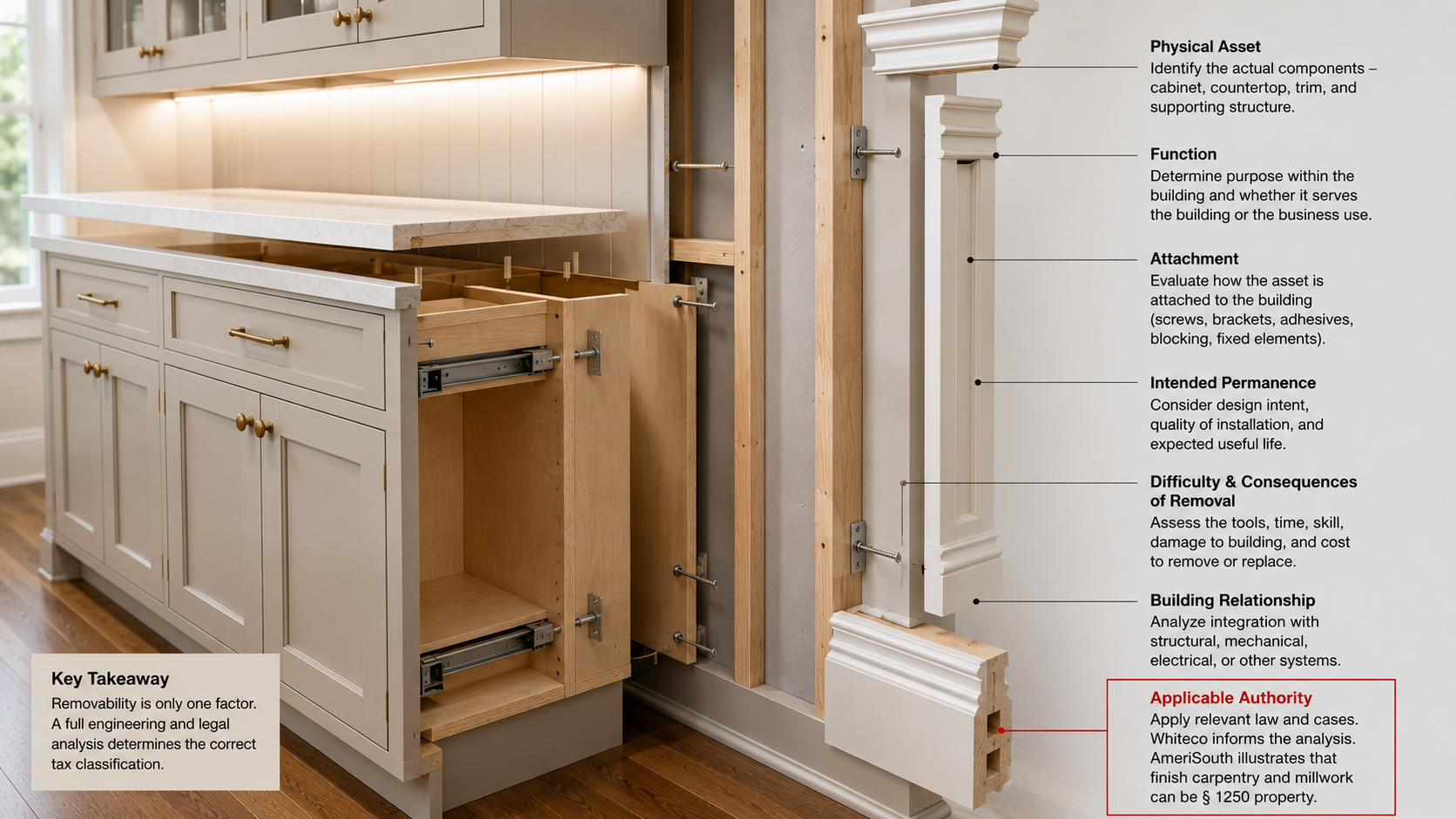
One part of the analysis can involve whether property is inherently permanent. ATG 2025 discusses Whiteco Industries, Inc. v. Commissioner, 65 T.C. 664 (1975), and identifies six factors commonly called the Whiteco factors. They examine questions including whether property is capable of being moved, whether it was designed to remain permanently in place, the expected duration of its attachment, the difficulty of removal, damage resulting from removal, and the manner of attachment.
But there is an important warning for investors: removable does not automatically mean 5-year property.
ATG 2025 specifically notes that movability is not determinative of permanence. The fact that a cabinet can be unscrewed, baseboard can be removed, or trim can be detached does not, standing alone, establish that the property is tangible personal property.
The ATG also identifies additional considerations such as function and design, taxpayer intent, the time and resources required for removal, the effect removal would have on the building, and whether the property could be reused afterward.
For CostSegRx engineers, Whiteco therefore contributes to the analysis. It is not a shortcut that converts removable finish work into 5-year property.
AmeriSouth Provides an Important Reality Check
AmeriSouth XXXII, Ltd. v. Commissioner, T.C. Memo. 2012-67, is particularly relevant to this discussion.
ATG 2025 summarizes AmeriSouth as treating finish carpentry and millwork as § 1250 property. The ATG's summary of the case also identifies three categories considered in connection with § 1245 property: property accessory to a business, nonpermanent property, and ornamental or decorative property.
That does not create a universal rule that every item described as millwork must be § 1250 property. ATG 2025 itself warns that there are no bright-line tests for distinguishing § 1245 from § 1250 property and that these determinations are factually intensive. The ATG also directs attention to relevant court cases and industry-specific guidance when analyzing individual assets.
That broader legal framework is one reason the Hospital Corporation of America cost segregation case remains important to modern asset classification.
The practical lesson from AmeriSouth is more disciplined: do not assume that finish carpentry or millwork qualifies as § 1245 property merely because it can be described as decorative or removable.
Why Residential vs. Commercial Millwork Matters
Residential rental property gives us a particularly useful comparison because ATG 2025 contains a dedicated Residential Rental Property matrix.
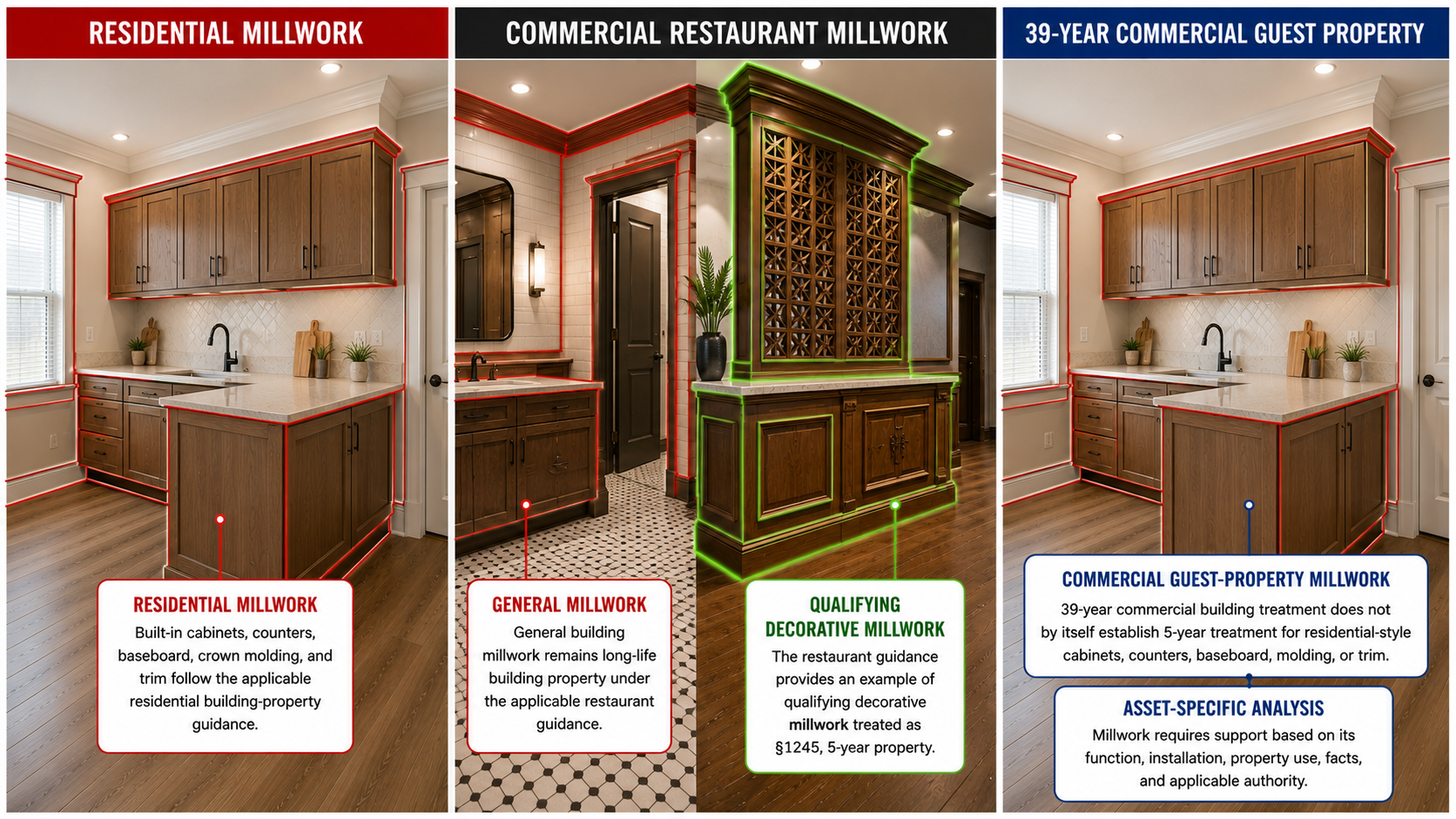
For property meeting the residential rental property definition discussed in the ATG, the matrix identifies general building or structural millwork as § 1250 property and 27.5-year residential rental property. Its description includes kitchen or restroom cabinets and counters, door jambs, baseboard, crown moldings, trim, and other general millwork.
ATG 2025 also separately identifies residential kitchen components, including kitchen cabinets, counters, and sinks, as § 1250 property and 27.5-year residential rental property.
That is significant because it prevents a simplistic Whiteco argument such as, "The cabinet can be unscrewed, so it must be personal property."
The residential matrix already addresses these common residential components. It also states that the matrix reflects general fact patterns specific to residential rental properties and that those classifications may not be applicable to other properties.
Commercial property can therefore present a different analysis.
For example, ATG 2025's restaurant guidance distinguishes general building or structural millwork from decorative millwork. General millwork includes items such as restroom cabinets, door jambs, moldings, and trim and is identified as § 1250, 39-year nonresidential real property. Decorative restaurant millwork, including certain detailed crown moldings, lattice work, cabinets, and counters that enhance the restaurant's theme and are not related to operation of the building, is identified as § 1245, 5-year property.
But even that result should not be generalized across every commercial building. Other ATG industry matrices demonstrate why the applicable business activity matters. For example, decorative millwork in the pharmaceutical and biotech matrix is § 1245 property but carries a different recovery period than the restaurant example.
The lesson is not "commercial millwork equals 5-year property."
The lesson is that commercial millwork requires the correct fact pattern, function, asset class, and applicable authority.

Where the Rules Apply: Residential, STR, and Commercial Property
Traditional Residential Rental Property
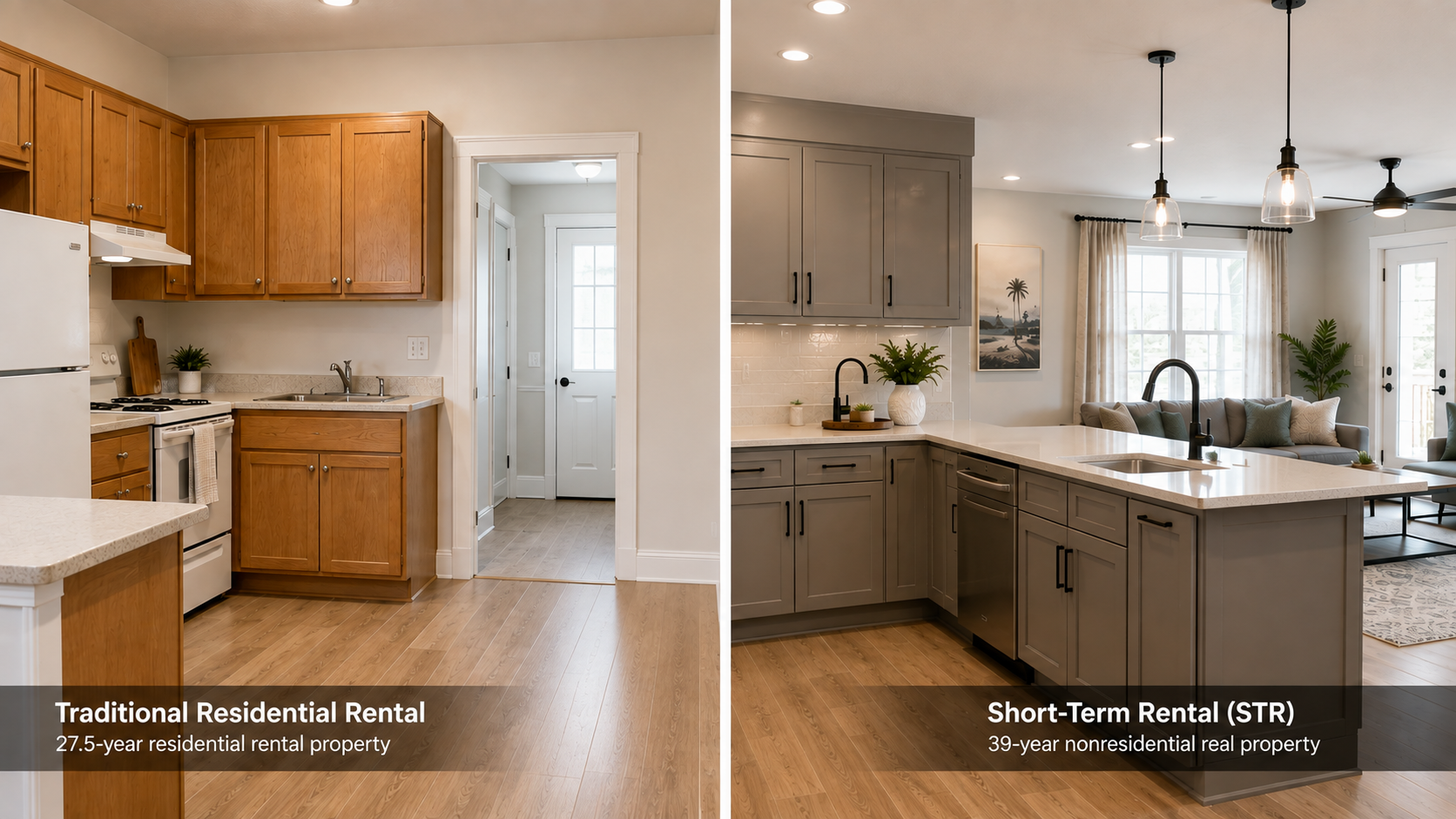
When the property falls within the residential rental property rules, ATG 2025's dedicated matrix provides specific guidance for common residential assets. General millwork, kitchen cabinets, counters, baseboard, crown molding, trim, and similar building finish items are generally treated in that matrix as § 1250 property and 27.5-year residential rental property.
That does not mean residential properties lack 5-year property. The same ATG residential matrix separately identifies qualifying assets such as residential furnishings and kitchen appliances as § 1245, 5-year property, and even distinguishes certain dedicated appliance electrical and plumbing components from general building systems.
That is exactly why engineers classify assets individually.
An STR Properly Treated as Nonresidential Real Property
An STR should not automatically be called 39-year property merely because it is operated as a short-term rental. The proper tax treatment depends on the applicable facts and tax rules.
But when an STR is properly treated as 39-year nonresidential real property, an engineer should not simply copy the residential rental matrix and replace 27.5 years with 39 years.
ATG 2025 specifically cautions that the Residential Rental Property matrix reflects fact patterns particular to residential rental property and may not apply to other properties. Investors considering a short-term rental tax strategy should therefore keep the building-level treatment and the classification of individual assets conceptually separate.
A house can physically look residential while its applicable tax treatment requires a different analysis. CostSegRx engineers still need to determine what the individual asset is, how it functions, how it is installed, and what authority applies.
Commercial Operating Property
Commercial properties can add another layer because millwork may relate to the business operating inside the real estate.
A restaurant may contain themed decorative millwork. A retail environment may contain merchandise-related display elements. A casino or hotel may contain decorative finish carpentry associated with different business activities.
ATG 2025 repeatedly demonstrates that industry and use can matter. That is why taking one favorable millwork classification from one industry matrix and applying it to every commercial property would be inappropriate.
The physical asset matters, but so does its function.
The Better Investor Strategy: Do Not Chase a 5-Year Percentage
Millwork becomes financially important because there can be a substantial amount of it in a property.
Think about a multifamily project with cabinets in every unit, bathroom vanities, kitchen counters, baseboard throughout the units, door trim, closet components, and other finish carpentry. Collectively, those installed costs can represent a meaningful portion of depreciable basis.
Now consider what happens if a study treats a large portion of those costs as 5-year property when the applicable authority instead supports building treatment.
The reported 5-year percentage goes up.
That does not mean the study got better.
In fact, this is precisely why investors should understand the risk of overestimating short-life assets. A provider that reports a larger 5-year percentage is not necessarily delivering a stronger cost segregation study.
The correct sequence is:
Identify the asset → understand its function and installation → determine the supported classification → establish or allocate its cost → reconcile the costs → calculate the resulting depreciation findings.
Not:
Choose the desired 5-year percentage → classify enough assets to reach it.
ATG 2025 supports this engineering-first sequence. Its examination guidance discusses establishing proper classifications and recovery periods and then evaluating how construction costs were allocated to those individual assets. It also warns that different estimation techniques for shorter-life assets can skew results in favor of § 1245 property.
This is why CostSegRx engineers treat percentages as an outcome rather than a methodology.
If the supported engineering analysis produces less 5-year property than an investor expected, that does not make the study unsuccessful. The objective is a supportable allocation of depreciable basis across the appropriate property classes.
Example: Three Similar-Looking Millwork Situations
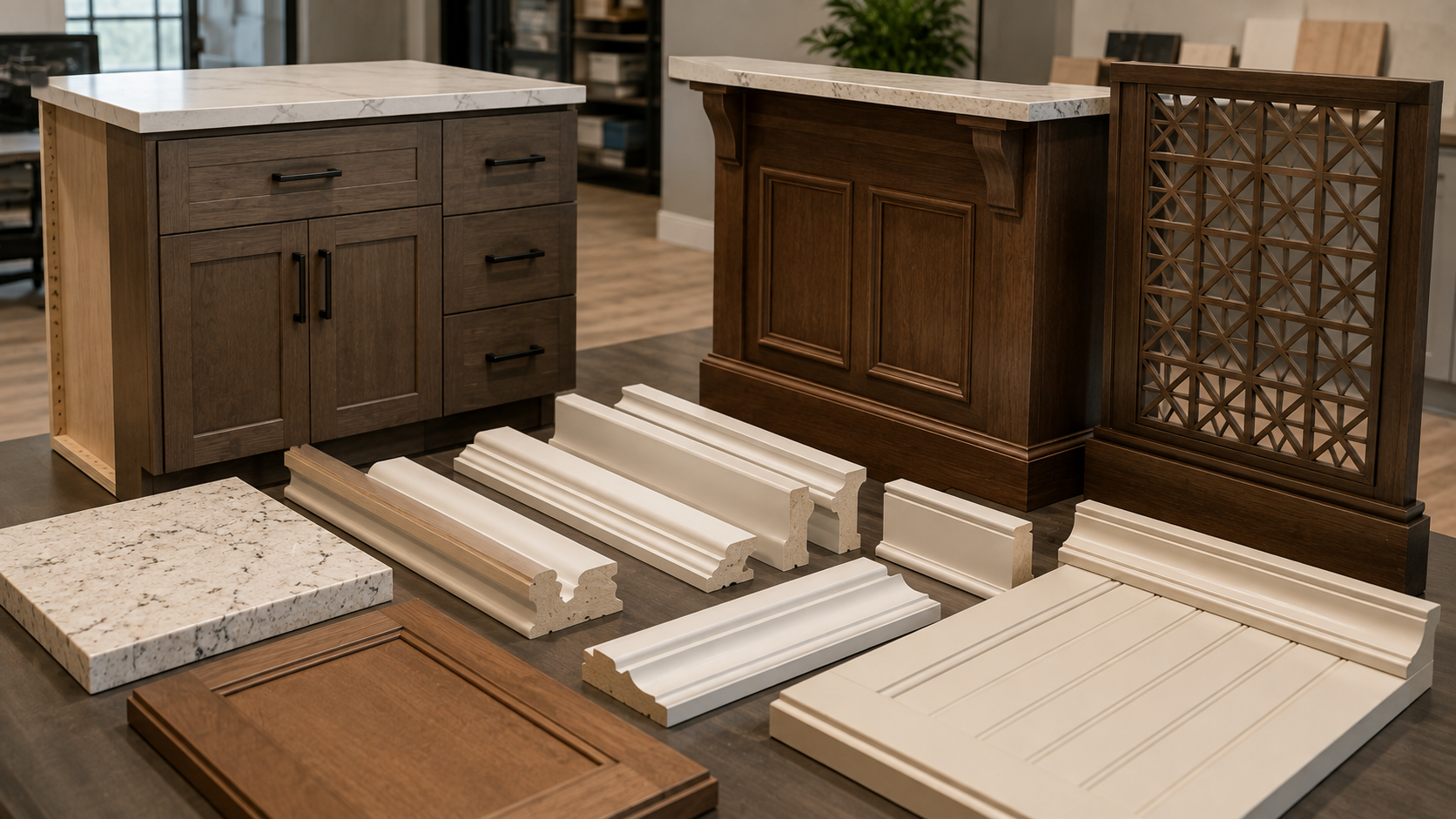
Consider three properties containing professionally installed cabinetry and finish carpentry.
Property A: Apartment Building
The apartment units contain kitchen cabinets and counters, bathroom cabinetry, baseboard, and door trim.
These components may be physically removable. Some could potentially be detached without destroying the building.
But removability alone does not control the classification.
The ATG 2025 Residential Rental Property matrix specifically identifies kitchen cabinets and counters and general building millwork as § 1250 property and 27.5-year residential rental property. The Whiteco permanence analysis does not justify ignoring that specific residential guidance simply because a component can be unscrewed or removed.
Property B: Restaurant
The restaurant contains ordinary restroom cabinetry and general trim, but it also contains elaborate decorative millwork used to establish the restaurant's theme.
Now the analysis changes.
ATG 2025's restaurant matrix distinguishes the general building or structural millwork from decorative millwork. Under that guidance, restroom cabinets, door jambs, moldings, and trim remain § 1250, 39-year nonresidential real property, while qualifying decorative millwork serving the restaurant's theme and not the operation of the building is identified as § 1245, 5-year property.
The contractor might have called all of it "millwork."
The engineer should not.
Property C: STR Treated as Nonresidential Real Property
The third property physically resembles Property A. It has a kitchen, cabinets, counters, baseboard, trim, furnishings, and other features commonly found in a residence.
But assume the taxpayer and tax adviser have properly determined that the property is 39-year nonresidential real property.
The engineer should not automatically import every classification from the Residential Rental Property matrix simply because the building looks like a house. The ATG itself cautions that the residential matrix reflects residential rental property fact patterns that may not apply to other properties.
Nor should the engineer jump to the opposite conclusion and classify the cabinetry as 5-year property simply because the property is now being treated as nonresidential.
The classification still requires support.
This is where CostSegRx engineers evaluate the actual asset, its function, its installation, its relationship to the building or business activity, applicable permanence considerations, documentation, and the relevant authority before reaching a conclusion.
The three properties demonstrate the central lesson: similar-looking millwork does not necessarily mean identical tax treatment.
Millwork Classification Should Drive the Yield, Not the Other Way Around
The final percentage of depreciable basis identified as 5-year property can be important to an investor. Accelerating supported basis into 5-year property can materially change the timing of depreciation deductions.
But the percentage itself tells you very little about the quality of the underlying classifications.
If one study identifies a higher percentage of 5-year property than another, investors should ask why.
Were different physical assets identified?
Were different property facts documented?
Did one provider apply industry-specific guidance?
How were cabinetry and millwork treated?
Was Whiteco used as a complete factual analysis or reduced to a simple "removable equals personal property" argument?
Was relevant case law considered?
Were costs reasonably allocated and reconciled?
Those questions tell you more about the engineering than the headline percentage.
ATG 2025 states that asset classification is factually intensive and that there are no bright-line tests for separating § 1245 property from § 1250 property. Its examination guidance also emphasizes methodology, asset detail, applicable recovery periods, rationale, authority, and supporting documentation when evaluating a cost segregation report.
For investors, that means the goal should not be the highest possible 5-year yield.
The goal should be the highest supportable classification based on the actual property facts and applicable authority.
Millwork is a perfect example of why that distinction matters. Cabinets, counters, baseboard, crown molding, trim, paneling, and finish carpentry may look ordinary during a property walkthrough. But once those costs are multiplied across dozens or hundreds of units or across a heavily finished commercial property, classification decisions can meaningfully influence the overall study.
CostSegRx engineers begin with the property, not a target percentage.
The percentage comes later.
And that is exactly how an engineering-based cost segregation study should work.
Do you have a question about Cost Segregation?
Let us know how we can help
Your information is secure. We only use your details to answer your direct inquiry.